

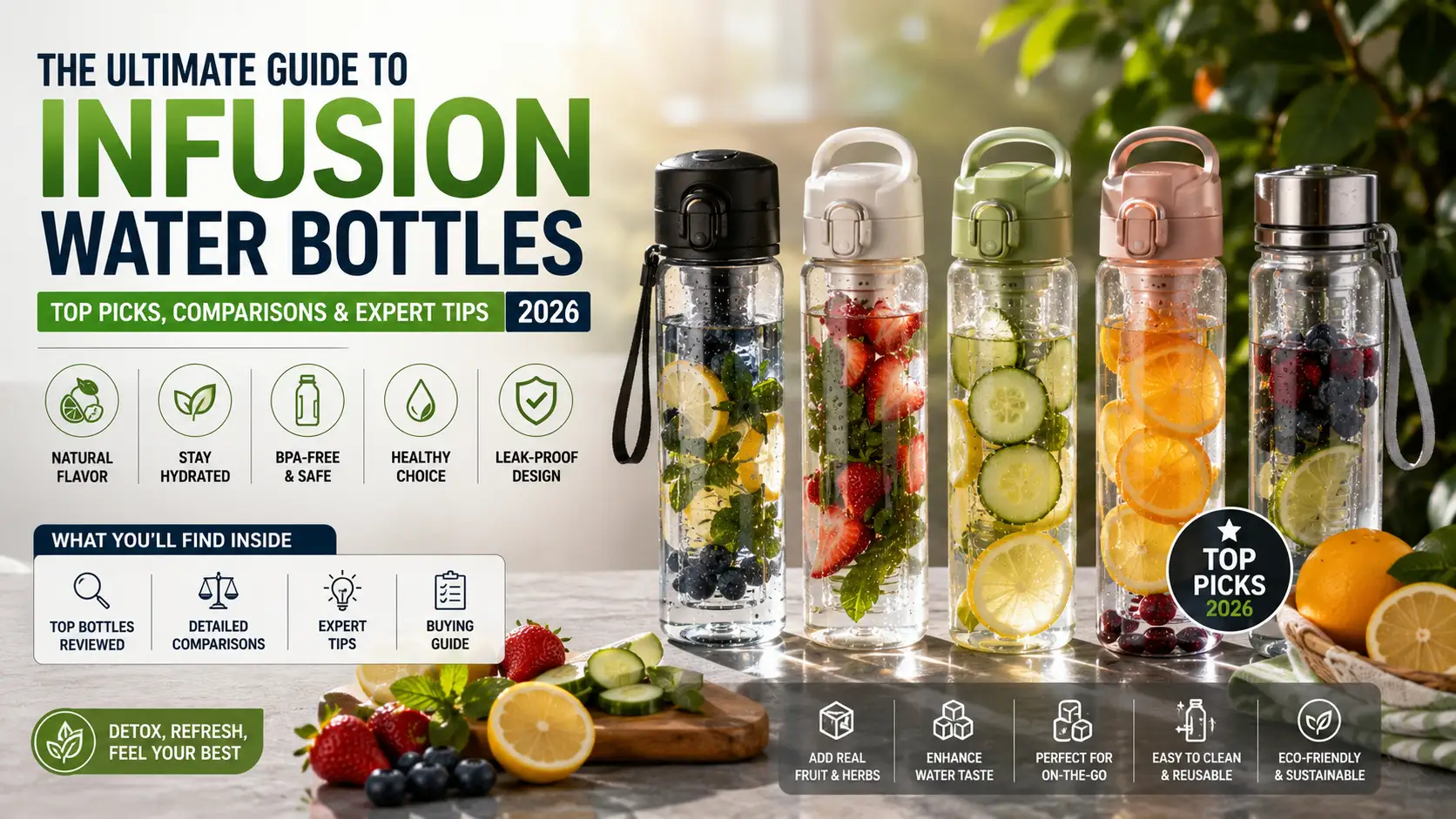
You know you should drink more water. The problem is that plain water can get boring fast. Before long, you are reaching for fizzy drinks, sweetened juices, or another cup of coffee just to enjoy some flavour.
A good fruit infuser bottle makes water far more appealing. Add lemon, berries, cucumber, mint, or your favourite fruit, and ordinary water becomes fresh and flavourful with little or no added sugar. It is an easy option for gym sessions, office days, travel, and outdoor activities.
But choosing the right bottle matters.
Some bottles leak inside your bag. Others have small infuser baskets that produce weak flavour. Complicated parts can also trap fruit pieces, develop unpleasant smells, and become difficult to clean.
Key Takeaways
- Lexlion is the best overall option for fruit, tea, cold brew, and temperature control.
- Infusion Pro offers the best value, while Brimma is a good budget starter.
- Choose Tritan for low weight, glass for clean taste, and stainless steel for insulation.
- A large or full-length infuser gives stronger, more consistent flavour.
- Wide openings and removable seals make cleaning easier.
- Infused water mainly supports hydration. It is not a detox or medical drink.
- Clean the bottle after every use and refrigerate the fruit water.
This guide covers the seven best infuser water bottles of 2026 based on product specifications, practical design details, and verified customer feedback. You will learn which bottles offer strong flavour, reliable lids, easy cleaning, and useful features for everyday life. You will also find simple cleaning advice and tasty fruit combinations to try at home.
Ready to make drinking water less of a chore? Let’s find the right infuser bottle for you.
What Is an Infusion Water Bottle and How Does It Work?
An infusion water bottle is a reusable bottle with a separate chamber for fruit, herbs, vegetables, or tea leaves. This chamber allows flavour to spread through the water while keeping seeds, pulp, and leaves away from the drinking opening.
Using one is simple. Cut your ingredients into small pieces, place them inside the infuser, and fill the bottle with water. Leave it for at least 30 minutes. The water gradually absorbs the flavour, although some ingredients need longer to steep.
You control exactly what goes inside. You can adjust the flavour strength, avoid unnecessary sweeteners, and try different combinations whenever plain water starts to feel boring.
Bottom-Loading vs Top-Loading Infusers
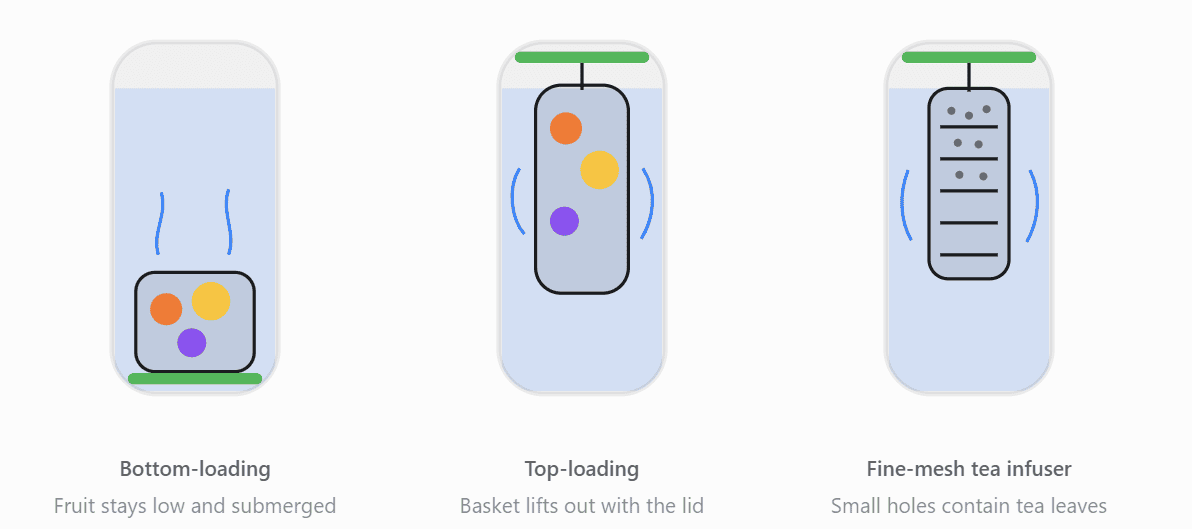
A bottom-loading infuser connects near the base of the bottle. It keeps the ingredients low in the water, so they can remain submerged even as you drink. These models often provide consistent flavour, but the extra seal at the bottom may be harder to clean. It can also become a leak point if the base is not tightened correctly.
A top-loading infuser hangs below the lid or sits inside the bottle as a removable core. It is usually easier to remove, refill, and wash. However, the ingredients may stop touching the water as its level drops, which can reduce flavour later in the day.
Some bottles include a fine-mesh infuser for loose-leaf tea. The smaller holes keep most tea particles inside while allowing the water to move through. Certain models can also prepare cold-brew coffee, but you should check the manufacturer’s instructions before adding coffee grounds.
Fruit Infusion vs Tea Infusion vs Cold-Brew Coffee
Infuser bottles can do more than flavour water with fruit. Depending on the filter, bottle material, and temperature rating, some models can also prepare tea or cold-brew coffee. The process is similar, but the required filter and steeping times differ.
Fruit Infusion
Fruit infusion uses cold water to draw flavour from fresh or frozen fruit, vegetables, herbs, and citrus peel. No heat is required.
Soft fruits such as strawberries release flavour quickly. Harder ingredients, including apples and ginger, usually need to be sliced thinly and left for longer. Most combinations begin to taste noticeably after 30 minutes, but a few hours in the refrigerator normally produce a stronger result.
Tea Infusion
Tea can be prepared with either cold or hot water. Cold-brew tea usually takes around 4 to 12 hours in the refrigerator. The slower process often produces a smoother drink with less bitterness.
Hot brewing is faster, but the bottle must be rated for hot liquids. Do not pour boiling water into an ordinary plastic infuser bottle unless the manufacturer clearly says it is heat-safe.
Cold-Brew Coffee
Cold-brew coffee is made by steeping ground coffee in cold water for several hours. It requires a fine filter because ordinary fruit baskets have openings large enough for coffee grounds to escape.
Depending on the coffee-to-water ratio, the result may be ready to drink or a stronger concentrate that needs diluting. Choose a bottle specifically designed for cold brew if you want less sediment and easier cleanup.
Health Benefits of Infused Water
Hydration That Actually Tastes Good
The biggest benefit of infused water is simple. It can make water more enjoyable, which may encourage you to drink it more often.
Lemon, berries, cucumber, mint, and other ingredients add flavour without requiring the amount of sugar found in many soft drinks and sweetened juices. Research conducted during exercise has also found that flavouring water can increase voluntary fluid intake in some conditions. However, these studies did not specifically test homemade fruit-infused water, so the finding should be treated as useful evidence rather than a guarantee.
Drinking enough water supports normal body functions, including temperature control, digestion, and physical performance. It may also help you avoid some of the discomfort associated with dehydration.
In one controlled study, women who lost an average of 1.36% of their body weight through dehydration reported more headaches, fatigue, difficulty concentrating, and mood changes. Most measured areas of cognitive performance were not affected.
A separate study involving young men found that mild dehydration affected vigilance and working-memory response time while increasing fatigue and tension. Research reviews also suggest that dehydration equal to around 2% to 3% of body weight can reduce endurance performance, particularly during exercise in hot conditions.
Infused water is not a detox drink or medical treatment. Its main advantage comes from the water itself. The added fruit simply makes that water more appealing and may help replace drinks containing a lot of added sugar.
Appetite Control and Weight Management
Water can help you feel full, especially when you drink it before eating. Fruit infusion does not create this effect. It simply makes the water more enjoyable.
In a 12-week trial involving 84 adults with obesity, participants who drank 500 millilitres of water around 30 minutes before their main meals lost about 1.3 kilograms more than the comparison group. The researchers described the evidence as preliminary, so water should support a balanced eating plan rather than replace one.
The clearer benefit comes from replacing high-calorie drinks. Unsweetened infused water normally contains very few calories, although the amount may increase if you squeeze or crush a lot of fruit into it.
As registered dietitian Lauren Sullivan explains, “Water, whether plain or carbonated, is better than high-calorie, sugar-infused drinks.”
Swapping one or two daily sodas, sweetened coffees, or bottled juices for infused water can reduce your sugar and calorie intake. That can support weight loss or maintenance over time, but infused water does not burn fat by itself.
Immune Support and Antioxidants
Citrus fruits, berries, mint, and other common infusion ingredients contain vitamins and protective plant compounds. Some water-soluble compounds may enter the water, particularly when the ingredients are sliced or lightly crushed.
But the amount is small and difficult to predict.
You will get far more fibre, vitamins, and antioxidants by eating the fruit. Cleveland Clinic registered dietitian Beth Czerwony notes that infused water does not provide many nutrients because you are not consuming much of the ingredient. Its main value is making water taste better.
A Prairie View A&M University extension article lists immune defence among the possible benefits of fruit-infused water. However, it does not provide clinical evidence showing that an ordinary infusion prevents illness or meaningfully strengthens immunity.
Think of any transferred nutrients as a small bonus. Do not treat infused water as a replacement for fruit, vegetables, or a balanced diet.
Blood Sugar Regulation
Unsweetened infused water can be a useful alternative to soda, sweet tea, and other drinks containing added sugar. It usually contributes little carbohydrate, so it is less likely to raise blood glucose in the same way as a sugary beverage.
However, it does not lower blood sugar on its own.
Claims about cinnamon water require particular care. Some research has examined cinnamon supplements, but the results are inconsistent. The National Center for Complementary and Integrative Health says it remains unclear whether cinnamon helps manage diabetes. Steeping one cinnamon stick in water is also very different from taking the measured doses used in studies.
If you have diabetes, insulin resistance, kidney disease, or another medical condition, discuss major diet and fluid changes with your doctor or registered dietitian. Never use infused water in place of prescribed medication or medical care.
Types of Infuser Water Bottles: Materials, Designs, and Features
The bottle material affects more than appearance. It changes the weight, durability, cleaning process, flavour retention, and ability to keep drinks cold.
There is no perfect material for everyone. The best choice depends on where you will use the bottle and how much cleaning effort you are willing to give it.
Material | Main advantage | Main drawback | Best for |
Tritan plastic | Light and affordable | Can hold smells if neglected | Gym and travel |
Glass | Clean, neutral taste | Heavy and breakable | Home and office |
Stainless steel | Strong cold retention | Contents are not visible | Outdoors and long days |
Silicone | Collapsible and compact | Little insulation | Space-saving travel |
Tritan Plastic
Tritan is a clear copolyester commonly used in reusable drinkware. It is lightweight, tough, and easier to carry than glass or stainless steel; for the lightest options, explore our guide to ultralight bottles. Eastman, the manufacturer, states that Tritan is made without BPA, BPS, or other bisphenol compounds.
This is usually the most practical choice for the gym, commuting, and everyday travel. Clear sides also let you check the water level and see whether the fruit is still submerged.
The downside is flavour retention. Lemon, mint, and berries can leave a smell if the bottle sits unwashed for several hours. Tritan products are not all made to the same heat or dishwasher standards, so check the bottle’s care instructions before placing it in a dishwasher.
Best for: Gym bags, daily commuting, travel, and lower budgets.
Glass
Glass provides the cleanest, most neutral drinking experience. Its non-porous surface does not easily hold flavours, stains, or smells. This makes it a strong choice if you regularly switch between citrus, herbs, fruit, and tea.
Most glass infuser bottles include a silicone sleeve for grip and limited impact protection. That sleeve helps, but it does not make the bottle unbreakable.
Glass is also heavier than plastic. It works well on a desk or around the house, but I would be cautious about carrying it on a hike or placing it inside a crowded gym bag.
Although the main bottle body contains no plastic, the lid, straw, seal, or infuser may still use plastic or silicone parts. Check the complete material list if avoiding plastic contact is important to you.
Best for
Home, office desks, and people who prioritise a neutral taste.
Stainless Steel
Double-wall vacuum-insulated stainless steel is the best option when cold water matters most. A good insulated bottle can keep drinks cold for many hours, even during a long workday or outdoor trip.
Insulation times vary by bottle. Stainless steel alone does not guarantee 24-hour cold or 12-hour heat retention, so check the manufacturer’s tested claim.
These bottles are durable, but they can still dent when dropped. They are also heavier and usually cost more than plastic models. Because the body is opaque, you cannot see the remaining water or watch the infusion develop.
For hot tea, confirm that the bottle, lid, seals, and infuser are all approved for hot liquids. Some insulated bottles are designed only for cold drinks.
Best for: Long workdays, hot weather, outdoor activities, and cold-water retention.
Silicone
Collapsible silicone bottles save valuable space once they are empty. They can fit into small travel bags, hiking packs, and luggage more easily than rigid bottles.
The trade-off is structure. A partially filled silicone bottle may feel soft or awkward to hold. Silicone also provides little insulation, and the folds can take more effort to scrub properly.
Some new bottles may have a noticeable smell or taste. Washing the bottle thoroughly and leaving it open to air can help, but a strong smell that does not disappear may indicate poor-quality material.
Best for: Flights, backpacking, camping, and travellers with limited storage space.
Quick verdict: Choose Tritan for light everyday use, glass for neutral flavour, stainless steel for cold retention, and silicone when saving space is the main priority.
Design Variations and Their Impact
The infuser position affects flavour strength, cleaning, and leak risk. A large chamber that remains submerged usually matters more than whether the basket connects at the top or bottom.
Bottom-Loading Infusers
A bottom-loading basket keeps fruit near the base, where it often remains covered as the water level drops. This can produce more consistent flavour throughout the day.
The extra opening creates another possible leak point. Look for a thick silicone gasket and check that it sits flat inside the base. Even a good seal can leak if it is twisted, dirty, or incorrectly fitted.
Top-Loading Infusers
Top-loading baskets attach near the lid. They are easy to remove, refill, and wash without opening the bottom of the bottle.
Short baskets may stop touching the water after you drink part of the bottle. A full-length infuser rod solves much of this problem by keeping the ingredients submerged for longer.
Tea and Coffee Infusers
Tea-specific bottles use smaller mesh openings to contain loose leaves; for our top recommendations, see our favorite tea infuser bottles. They work well for cold-brew tea, while heat-rated models can also prepare hot tea.
Coffee grounds are much finer than fruit pieces or most tea leaves. Choose a bottle specifically approved for cold-brew coffee if you want to reduce sediment. An ordinary tea strainer may still allow fine coffee particles to escape.
Time-Marker Bottles
Time markers divide the bottle into suggested drinking targets. They can provide a useful reminder during a busy office day, but they are not a personalised hydration prescription.
Your fluid needs change with body size, weather, exercise, diet, pregnancy, and health conditions. Treat the markings as prompts rather than strict medical targets.
Infuser Designs Compare
Key Features to Look For
Double-Wall Insulation
Double-wall vacuum insulation is the best choice when you need water to stay cold for most of the day; see our top picks for cold-water bottles for more options. Single-wall bottles are lighter and usually cheaper, but their contents warm up faster.
Do not assume every stainless steel bottle offers the same performance. Check the manufacturer’s tested cold and hot retention times.
A Properly Sealed Lid
A reliable lid should have a locking button, secure screw thread, or firm flip-top closure. Check for removable silicone seals around the lid and any bottom connection.
Removable seals are easier to clean. They are also easier to inspect for cracks, mould, or incorrect placement. A bottle can still leak if fruit pulp becomes trapped around the gasket.
A Wide Opening
A wide mouth makes almost everything easier; browse our selection of wide-mouth bottles for easy-fill designs. You can add larger fruit pieces and standard ice cubes without forcing them through a narrow opening.
It also gives a bottle brush enough room to reach the bottom. This matters because fruit sugars and pulp can collect in places that are difficult to see.
A Comfortable Carrying Loop
A loop or handle makes a large bottle easier to carry between the gym, office, and car. Some loops can attach to a backpack with a clip, but check that both the lid and loop are designed to support the bottle’s filled weight.
Clear Measurement Markings
Volume markings help you monitor water intake and repeat recipes. They are especially useful when comparing different water-to-fruit ratios.
Printed markings can fade after frequent washing. Moulded or engraved measurements normally last longer.
How to Choose the Best Infuser Water Bottle for Your Needs
The best bottle is not always the most expensive one. It is the bottle that fits your routine, stays sealed, and does not make cleaning feel like a chore.
For a broader look at bottle size, material, insulation, lid style, and everyday use, our guide on how to choose a water bottle can help you narrow down the features that matter most before choosing an infuser model.
Start with where you will use it most.
Step 1: Identify Your Main Use
Use | Recommended size | Useful features | Suitable material |
Gym and workouts | 24–32 oz | Locking lid, loop, insulation | Tritan or stainless steel |
Office and desk | 32 oz or more | Time markers, wide mouth | Glass or stainless steel |
Travel and commuting | 20–32 oz | Slim shape, low weight, secure seal | Tritan or silicone |
Home and family | 32–40+ oz | Large infuser, easy cleaning | Glass or stainless steel |
Gym and Workouts
Choose a durable bottle with a locking lid and comfortable carrying loop. A capacity between 24 and 32 ounces provides a useful balance between water volume and carrying weight.
Insulation is worth paying for if your gym gets hot or you dislike warm water. Check whether the bottle fits your equipment’s holder before buying.
Office and Desk
A 32-ounce bottle reduces refill trips without taking over the entire desk. Time markings can also remind you to drink during long periods of focused work.
Glass provides a neutral taste, while insulated stainless steel keeps water cold for longer. Make sure the base fits securely on your desk and will not tip easily.
Travel and Commuting
Weight and shape matter most here. A slim Tritan bottle fits into bags and cup holders more easily than a wide insulated model. Collapsible silicone saves space after the bottle is empty.
Never rely on a product listing that only says “leakproof.” Look for a locking lid, silicone gasket, and reviews that specifically discuss bag leaks.
Home and Family
A large bottle works well for preparing bigger batches, but use it to pour water into separate cups rather than sharing the drinking spout. A wide opening and removable infuser make refilling and cleaning much easier.
For serving several people, a fruit-infuser pitcher may be more practical than an oversized personal bottle.
Step 2: Match the Material to Your Priorities
For a neutral taste: Choose glass or stainless steel. Both materials are less likely to retain fruit smells than plastic when cleaned correctly.
For portability: Tritan is usually the lightest rigid option. Stainless steel is tougher but heavier, particularly in
For portability: Tritan in larger insulated sizes.
For a lower price: Tritan bottles generally offer good value. Glass often sits in the middle, while insulated stainless steel usually costs more.
For less plastic contact: Choose glass or stainless steel, but inspect the complete design. The lid, straw, seal, or infuser basket may still contain plastic or silicone, so it’s worth understanding the plastic components hidden in stainless steel bottles.
Tritan is a type of copolyester used in many food-contact products. Eastman states that its Tritan material is made without BPA, BPS, or other bisphenols.
The FDA regulates substances intended to come into contact with food and evaluates authorised uses according to expected conditions. However, this does not mean every bottle is safe for every temperature or cleaning method. Always follow the individual manufacturer’s instructions
Step 3: Choose the Right Capacity and Insulation
A larger bottle requires fewer refills, but it is also heavier and harder to fit inside bags and cup holders; our water bottle ounce guide explains common capacities.
- 20 to 24 ounces: Good for short outings, small bags, and easy access to refills. If you want an even smaller option, our comparison of compact Hydro Flask sizes is worth a look.
- 32 ounces: The most practical middle ground for many gym, office, and travel routines.
- 40 ounces or more: Useful for long days without easy refill access, but bulky when full.
Your actual water needs depend on your activity level, climate, diet, body size, and health. Bottle capacity should make drinking convenient, not force you to meet an arbitrary target.
For water that needs to stay cold for several hours, double-wall vacuum insulation is the most reliable option. A single-wall bottle is lighter, but it will warm up more quickly.
If you plan to make hot tea, confirm the maximum temperature for every part of the bottle. The body may tolerate heat while the lid, gasket, straw, or infuser cannot. Never pour boiling water into a bottle unless the manufacturer clearly approves it.
Step 4: Check Cleaning and Maintenance Ease
- Look for bottles that are dishwasher-safe (top rack) or have wide openings for hand washing.
- Removable infuser baskets and silicone seals make deep cleaning possible.
- Avoid bottles with hard-to-reach crevices where mold can hide.
Step 5: Set a Budget and Compare Value
- Budget picks under $15 can work well but may lack insulation or durability.
- Mid-range ($15–$30) offers a balance of features and quality.
- Premium ($30+) typically includes superior insulation, lifetime warranties, and premium materials.
Top 7 Infuser Water Bottles of 2026: Detailed Reviews
1. Lexlion Tea Infuser Water Bottle: Best Overall
The Lexlion takes our Best Overall position because it handles more than fruit water. Its fine stainless steel infuser works with loose-leaf tea, herbs, fruit, and cold-brew coffee. Remove the infuser, and it becomes a regular insulated bottle.
That flexibility makes the higher price easier to justify.
The bottle uses triple-wall vacuum insulation. Lexlion claims it can keep drinks cold for up to 24 hours and hot for up to 12 hours. These are manufacturer claims rather than independently verified results
Key Specifications
Feature | Details |
Capacity | 22 oz |
Material | 18/8 stainless steel |
Insulation | Triple-wall vacuum insulation |
Infuser | Removable two-piece stainless steel filter |
Intended infusions | Fruit, herbs, loose tea, and cold brew |
Lids | Spout, flip and straw lids |
Cleaning | Lids and infuser are top-rack safe; hand-wash bottle body |
Included extras | Silicone protective boot and cleaning brush |
Price | $33 |
Warranty | Lifetime warranty against covered defects |
Infusion Performance
The fine-mesh filter is the feature that separates the Lexlion from basic fruit bottles. Large fruit baskets work well with lemon and berries, but their openings are too wide for tea leaves or coffee grounds. Lexlion’s finer filter gives it much more brewing flexibility.
The two-piece construction also lets ingredients sit inside the filter while water moves around them. It should contain loose tea more effectively than a standard fruit basket, although very fine tea dust or coffee sediment may still pass through some filters.
I would not promise “zero sediment” without a documented side-by-side test.
Temperature Retention and Portability
Insulation is another clear advantage. The outside should remain free from normal condensation when holding cold water, while the silicone boot helps protect the base from scratches and light impacts.
The trade-off is weight.
Amazon lists the empty 32-ounce model at approximately 1.33 pounds. Once filled, it can weigh more than three pounds. Lexlion also states that the 22-ounce version fits most standard cup holders, while the 32-ounce model may not.
Three Lids Add Real Flexibility
Lexlion includes spout, flip, and straw lids. That is more useful than it first sounds.
The straw lid suits cold fruit water. The spout provides a faster flow during workouts, and the flip-style option works for everyday sipping. However, more lids also mean more seals and small parts to clean and store.
Lexlion says the lids and infuser can go on the dishwasher’s top rack. The insulated body should be washed by hand to protect its exterior finish.
Pros
- Available in practical 22-ounce and 32-ounce sizes
- Works with fruit, herbs, loose tea, and cold brew
- Fine two-piece stainless steel infuser
- Three interchangeable drinking lids
- Triple-wall vacuum insulation
- Protective silicone boot and cleaning brush included
- Lifetime warranty against eligible defects
Cons
- Costs more than basic plastic infuser bottles
- The 32-ounce model is heavy when full
- Larger size may not fit every cup holder
- Bottle body requires hand washing
- Multiple lids and infuser pieces create more cleaning work
- Insulation and leakproof claims come from the manufacturer
Who Should Buy It?
Choose the Lexlion if you regularly switch between fruit water, loose-leaf tea, and cold-brew coffee. It also suits commuters and outdoor users who care more about insulation than low weight.
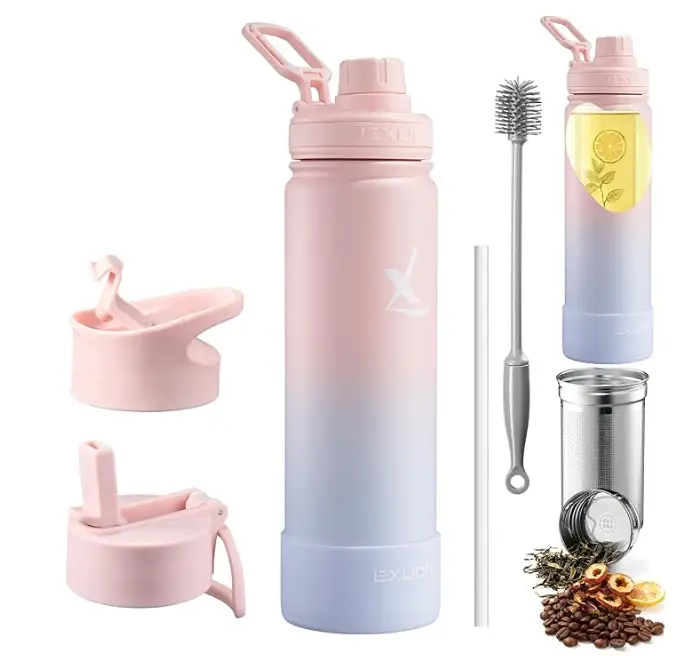
Lexlion 22 oz Triple-Wall Insulated Tea Infuser Water Bottle
The Lexlion 22 oz combines triple-wall insulation with a removable tea and fruit infuser, keeping drinks cold for up to 24 hours and hot for up to 12 hours. With three leakproof lids, a protective silicone sleeve, and premium stainless-steel construction, it’s designed for tea lovers, commuters, and everyday hydration.
2. Infusion Pro 24 oz Two-Pack: Best Value
Two usable infuser bottles for $29.99 is hard to beat. Each Infusion Pro Classic holds up to 24 ounces and uses a bottom-loading basket that keeps the fruit submerged as the water level drops.
That design gives it a clear advantage over short top-loading baskets. The water continues touching the fruit instead of leaving it above the water halfway through the bottle.
The two-pack is currently available in green and black. The pink and black set was listed as out of stock when checked in July 2026.
Key Specifications
Feature | Details |
Capacity | 24 oz per bottle |
Quantity | Two bottles |
Material | BPA-free Tritan plastic |
Infuser | Removable bottom-loading fruit basket |
Lid | Flip-top drinking spout |
Seal | Silicone O-rings |
Insulation | Neoprene sleeve only |
Carrying feature | Built-in carrying handle |
Cleaning | Top-rack dishwasher safe |
Current price | $29.99 per two-pack |
Warranty | Product page lists a limited lifetime warranty |
Flavour Performance
The bottom basket is the main reason to buy this set. It holds fruit near the base, where it remains in contact with the water until the bottle is nearly empty.
It also has a flat bottom, so you can place the basket on a cutting board while adding fruit. That is a small detail, but it makes filling less awkward than trying to hold a rounded basket in one hand.
Large pieces still need to be cut small enough to fit. The basket also takes up space, so the usable water volume will be lower than the full 24-ounce capacity once fruit is added.
Brand-hosted customer feedback supports the design’s practical benefits. One reviewer reported stronger flavour than a previous top-loading bottle and no leaks after a week of daily use. The reviewer also found the removable top and bottom easy to clean. These are individual customer experiences, not results from our own controlled test.
Leak Protection and Portability
The bottle has silicone O-rings around its openings. These seals are important because a bottom-loading bottle has more possible leak points than a standard bottle.
Check that both O-rings are clean, flat, and correctly fitted before tightening the base. Fruit pulp caught around a seal can cause leaking even when the bottle itself is undamaged.
Tritan keeps the bottle light, while the carrying handle makes it easy to pick up at the gym or during a commute. Its slim shape should also fit more cup holders than many wide 32-ounce bottles.
Cooling and Cleaning
This is not a vacuum-insulated bottle. The included neoprene sleeve can slow warming and reduce condensation, but it will not keep water cold all day like insulated stainless steel.
The original outline described the bottle as hand-wash only. The current manufacturer listing says it is safe for the dishwasher’s top rack. Hand washing may still help protect the printed finish and silicone seals.
Because both ends open, a bottle brush can reach the inside more easily. Remove the basket and O-rings during deeper cleaning, then allow every part to dry completely.
Pros
- Two bottles for a reasonable price
- Bottom-loading basket stays submerged
- Lightweight Tritan construction
- Flat-bottom basket is easy to fill
- Neoprene sleeves included
- Flip-top spouts and carrying handles
- Top-rack dishwasher safe
- Replaceable backup bottle for couples or families
Cons
- No vacuum insulation
- More seals create additional potential leak points
- Fruit basket reduces usable water capacity
- Only one two-pack colour combination was in stock
- Not designed for loose-leaf tea or coffee grounds
- Warranty wording varies across the brand’s website
Who Should Buy It?
This set works well for couples, family members, or anyone who wants one bottle in use while the other is being cleaned. It is also a sensible choice for office workers who want to prepare tomorrow’s infusion in advance.
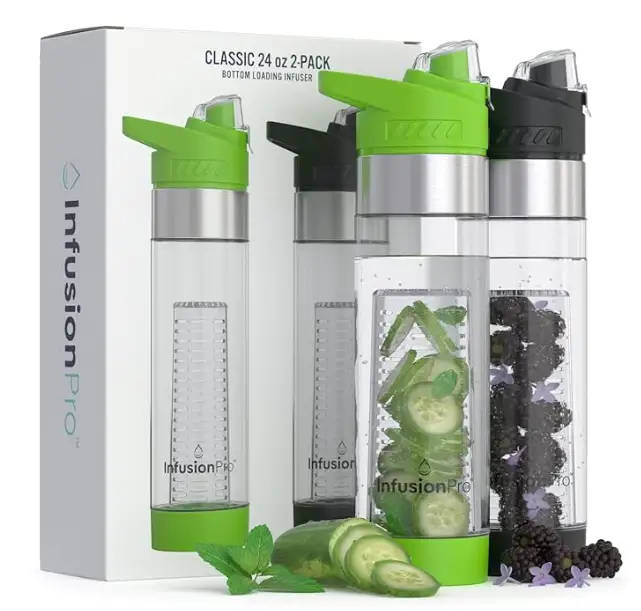
Infusion Pro 24 oz BPA-Free Fruit Infuser Water Bottle
The Infusion Pro 24 oz bottle makes it easy to enjoy naturally flavored water thanks to its bottom-loading fruit infuser design. Made from durable, BPA-free Tritan plastic, it features a leakproof flip-top lid, an insulated neoprene sleeve, and a removable strainer, making it perfect for the gym, work, and everyday hydration.
3. Hydracy 32 oz Time-Marker Bottle: Best for Tracking Intake
The Hydracy Coach is built for people who forget to drink until late in the day. Its printed timeline provides a visible reminder without requiring you to unlock your phone or count every sip.
The 32-ounce capacity is also practical. It holds enough water for several hours without becoming as heavy as a half-gallon bottle.
Hydracy currently sells chug-lid and straw-lid versions. The official price is listed between $24.99 and $27.99, although some colours and lid options are backordered. Walmart listed the 32-ounce fast-flow version at $24.97 when checked in July 2026.
Key Specifications
Feature | Details |
Capacity | 32 oz / 1 L |
Material | BPA-free Tritan plastic |
Infuser | Removable fruit infusion strainer |
Tracking feature | Printed hourly time markers |
Lid options | Fast-flow chug or straw lid |
Opening | Wide mouth |
Carrying feature | Detachable strap |
Insulation | Neoprene sleeve only |
Cleaning | Hand wash only |
Current price | Approximately $24.97–$27.99 |
Warranty | Lifetime satisfaction guarantee |
Do the Time Markers Help?
The time markings turn a vague goal into small checkpoints. Instead of thinking about an entire day’s water intake, you only need to check whether the water has reached the next line.
That visual prompt will not work for everyone, but customer feedback suggests it can be useful. One nurse wrote that the markings helped her track progress during busy shifts. Another buyer specifically said the bottle motivated her to drink throughout the day. These are individual customer experiences rather than clinical evidence.
The markings should not be treated as a personalised medical target. Your fluid needs depend on your body, activity level, weather, diet, and health; a hydration calculator can help estimate your personal baseline.
Infusion Performance
The current model does not contain the older full-length rod. Instead, its removable strainer helps control fruit pieces, herbs, seeds, and ice near the drinking opening.
The wide mouth makes it easy to add sliced citrus, cucumber, berries, or mint directly to the bottle. This approach provides more room for ingredients than a narrow basket, but it also means fruit can move around inside the water.
Remove the strainer when you want to use the Hydracy as a standard sports bottle.
Portability and Temperature Control
Tritan keeps the bottle relatively light, while the detachable strap makes it easier to carry between meetings, classes, or gym sessions. The locking flip-top lid is designed to prevent accidental opening inside a bag.
This is not a vacuum-insulated bottle.
The neoprene sleeve can reduce condensation and slow down warming, but it will not keep water cold all day. One Hydracy customer reported that the bottle still developed condensation and that the sleeve became difficult to keep clean. That is worth considering if you plan to use it in a hospital, kitchen, or another place requiring frequent cleaning.
Pros
- Clear time markers provide visible reminders
- Practical 32-ounce capacity
- Lightweight Tritan construction
- Removable fruit strainer
- Wide mouth for fruit and ice
- Locking flip-top lid
- Detachable carrying strap
- Chug and straw versions available
- Lifetime satisfaction guarantee
Cons
- Current model lacks the older full-length infuser rod
- No vacuum insulation
- Neoprene sleeve can become damp or dirty
- Hand washing is required
- Some colours and lid styles may be backordered
- Time markers are general prompts, not personalised intake advice
Who Should Buy It?
Choose the Hydracy if you regularly reach the afternoon and realise you have barely touched your water. It is especially useful for office workers, teachers, nurses, students, and anyone who responds well to visible progress markers.
Skip it if strong fruit extraction or all-day cold retention matters more than intake tracking.
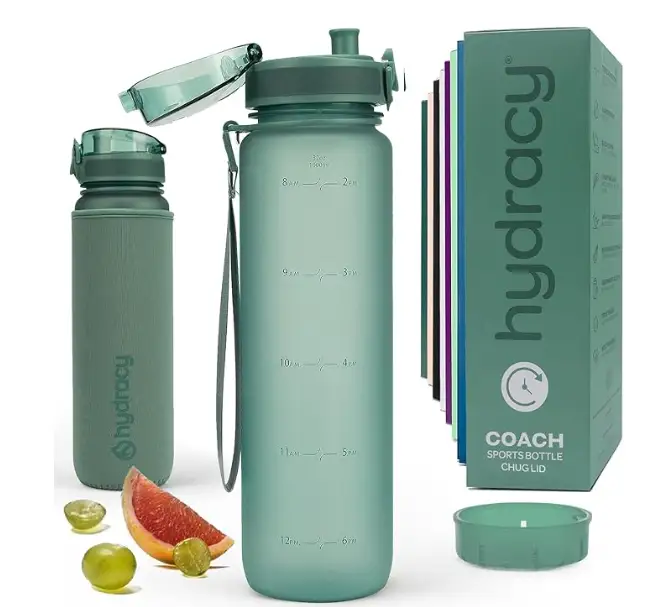
Hydracy 32 oz Water Bottle with Fruit Infuser
The Hydracy 32 oz combines motivational time markers with a built-in fruit infuser to help you stay on track with your daily hydration goals. Made from durable, BPA-free Tritan, it features a leakproof flip-top lid, a no-sweat sleeve, and a convenient carry strap for the gym, work, and outdoor adventures.
4. MAMI WATA 24 oz Rose Gold Infuser Bottle: Best Giftable
The MAMI WATA stands out because it arrives ready to give. Its rose gold finish, presentation box, matching sleeve, recipe ebook, and spare seals make it feel more thoughtful than the average plastic infuser bottle.
There is one important correction. This is a 24-ounce Tritan plastic bottle, not a 20-ounce glass bottle. It also has a neoprene sleeve and locking flip-top lid, rather than a silicone sleeve and stainless steel cap.
Key Specifications
Feature | Details |
Capacity | 24 oz or 700 mL |
Material | BPA-free Tritan plastic |
Infuser | Removable fruit infuser |
Lid | Locking flip-top |
Sleeve | Neoprene insulating sleeve |
Extras | Recipe ebook and two spare gaskets |
Insulation | Sleeve only, not vacuum insulated |
Color | Rose gold |
Typical price | Approximately $20 to $25, depending on seller |
Best for | Gifting, office use, and first-time infuser users |
Design and Giftability
This bottle looks more polished than most budget infusers. The rose gold detailing gives it a warmer, more stylish appearance, while the tube-shaped presentation box makes wrapping almost unnecessary.
That is why it earns the giftable pick.
It also includes a fruit-infused water recipe ebook and two replacement gaskets. The spare seals are a small but genuinely useful addition because worn or misplaced gaskets are a common cause of leaking.
The bottle is lightweight enough for work, the gym, or short trips. The neoprene sleeve improves grip, reduces condensation, and slows down warming slightly. Just do not mistake it for real insulation. It will not keep water cold all day like a double-wall stainless steel bottle.
Infusion and Daily Use
The removable infuser gives fruit plenty of contact with the water. Citrus wedges, berries, cucumber, and mint are all easy choices. Cutting fruit into smaller pieces helps produce stronger flavor.
The locking flip-top lid is useful when carrying the bottle in a tote or gym bag. As with any bottle that uses several seals, check that the gaskets are seated flat before tightening everything. One twisted seal can be enough to cause a leak.
At 24 ounces, the capacity is comfortable to carry and fits many cup holders. The tradeoff is more frequent refilling than with a 32-ounce bottle.
Cleaning and Care
The available listings do not provide a clear, consistent dishwasher-safe guarantee. Hand washing is the safer choice.
Remove the infuser and gaskets after every flavored drink. Wash them with warm soapy water, then let every part dry completely before reassembly. The neoprene sleeve should also be removed and air-dried if it gets wet.
Tritan is durable and resists many stains, but it can eventually hold onto strong citrus, berry, or herbal smells if residue sits overnight. Prompt cleaning matters more here than it would with glass.
Pros
- Attractive rose gold design
- Arrives in a presentation box
- Lightweight and more drop-resistant than glass
- Locking flip-top lid
- Neoprene sleeve improves grip
- Includes two replacement gaskets
- Recipe ebook is helpful for beginners
- 24-ounce size fits many cup holders
Cons
- Made from Tritan plastic, not glass
- Sleeve provides only modest temperature control
- May retain odors if not washed promptly
- Smaller than popular 32-ounce bottles
- Dishwasher safety is unclear
- Availability and pricing vary between sellers
Who Should Buy It?
Choose the MAMI WATA if you want an attractive starter infuser that already feels gift-ready. It works particularly well for birthdays, office gift exchanges, Mother’s Day, or anyone trying to replace soda with flavorful water.
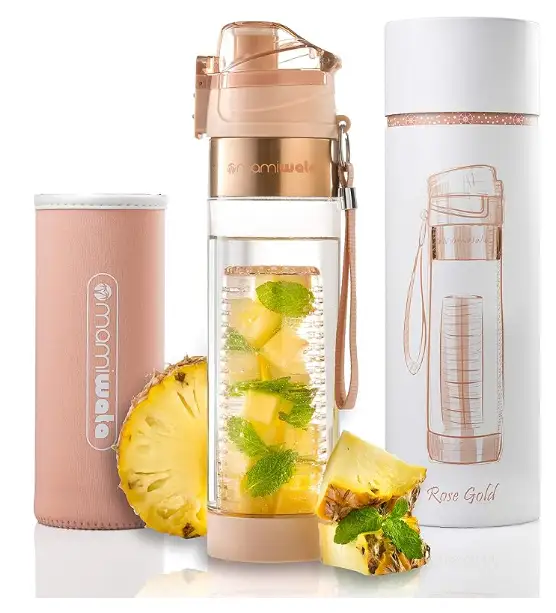
MAMI WATA 24 oz BPA-Free Tritan Infuser Bottle
The MAMI WATA 24 oz Fruit Infuser Bottle transforms plain water into refreshing, fruit-infused drinks with its unique bottom-infusing design. Made from durable, BPA-free Tritan plastic, it includes an insulating sleeve, a recipe eBook, and a premium gift box—making it perfect for daily hydration or thoughtful gifting.
5. Zulay Kitchen 34 oz Fruit Infuser Bottle: Best Large-Capacity Option
The Zulay Kitchen Fruit Infuser Bottle is a practical choice for anyone tired of refilling a smaller bottle.
Its 34-ounce capacity gives you plenty of water for a workout, office morning, or afternoon outdoors. The removable infuser keeps seeds and pulp away from the drinking opening, while time markings remind you to keep sipping.
It is not insulated like a stainless steel bottle. However, the included sleeve offers a little temperature control and helps reduce condensation.
Key Specifications
Feature | Details |
Capacity | 34 oz |
Material | BPA-free Tritan plastic |
Infuser | Removable fruit infuser |
Lid | Airtight flip-top lid |
Tracking | Printed time markers |
Carrying option | Sport loop |
Insulation | Removable insulating sleeve |
Cleaning | Top-rack dishwasher safe |
Extras | Recipe ebook with 11 infusion recipes |
Official price | $6.99 to $18.99, depending on color |
Best for | Office days, workouts, and fewer refills |
Capacity and Flavor
Capacity is the main reason to choose this bottle.
At 34 ounces, it holds ten ounces more than many standard fruit infusers. That means fewer trips to the water dispenser during a busy workday. It is also a useful size for long workouts or afternoons outside.
The removable infuser can hold fruit, vegetables, or herbs. Smaller pieces will generally create flavor faster, but do not crush soft berries too much. Mashed fruit can escape through the openings and make cleaning harder.
The bottle works particularly well with simple combinations such as lemon and mint, strawberry and basil, or cucumber and lime.
Lid and Portability
The flip-top lid uses an airtight seal to help prevent leaks. A sport loop makes the bottle easier to carry between the gym, office, and car.
Check the seal before putting it beside a laptop or clean clothes. Fruit pulp can sometimes collect around the gasket and stop it from closing properly. A quick rinse around the lid can prevent that problem.
Zulay says the bottle fits standard car cup holders, which is useful for commuting despite its larger capacity.
Temperature Control
This is a single-wall plastic bottle.
The sleeve can reduce condensation and slow down warming, but it will not keep water cold all day. For better results, start with refrigerated water, cold fruit, and a few ice cubes.
Do not use the original tip about pre-chilling the glass. This bottle is not glass. Zulay also does not provide a clear hot-liquid temperature rating, so it is safer to use it only with cold or room-temperature drinks.
Cleaning
The removable infuser makes regular cleaning fairly simple. Zulay lists the bottle as top-rack dishwasher-safe, although washing the lid and gasket by hand may help those parts last longer.
Remove the infuser after every use. Fruit left inside a closed bottle can develop unpleasant smells quickly, especially in warm weather.
Pay close attention to the gasket, lid hinge, and small infuser openings. These are the areas where pulp and moisture are most likely to remain.
Pros
- Large 34-ounce capacity
- Lightweight Tritan construction
- Removable infuser is easy to access
- Time markings encourage regular drinking
- Airtight flip-top lid
- Carrying loop for workouts and travel
- Top-rack dishwasher safe
- Includes an insulating sleeve
- Affordable official price
Cons
- Not made from glass
- No vacuum insulation
- Sleeve provides only limited temperature control
- Plastic may hold odors if fruit is left overnight
- Larger body may feel bulky for small hands
- No verified hot-liquid compatibility
Who Should Buy It?
Choose this Zulay bottle if you want a large, affordable infuser for cold water. It is particularly useful for office workers, gym users, and anyone who dislikes frequent refills.
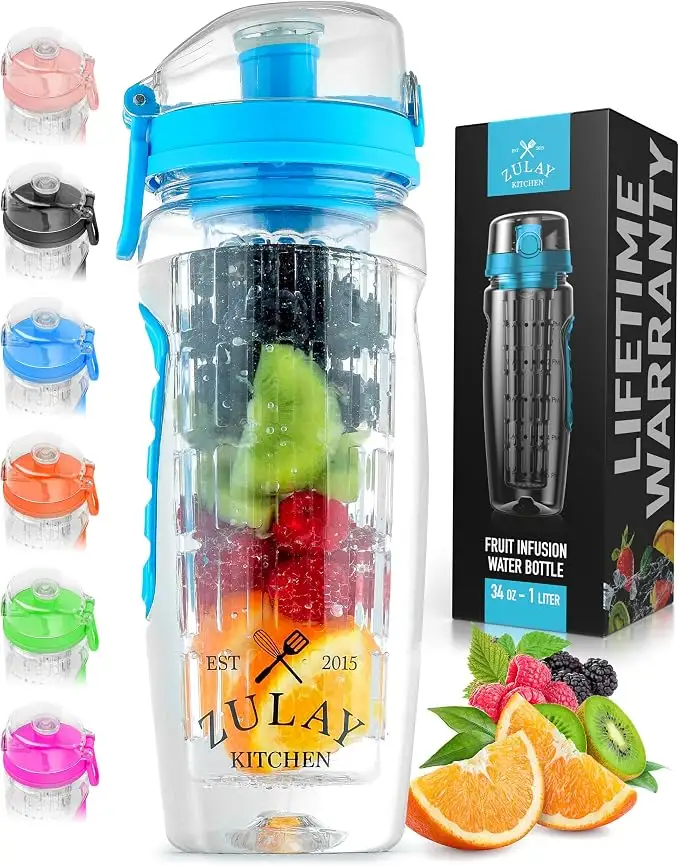
Zulay 34 oz Leakproof Fruit Infuser Water Bottle
The Zulay 34 oz Fruit Infuser Water Bottle transforms plain water into refreshing, fruit-infused drinks with its full-length infusion rod and built-in filter. Made from durable, shatter-resistant Tritan, it features a leakproof flip-top lid, convenient time markers, and dual-grip handles—perfect for the gym, hiking, and everyday hydration.
6. Live Infinitely 32 oz Fruit Infuser Bottle: Best Full-Length Infuser
The Live Infinitely bottle is built for people who want flavorful water from the first sip to the last.
Its long infuser keeps fruit in contact with the water even as the level drops. That is more useful than a short top basket, where the fruit stops steeping once you drink below it.
You also get time markings, a locking flip-top lid, dual hand grips, a carrying loop, and a neoprene sleeve. It is a well-rounded bottle for work, workouts, and daily hydration.
Key Specifications
Feature | Details |
Capacity | 32 oz |
Material | BPA-free Tritan plastic |
Infuser | Full-length removable infuser rod |
Lid | Push-button flip-top with lock |
Grip | Dual slip-resistant hand grips |
Carrying option | Built-in carrying loop |
Tracking | Time markers from 8 a.m. to 5 p.m. |
Sleeve | Neoprene insulating sleeve |
Cleaning | Dishwasher safe |
Extras | Recipe ebook with 20 infusion ideas |
Best for | Stronger, more consistent all-day flavor |
Infusion Performance
The full-length infuser is the feature that makes this bottle worth considering.
It extends through most of the bottle rather than holding fruit only near the lid. This keeps ingredients surrounded by water as you drink. It also provides more space for cucumber slices, berries, citrus pieces, and herbs.
Do not pack the chamber too tightly. Water needs space to move around the ingredients. Thin slices usually release flavor faster than large chunks.
The infuser can hold enough ingredients for more than one fill, but flavor will become weaker with each refill. Citrus and cucumber usually last longer than soft berries or mint.
Capacity and Hydration Tracking
A 32-ounce bottle cuts down on refill trips without becoming as heavy as a large glass bottle.
The printed time markers run from 8 a.m. to 5 p.m. They provide a simple visual reminder during office days when it is easy to forget about drinking water.
However, 32 ounces is not necessarily enough for an entire workday. Most users will still need at least one refill, depending on activity, weather, and individual hydration needs.
Lid and Portability
The push-button flip-top can be opened with one hand. A locking mechanism helps prevent accidental opening inside a bag.
Dual hand grips make the wide bottle easier to hold. There is also a strong carrying loop for short walks between the car, office, and gym.
The bottle is fairly wide. Verywell Fit lists its diameter at approximately 3.8 inches, so it may not fit every narrow car cup holder. Check your cup holder before choosing it specifically for road trips.
Temperature Control
The included neoprene sleeve reduces condensation and slows down warming.
It is not vacuum insulation.
Do not expect ice to survive all day in a hot car. Start with cold water, chilled fruit, and ice if temperature matters. Customer feedback suggests the sleeve can be tight and slightly difficult to remove, although that snug fit helps it stay in place.
Cleaning
The bottle is listed as dishwasher safe, but the long infuser still needs attention. Seeds, berry pulp, and small herb leaves can become trapped inside its openings.
Rinse the infuser as soon as you finish drinking. A narrow cleaning brush will make deep cleaning easier, but one is not included.
Remove the neoprene sleeve before washing the bottle. Let the sleeve and all plastic parts dry completely before putting everything back together.
Pros
- Full-length infuser maintains flavor as the water level drops
- Large 32-ounce capacity
- BPA-free Tritan construction
- Lightweight and shatter-resistant
- Time markers encourage regular drinking
- Locking, one-touch flip-top lid
- Dual slip-resistant grips
- Built-in carrying loop
- Dishwasher safe
- Neoprene sleeve reduces condensation
- Available in several colors
Cons
- Not the largest bottle in this roundup
- No vacuum insulation
- Sleeve can be difficult to remove
- Long infuser takes more effort to clean
- No cleaning brush included
- Wide body may not fit narrow cup holders
- Stock and pricing vary between sellers
Who Should Buy It?
Choose the Live Infinitely bottle if you want stronger, more consistent fruit flavor throughout the day. It suits office workers, gym users, and people who prefer a large infuser chamber.
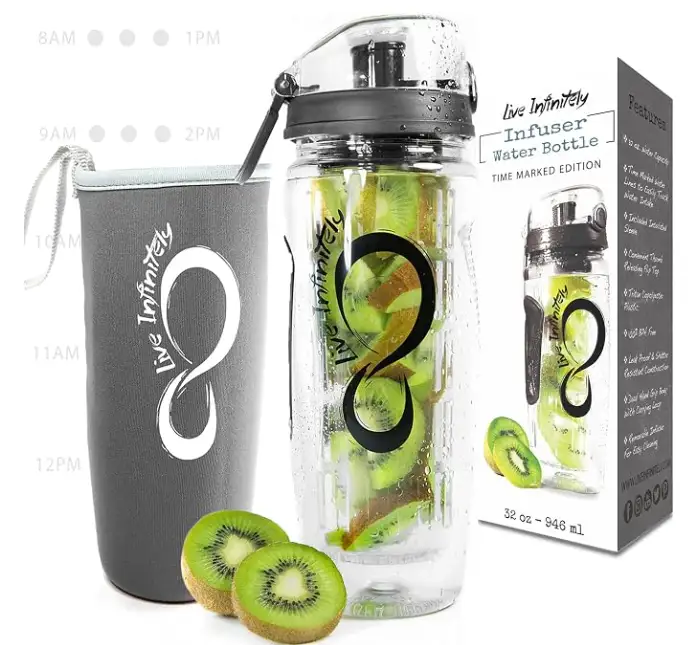
Live Infinitely 32 oz BPA-Free Infuser Water Bottle
The Live Infinitely 32 oz Fruit Infuser Bottle makes hydration more enjoyable with a full-length infusion rod that adds flavor to every sip. Built from durable, BPA-free Tritan, it features time markers to help track your water intake, a leakproof flip-top lid, and an insulating sleeve to keep drinks cool throughout the day.
7. Brimma 32 oz Fruit Infuser Bottle: Best Budget Starter
The Brimma covers the basics without loading the bottle with unnecessary extras.
You get a large Tritan body, removable infuser, locking flip-top lid, nonslip grip, and simple cleaning. At around $12.49 on Amazon during research, it remains an affordable way to try infused water without spending much.
It is not the cheapest bottle everywhere. Zulay Kitchen sometimes sells its bottle for less through its own website. However, Brimma offers a useful balance of capacity, durability, established customer feedback, and price.
Key Specifications
Feature | Details |
Capacity | 32 oz |
Material | BPA-free Tritan plastic |
Infuser | Removable, top-accessed fruit infuser |
Lid | One-touch flip-top with locking clip |
Grip | Nonslip side grip |
Carrying option | Integrated carrying handle |
Insulation | None |
Cleaning | Top-rack dishwasher safe, hand washing recommended for best results |
Current color | Primarily black and clear |
Price during research | Approximately $12.49 |
Best for | First-time users and affordable daily hydration |
Infusion and Flavor
The removable basket keeps fruit pieces, seeds, and herbs away from the drinking spout. It can be removed when you want to use the Brimma as a regular 32-ounce water bottle.
The infuser openings are reasonably large. This helps water move around berries, citrus, mint, and cucumber, but very soft fruit can release pulp through the holes.
For cleaner water, use firm fruit pieces instead of crushed berries. Frozen strawberries, blueberries, and citrus slices are practical choices because they add flavor while helping the water stay cold.
Flavor strength is good for a basic plastic bottle, but results depend more on your ingredients than the price. Thin citrus slices will produce more noticeable flavor than a few large apple chunks.
Lid and Leak Protection
Brimma describes the locking flip-top lid as leakproof. The lock adds useful protection against the lid opening accidentally in a backpack or gym bag.
The small circular seal inside the lid needs to sit flat. One Walmart reviewer reported leaking when that seal folded sideways, but said the problem stopped after adjusting it properly.
That is the important detail.
Inspect the seal after washing. Then close the bottle and turn it upside down over a sink before placing it beside electronics or clothing.
Capacity and Portability
The 32-ounce capacity is generous for a budget bottle. It reduces refills during workouts, office mornings, or short outdoor trips.
The Tritan body keeps the empty weight low. Verywell Fit lists the bottle at approximately 9.1 ounces and notes that it fits most cup holders. It also has a nonslip grip, although there is no separate carrying strap.
A full 32-ounce bottle may be too large for younger children. This is better suited to adults, teenagers, or older children who can comfortably handle its size.
Temperature Control
There is no insulation or protective sleeve.
Cold water will gradually warm up, especially in a car or sunny outdoor area. Add ice or use chilled ingredients if you want it to stay cold longer.
Avoid hot or boiling water. Retailer instructions limit the bottle to cold or warm drinks and do not provide a safe maximum temperature.
Cleaning
The removable infuser makes cleaning straightforward. Brimma lists the bottle as top-rack dishwasher safe, while its US Amazon description recommends hand washing with warm water and dish soap for the best results.
I would hand wash the lid and seal.
Those small parts control whether the bottle leaks. Gentle cleaning also makes it easier to notice fruit pulp trapped around the gasket.
Pros
- Affordable price
- Large 32-ounce capacity
- Lightweight Tritan body
- Removable fruit infuser
- Locking flip-top lid
- Nonslip grip
- Fits most cup holders
- Top-rack dishwasher safe
- Can be used without the infuser
- Thousands of customer ratings
Cons
- Not currently verified in a 24-ounce size
- Limited color selection
- No insulation
- No separate carrying strap
- Seal must be positioned correctly to prevent leaks
- Large size may be awkward for young children
- No cleaning brush or sleeve included
Who Should Buy It?
Choose the Brimma if you want a simple and affordable first infuser bottle. It is also a sensible backup for the office, gym, or car.
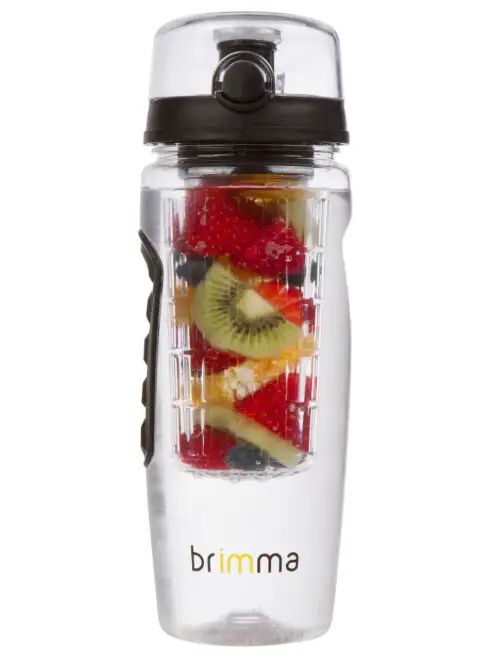
Brimma 32 oz Leakproof Fruit Infusion Water Bottle
The Brimma 32 oz Fruit Infuser Water Bottle makes it easy to create refreshing, naturally flavored drinks wherever you go. Its leakproof design and large capacity are perfect for the gym, camping, and travel, while the removable infuser lets you enjoy fresh fruit flavors without added sugar.
Infuser Water Bottle Comparison Table
This corrected table should replace the supplied version. Several original specifications were attached to the wrong products.
Product | Price | Material | Capacity | Infuser Type | Insulation | Leak Protection | Cleaning | Best For | Research Score |
Lexlion Tea Infuser Bottle | $36.99 | 18/8 stainless steel | 22 or 32 oz | Removable two-piece stainless mesh infuser | Triple-wall vacuum | Manufacturer-rated leakproof | Hand-wash body; lids and infuser top-rack safe | Tea, fruit, herbs and cold brew | 9.0/10 |
Infusion Pro 24 oz Classic 2-Pack | $29.99 Per | BPA-free Tritan | 24 oz each | Bottom-loading fruit basket | No vacuum insulation; neoprene sleeve | Manufacturer-rated leakproof | Top rack; hand-wash sleeve and seals | Couples and strong fruit flavour | 8.6/10 |
Hydracy Coach Time Marker Bottle | $27.99 | BPA-free Tritan | 32 oz | Removable fruit strainer or basket | No vacuum insulation; neoprene sleeve | Manufacturer-rated leakproof | Hand wash only | Tracking daily water intake | 8.2/10 |
MAMI WATA Rose Gold Infuser | $19.77 | BPA-free Tritan | 24 oz | Bottom-loading fruit basket | No vacuum insulation; neoprene sleeve | Manufacturer-rated leakproof | Dishwasher safe; top rack is safest | Gifting and first-time users | 8.1/10 |
Zulay Kitchen Fruit Infuser | $6.99 to $18.99 | BPA-free Tritan | 34 oz | Removable fruit infuser | No vacuum insulation; insulating sleeve | Manufacturer-rated leakproof | Top-rack dishwasher safe | Large capacity on a budget | 8.6/10 |
Live Infinitely Fruit Infuser | $19 | BPA-free Tritan | 32 oz | Full-length infuser rod | No vacuum insulation; neoprene sleeve | Manufacturer-rated leakproof | Dishwasher safe; remove sleeve first | Consistent flavour as water drops | 8.1/10 |
Brimma Fruit Infuser Bottle | $12.49 | BPA-free Tritan | 32 oz | Removable top-accessed infuser | None | Leakproof when the lid seal sits correctly | Top-rack safe; hand washing preferred | Simple, affordable starter bottle | 8.5/10 |
How to Use and Clean Your Infuser Bottle for Longevity
An infuser bottle is simple to use, but a few small details make a big difference. Overpacking the basket weakens water flow. Poorly seated seals cause leaks. Leaving fruit warm for too long can also create a food-safety risk.
Step-by-Step Assembly and Infusion
1. Take the Bottle Apart
Remove the lid, infuser basket, seals, sleeve, and any removable base.
Check that each silicone gasket is clean and sitting flat. A twisted or missing seal is one of the most common reasons an infuser bottle leaks.
2. Wash and Prepare the Ingredients
Wash your hands before handling the fruit. Rinse all fresh fruit, vegetables, and herbs thoroughly under running water before cutting them.
Do not wash produce with soap or detergent. The FDA explains that produce can absorb these cleaners. Firm ingredients such as cucumbers and melons can be scrubbed with a clean produce brush.
Cut the ingredients into pieces that fit comfortably inside the basket. Thin citrus and cucumber slices release flavour faster than large chunks.
Gently tear or bruise mint, basil, and rosemary. Do not mash them into a paste. Tiny herb pieces may escape through the basket and clog the drinking spout.
3. Fill the Infuser Basket
Add enough fruit to cover around two-thirds of the basket.
Do not pack it to the top. Water needs room to move between the ingredients. A tightly packed basket may produce weaker flavour, even though it contains more fruit.
Remove thick citrus peel if you plan to steep the water for several hours. Lemon, lime, and orange peel can make water taste bitter.
4. Assemble the Bottle
Attach the infuser to the lid or base, depending on the bottle’s design. Make sure it is straight before tightening.
Fill the bottle with cold or room-temperature water. Add ice if there is enough space, but do not force large cubes against the infuser.
Close the lid firmly. Turn the bottle upside down over a sink for several seconds before placing it in a bag.
5. Give the Flavour Time to Develop
For light flavour, wait around 10 to 15 minutes.
For stronger flavour, place the closed bottle in the refrigerator for three to four hours. Overnight infusion is also possible, but the bottle must remain refrigerated at 40°F or below.
Fresh infused water should not sit at room temperature for more than two hours. Michigan State University Extension recommends refrigerating leftovers within that period.
Long steeping does not always mean better flavour. Soft berries can become mushy, while citrus peel can turn bitter. Remove the fruit after about four hours if the flavour is already strong.
6. Drink and Refill Carefully
Strong ingredients such as lemon, orange, pineapple, cucumber, and ginger may provide one or two additional fills. Berries, melon, and soft herbs usually lose flavour faster.
Keep all refills refrigerated or properly chilled. Do not repeatedly top up the same warm fruit throughout the day.
Replace the ingredients when the flavour becomes weak, or the fruit looks soft, cloudy, slimy, or discoloured. When in doubt, throw it away.
Deep Cleaning Routine to Prevent Mold and Odors
Fruit leaves behind more residue than plain water. Tiny pieces can hide inside the infuser holes, drinking spout, lid hinge, and silicone seals.
A quick rinse is not enough.
The routine below keeps those hard-to-reach areas clean without damaging the bottle.
After Every Use
Empty the bottle as soon as you finish drinking. Do not leave wet fruit sealed inside overnight.
Take apart every removable component:
- Bottle body
- Infuser basket
- Lid
- Silicone seals
- Straw or spout
- Protective sleeve
Wash the bottle, lid, and infuser with warm water and mild dish soap. Use a bottle brush for the main body and a smaller brush for the infuser holes, spout, threads, and lid grooves.
CamelBak also recommends hot soapy water and a bottle brush for bottles that require hand washing.
Rinse until there are no soap bubbles or pieces of fruit left. Only use a dishwasher when the bottle manufacturer specifically allows it.
Once a Week
Remove the silicone gaskets from the lid. These seals are easy to overlook, but moisture and fruit juice often collect underneath them.
Wash each gasket separately with warm soapy water. Use a soft toothbrush or narrow cleaning brush around the seal channel.
For mineral film or mild smells, fill the bottle with one part white vinegar and four parts warm water. Let it sit for 15 to 30 minutes, then scrub and rinse thoroughly.
Vinegar can loosen deposits and reduce odors. It should not be described as a guaranteed disinfectant.
Do not leave silicone seals soaking in vinegar for hours. Acid may weaken some materials over time. Check the manufacturer’s care instructions first.
Once a Month
Inspect the bottle under bright light. Look closely at the lid hinge, infuser openings, threads, gasket channels, and the bottom of the bottle.
For stainless steel interiors, mix a small amount of baking soda with water to make a soft paste. Apply it with a non-scratch sponge to remove stubborn smells or stains.
Do not scrub a painted or powder-coated exterior with baking soda. The paste may dull the finish.
For compatible Tritan or glass bottles, use a cleaning tablet made specifically for water bottles or drinkware. Follow the tablet instructions and the bottle manufacturer’s care limits. Denture tablets may work, but they are not approved for every bottle material or lid seal.
Never mix baking soda and vinegar for deep cleaning. The bubbling looks useful, but the ingredients mostly neutralise each other.
Sanitise Only When Needed
Routine washing with dish soap should handle normal daily use. Sanitising is more appropriate when:
- Visible mold appears
- The bottle was forgotten with fruit inside
- A strong smell remains after washing
- Someone who was ill used the bottle
- The bottle was shared between several people
If the manufacturer allows diluted bleach, the CDC recommends washing the container first. Then use one teaspoon of unscented household bleach containing 5% to 9% sodium hypochlorite in one quart, or four cups, of water.
Close the container and shake it so the solution touches every internal surface. Wait at least 30 seconds, pour it out, and allow the container to air-dry.
Do not use bleach unless the bottle manufacturer confirms it is safe for that material. Chlorine can damage some stainless steel finishes, printed markings, plastics, and gaskets.
Never mix bleach with vinegar, ammonia, or any other cleaner. The CDC warns that mixing bleach with other products can create dangerous fumes.
Dry Every Part Completely
Drying matters just as much as washing.
Place the bottle body upside down at an angle so air can enter. Set the lid, infuser, and seals separately on a clean drying rack.
Do not reassemble the bottle while any part is damp. The CDC notes that thorough air-drying helps prevent germs and mold from growing on reusable feeding equipment. The same moisture-control principle applies to bottle parts.
Store the bottle with the lid off or loosely attached. A tightly closed, damp bottle creates the exact dark environment mold prefers.
When Should You Replace a Part?
Replace a gasket, straw, or infuser if it remains stained, slimy, cracked, or smelly after cleaning.
Deep scratches inside plastic can also trap residue. If a Tritan bottle stays cloudy or develops a lasting smell, replacing it is safer than repeatedly using stronger cleaners.
Infuser Bottle Cleaning Checklist
Schedule | Cleaning Task | Check |
After every use | Empty fruit and rinse immediately | ☐ |
After every use | Wash the bottle, lid, infuser, and spout | ☐ |
After every use | Air-dry every part separately | ☐ |
Weekly | Remove and clean all silicone seals | ☐ |
Weekly | Scrub lid grooves and infuser openings | ☐ |
Weekly | Check for odors, stains, or residue | ☐ |
Monthly | Inspect for cracks, mold, and worn seals | ☐ |
Monthly | Use a material-safe deodorising treatment | ☐ |
As needed | Sanitise using a manufacturer-approved method | ☐ |
As needed | Replace damaged or permanently stained parts | ☐ |
Troubleshooting Common Infuser Bottle Problems
Most infuser bottle problems come down to four things: a misplaced seal, poor water circulation, unsuitable ingredients, or trapped moisture. Here is how to fix them.
Why Is My Infuser Bottle Leaking?
Start with the silicone gasket or O-ring. Remove it, rinse away fruit fibers and other debris, then reinstall it so it lies completely flat. A twisted seal can create a surprisingly large leak.
Next, check that the lid, infuser, and removable base are aligned correctly. Tighten them by hand, but do not force them. Overtightening can deform the gasket and make a bottom cap difficult to remove.
Test the empty bottle upside down over a sink before putting it in your bag. If it still leaks, inspect the seal for cracks, stretching, or flat spots. Replace damaged gaskets with the correct part from the manufacturer. Infusion Pro’s instructions specifically warn that its O-rings must be securely positioned to prevent leaks, while Brimma customer feedback suggests that even a folded seal can cause dripping.
A cracked bottle body or damaged lid should be replaced rather than patched.
Why Does My Infused Water Taste Weak?
Cut fruit into thin slices to expose more surface area. Gently bruise mint, basil, or rosemary between your fingers, but do not mash everything into pulp. Too much muddling can clog the basket and make herbs taste bitter.
Leave some space inside the infuser so water can circulate. Make sure the ingredients remain submerged, too. This is why full-length and bottom-loading infusers often deliver stronger flavor than short baskets near the lid.
Let the bottle infuse in the refrigerator for two to four hours. Strong ingredients may flavor the water sooner, while cucumber, melon, and mild berries usually need more time. Bottom-loading bottles tend to produce a stronger taste because the ingredients remain in contact with the water.
Do not use warm water as a shortcut unless the manufacturer explicitly approves that temperature. Heat can damage some plastic bottles and seals. Cold or room-temperature water, thinner fruit slices, and additional steeping time are safer options.
How Do I Clear a Clogged Spout?
Remove the lid and rinse the spout from both directions. Use a small nylon straw brush or drinkware pipe cleaner to loosen trapped pulp. Avoid knives, metal wire, and sharp tools that can scratch the drinking surface or puncture a silicone valve.
Chia seeds, flax seeds, mashed berries, overripe mango, and heavily pulped citrus are common offenders. Loose tea and coffee grounds can also escape unless the bottle has a fine-mesh filter designed for them.
Use larger fruit pieces or place small ingredients inside a reusable tea bag. Never continue drinking through a partially blocked spout. A sudden release could send seeds or fruit pulp into your mouth.
How Do I Remove Lingering Odors?
Take the bottle completely apart. The smell is often hiding beneath the gasket rather than inside the bottle itself.
Wash every component with warm, soapy water and a bottle brush first. For persistent odors, soak compatible parts in a mild baking-soda solution. A diluted vinegar soak can help with mineral deposits. Use the two treatments separately, rinse thoroughly, and check the manufacturer’s care instructions before soaking insulated lids or metal components.
Skip the direct-sunlight trick. Sunlight is not a dependable way to clean a bottle or remove residue. The CDC’s solar water-treatment method requires clear water, transparent containers, strong sunlight, and at least six hours of exposure. It is an emergency method for treating water, not for cleaning bottle threads, lids, or gaskets.
Let every component air-dry completely in a ventilated place. If an old gasket or heavily scratched plastic part still smells after cleaning, replace it.
Why Does My Infusion Taste Bitter?
Citrus pith, cucumber skin, and strong herbs can become bitter when left too long. Remove most of the white pith from lemons and oranges, use herbs sparingly, and taste the water during steeping.
Once the flavor is where you want it, remove the ingredients. Refrigerate leftovers promptly rather than leaving cut fruit at room temperature for hours.
Infused Water Recipes and Flavor Combination Ideas
These combinations are sized for a 24 to 32-ounce bottle. If your infuser basket is smaller, reduce the ingredients rather than packing them tightly. Water needs room to circulate.
Wash all produce under running water before slicing. Use cold water and refrigerate longer infusions.
Strawberry, Lemon and Basil
Use four or five sliced strawberries, three or four thin lemon slices, and six basil leaves.
The strawberries add gentle sweetness, while the lemon keeps the flavor bright. Lightly tear the basil before adding it. Infuse for two to four hours. Remove the lemon peel if the water begins to taste bitter.
Cucumber, Lime and Mint
Combine half a small cucumber, half a thinly sliced lime, and 10 mint leaves.
This is crisp, cooling, and easy to drink during workouts or hot office days. Gently press the mint between your fingers to release its aroma. Do not crush it into pulp. Infuse for one to three hours.
Watermelon and Rosemary
Add about one cup of watermelon cubes and one small rosemary sprig.
Watermelon creates a mild sweetness without overpowering the water. Rosemary gets strong quickly, so start with a short sprig. Infuse for one to two hours and taste before leaving it longer.
If your basket is narrow, cut the watermelon into slim pieces instead of forcing in large cubes.
Blueberry, Lemon and Lavender
Use one-third cup of blueberries, three thin lemon slices, and a very small pinch of dried culinary lavender.
Gently press a few blueberries to break their skins. Whole berries release flavor slowly. Make sure the lavender is labeled food-grade or culinary. Decorative lavender may not be suitable for drinking.
Infuse for two to four hours. Lavender can taste soapy when overused, so less is better.
Tea and Herbal Infusions
Tea keeps extracting after the fruit has released its flavor. Leave it too long, and the bottle can turn bitter or overly herbal.
These recipes are sized for a 24 to 32-ounce bottle. Use two tea bags or two teaspoons of loose tea for a stronger brew. Loose leaves require a fine-mesh infuser. A standard fruit basket will let smaller particles escape.
Green Tea and Peach
Add one or two green tea bags and half a thinly sliced ripe peach. Fill with cold water and refrigerate for six to eight hours.
Cold brewing gives green tea a softer, less bitter taste. Remove the tea after eight hours, even if you leave the peach for a little longer. Research shows that high temperatures combined with long steeping can produce unpleasant bitterness.
Green tea contains caffeine, although the amount in your finished bottle will vary with the tea, quantity, and brewing time.
Hibiscus, Orange and Cinnamon
Brew one or two hibiscus tea bags according to the package directions. Let the tea cool before pouring it into a bottle that is not rated for hot liquids.
Add three thin orange slices and half a cinnamon stick. Top with cold water and refrigerate for two to four hours.
The result is tart, bright, and lightly spiced. Avoid describing it as “rich in vitamin C.” Some vitamin C may enter the water, but the amount is difficult to predict and will be much lower than eating the orange.
Chamomile, Apple and Ginger
Prepare one or two chamomile tea bags according to the package directions, then cool the tea.
Add half a small apple, sliced thinly, and two or three thin pieces of fresh ginger. Top with cold water and refrigerate for one to three hours.
This combination tastes floral, lightly sweet, and gently spicy. Chamomile is commonly associated with relaxation, but an infused bottle should not be presented as a treatment for sleep or digestive problems.
Rooibos, Vanilla and Fig
Brew one or two rooibos tea bags according to the package directions and allow the tea to cool.
Add one dried fig cut into quarters and one-quarter of a split vanilla bean. A whole vanilla bean is expensive and usually overpowering for a single bottle. Refrigerate for two to four hours.
Use a fine-mesh basket or reusable tea bag for the fig. Its seeds and softened flesh can escape through a coarse fruit infuser. Plain rooibos is naturally caffeine-free, but check the label because some blends contain caffeinated tea.
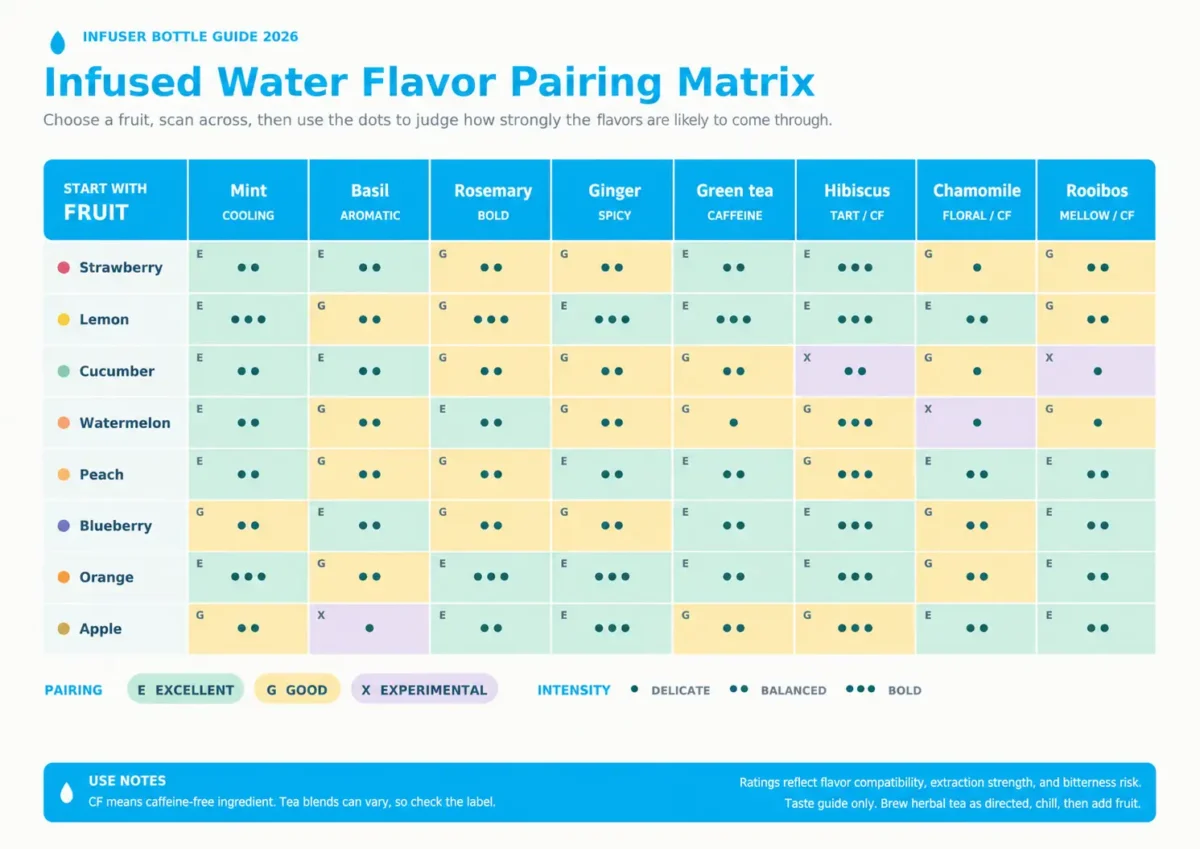
Infused Water Flavor Pairing Matrix
Not sure what to add to that lonely peach or half-used cucumber? Start with the fruit column, then scan across the matrix for compatible herbs and teas.
Green cells mark excellent pairings. Gold combinations are dependable but more subtle. Purple cells are experimental choices for anyone who enjoys unusual flavors. The dots show expected intensity, from delicate to bold.
A few combinations worth trying:
- Peach and green tea: excellent and balanced.
- Cucumber and mint: excellent and cooling.
- Orange and ginger: excellent and bold.
- Blueberry and hibiscus: excellent, tart, and colorful.
- Apple and basil: experimental and delicate.
The matrix uses flavor-profile tags instead of health-benefit icons. That is intentional. Adding an ingredient does not guarantee a measurable immune, digestive, antioxidant, or stress-relief effect.
“CF” identifies a naturally caffeine-free ingredient, but packaged blends can vary. Check the label. Herbal teas should also be brewed according to their package instructions, cooled, and then combined with fruit. Food-safety guidance recommends boiling water for dried herbal tea because the ingredients can occasionally carry harmful bacteria.
Tips for Creating Your Own Infused Water Recipes
You do not need a complicated recipe. Start with a simple formula, taste as you go, and write down the combinations that work.
Use a Simple Three-Part Formula
For a 24 to 32-ounce bottle, begin with:
- Half to one cup of sliced fruit
- Four to eight leaves of a soft herb, or one small sprig of a woody herb
- Two or three thin citrus slices
Do not pack the basket tightly. Water must move around the ingredients to extract their flavor.
One fruit, one herb, and one citrus is usually enough. Adding five or six ingredients often creates a muddled drink where nothing stands out.
Match Ingredients by Intensity
Soft herbs such as mint and basil release flavor quickly. Tear or gently bruise the leaves, then taste the water after 30 to 60 minutes.
Woody herbs such as rosemary and thyme take longer but can become overpowering. One small sprig is plenty for most bottles.
Citrus, ginger, hibiscus, and cinnamon are bold. Mild ingredients such as cucumber, melon, pear, and chamomile need more time or a stronger supporting ingredient.
Ingredient | Preparation | Start Tasting |
Berries and soft fruit | Slice or lightly press | 1 hour |
Cucumber and melon | Cut into thin pieces | 1–2 hours |
Mint and basil | Tear or gently bruise | 30–60 minutes |
Rosemary and thyme | Use one small sprig | 1–2 hours |
Citrus | Slice thinly and limit the white pith | 1 hour |
Ginger and cinnamon | Use thin slices or a small stick | 1–2 hours |
These are starting points, not strict brewing rules. Ingredient ripeness, basket size, and water volume will affect the result.
Use Cold Water as the Default
Cold water works well for fresh fruit and herbs. It also keeps delicate ingredients from breaking down too quickly.
Room-temperature water is fine for an infusion you plan to drink within a short period. Refrigerate anything that will steep for longer than two hours.
Use hot water only when preparing tea and only if the bottle is rated for that temperature. If it is not, brew the tea in a heat-safe cup, cool it, and transfer it afterward. Cold-brew coffee should remain refrigerated and requires a very fine filter to control sediment.
Stop the Infusion at the Right Time
Start tasting fruit infusions after one or two hours. Most develop plenty of flavor within two to four hours in the refrigerator.
Citrus peel and strong herbs can turn bitter when left overnight. Soft berries, peaches, and watermelon may begin to break apart, making the water cloudy and clogging the spout.
Once the flavor tastes right, remove the ingredients. Make only what you expect to drink that day, and refrigerate leftovers promptly.
Frequently Asked Questions
Are Infuser Water Bottles Safe? What About Plastic Leaching?
Yes, provided the bottle is made for food contact and used according to its temperature and cleaning instructions.
The plastic models in this guide are described by their manufacturers as BPA-free. Tritan is also made without BPA, but “FDA-approved plastic” is not the most accurate wording. The FDA authorizes food-contact substances for specific uses and conditions. It does not give every finished bottle a blanket safety approval.
Eastman, the maker of Tritan, states that the material is cleared for food-contact applications. However, the finished bottle manufacturer remains responsible for using it correctly.
Follow the bottle’s stated temperature limits. Replace plastic that becomes deeply scratched, cloudy, cracked, or warped. Glass and stainless steel bodies do not contain BPA, although their lids, straws, and gaskets may use plastic or silicone components.
Can I Put Hot Liquids in My Infuser Bottle?
Only if both the bottle and lid are specifically rated for hot drinks.
Vacuum-insulated stainless steel bottles are often suitable for tea, but insulation alone does not guarantee heat safety. Straw lids and some flip-top spouts may not be designed for hot liquid because they can release steam or hot water suddenly.
Borosilicate glass handles temperature changes better than ordinary glass, but it can still crack from thermal shock. Do not pour boiling water into a cold glass bottle unless the manufacturer explicitly allows it.
Most Tritan fruit-infuser bottles are intended for cold drinks. Check the stated temperature limit before adding hot water, using a dishwasher, or running a heated drying cycle.
How Long Does Infused Water Last?
For the best flavor and simplest safety rule, drink it the same day or within 24 hours.
Keep homemade infused water refrigerated at 40°F (4°C or below. Do not leave a bottle containing cut fruit at room temperature for more than two hours. Reduce that to one hour when the temperature is above 90°F or 32°C.
Remove soft fruit once it begins breaking apart. Natural fruit pulp can make water cloudy, so cloudiness alone does not always mean spoilage. Discard the drink if it develops an unexpected fermented smell, fizzing, pressure, slime, or an unusual taste. Do not taste water you already suspect is spoiled.
Can I Use Frozen Fruit?
Yes. Frozen mango, pineapple, peaches, and berries add flavor while helping the water stay cold.
Freezing does not sterilize fruit, however. Frozen berries have occasionally been connected to foodborne illness outbreaks. Check recall notices and follow any preparation directions on the package, especially if the fruit is not labeled ready to eat.
Frozen fruit also does not replace proper refrigeration. A few frozen berries will thaw quickly in a non-insulated bottle.
How Do I Prevent My Bottle From Leaking?
Clean and inspect every gasket before assembling the bottle. Fruit fibers, tea leaves, and seeds can prevent a silicone seal from sitting flat.
Install the gasket without twisting it. Screw the lid or removable base on straight and tighten it by hand. Overtightening can deform the seal or make the bottom cap difficult to remove.
Test the filled bottle upside down over a sink. If it still drips, inspect the gasket for cracks, stretching, or flat spots. Replace damaged seals with the correct manufacturer part.
Even with a leak-proof model, keeping the bottle upright in a bag’s side pocket adds protection against a wet laptop or notebook.
What Is the Best Way to Clean the Infuser Basket?
Rinse the basket immediately after use. Dried berry pulp and citrus fibers are much harder to remove later.
Wash it with warm, soapy water and a small nylon brush. Clean from both sides of the mesh, paying attention to the rim, connection threads, and space beneath removable seals.
A diluted vinegar soak can help loosen mineral buildup and odors, but it should not replace normal washing. Rinse thoroughly and let every part air-dry before reassembly. Use the dishwasher only when the manufacturer marks the basket as dishwasher safe.
Avoid metal brushes and sharp tools. They can damage fine mesh or create scratches where residue collects.
Can I Make Cold-Brew Coffee in an Infuser Bottle?
Use coarsely ground coffee, fill the bottle with cold water, and steep it in the refrigerator. Start tasting after about 12 hours. Many cold-brew recipes use 12 to 18 hours, but the best time depends on the coffee, grind size, and strength you prefer.
Keep cold brew refrigerated throughout preparation. Government food-safety guidance treats unheated cold brew as a drink that requires temperature control.
Strain the coffee once it tastes right. Coffee oils cling to mesh, silicone, and lid parts, so using a separate bottle for coffee is practical if you do not want your strawberry water tasting faintly like yesterday’s roast.
Infuser Bottle Finder Quiz
5 quick questions
Choose what matters most. The finder will match your answers with one of the seven bottles reviewed in this guide.
Your best match
Compare all seven bottlesExpert Insights and Evaluation Methodology
A product review is only useful when you know what sits behind the rankings.
This guide is research-based. It does not claim that every bottle was physically shake-tested, temperature-tested, taste-tested, or dropped unless those tests were completed and documented by the editorial team.
How We Evaluated the Bottles
Official Product Information
We checked manufacturer descriptions, care instructions, and available product documentation for:
- Bottle capacity and dimensions
- Body, lid, gasket, and infuser materials
- Infuser position and mesh type
- Insulation claims
- Dishwasher compatibility
- Hot-liquid restrictions
- Warranty coverage
Manufacturer claims are identified as specifications, not treated as independent test results.
Leak Resistance and Lid Design
We examined the number and position of silicone seals, the locking mechanism, removable base connections, and recurring leakage reports from owners.
One isolated review was not enough to change a rating. We looked for repeated complaints involving the same gasket, thread, hinge, or lid component.
Customer experiences are described as customer feedback. They are never rewritten as our personal comparisons.
Infusion Performance
Flavor scores considered infuser length, basket width, ingredient capacity, mesh size, and how well ingredients remain submerged.
Bottom-loading and full-length designs generally provide more contact between the ingredients and water. Fine-mesh baskets received additional credit when they could hold loose tea or coarse coffee without releasing excessive sediment.
These ratings reflect design analysis and recurring user feedback. They are not results from a controlled tasting panel unless stated otherwise.
Cleaning and Maintenance
We considered how many pieces must be removed, whether gaskets can be accessed, the width of the bottle opening, and whether the manufacturer allows dishwasher cleaning.
Bottles with narrow mesh, hidden seals, or difficult bottom caps lost points because these areas can trap fruit pulp and moisture.
Materials and Safety
Material claims were checked against manufacturer information and authoritative food-contact guidance. “BPA-free” was not treated as proof that a bottle is suitable for every temperature or cleaning method.
The FDA evaluates food-contact substances according to their intended use and conditions. Readers should still follow the bottle maker’s temperature and dishwasher limits
Value
Value was judged using capacity, materials, expected durability, included accessories, warranty coverage, and typical selling price.
How the Overall Scores Were Calculated
Evaluation Area | Weight |
Leak resistance and lid usability | 20% |
Infusion performance and versatility | 20% |
Cleaning and maintenance | 15% |
Materials and expected durability | 15% |
Temperature performance | 10% |
Capacity and portability | 10% |
Overall value | 10% |
What We Did Not Independently Verify
This guide did not conduct laboratory migration testing on plastics, independently confirm every insulation claim, or perform repeatable impact testing on multiple samples.
We also did not publish a three-person tasting panel, 12-hour temperature chart, or one-hour inverted-bag test as completed research without original records.
That distinction matters.
Expert Perspective
Registered dietitian Lauren Manaker, MS, RDN, LDN, explains why adding fruit can make plain water more appealing:
“Fruit infuses your water with natural sweetness and vibrant flavors, making it way more enjoyable to sip on without any added sugars or artificial ingredients.”
This supports the practical benefit of infused water: flavor may encourage you to drink more without relying on sugary drinks. It does not mean that fruit-infused water acts as a supplement or delivers the same nutrients as eating whole fruit.
Conclusion: Make Every Sip Count
The right infuser bottle can make plain water far easier to enjoy.
Lexlion is a strong all-round choice. Infusion Pro works well for tighter budgets. MAMI WATA is better suited to anyone who cares about style as much as function.
But the best bottle is not always the one with the longest feature list.
It is the one that fits your routine, feels easy to clean, won’t leak in your bag, and makes you want to drink more water throughout the day.
Pick the bottle that suits your lifestyle. Keep the infuser clean. Experiment with fruit, herbs, and different flavor combinations until you find something you genuinely enjoy.
Better hydration does not need to feel like another daily task. Sometimes, better flavor is all it takes.
Ready to Try It?
Choose your favorite bottle from the list above and start with one of the simple infusion recipes in this guide.