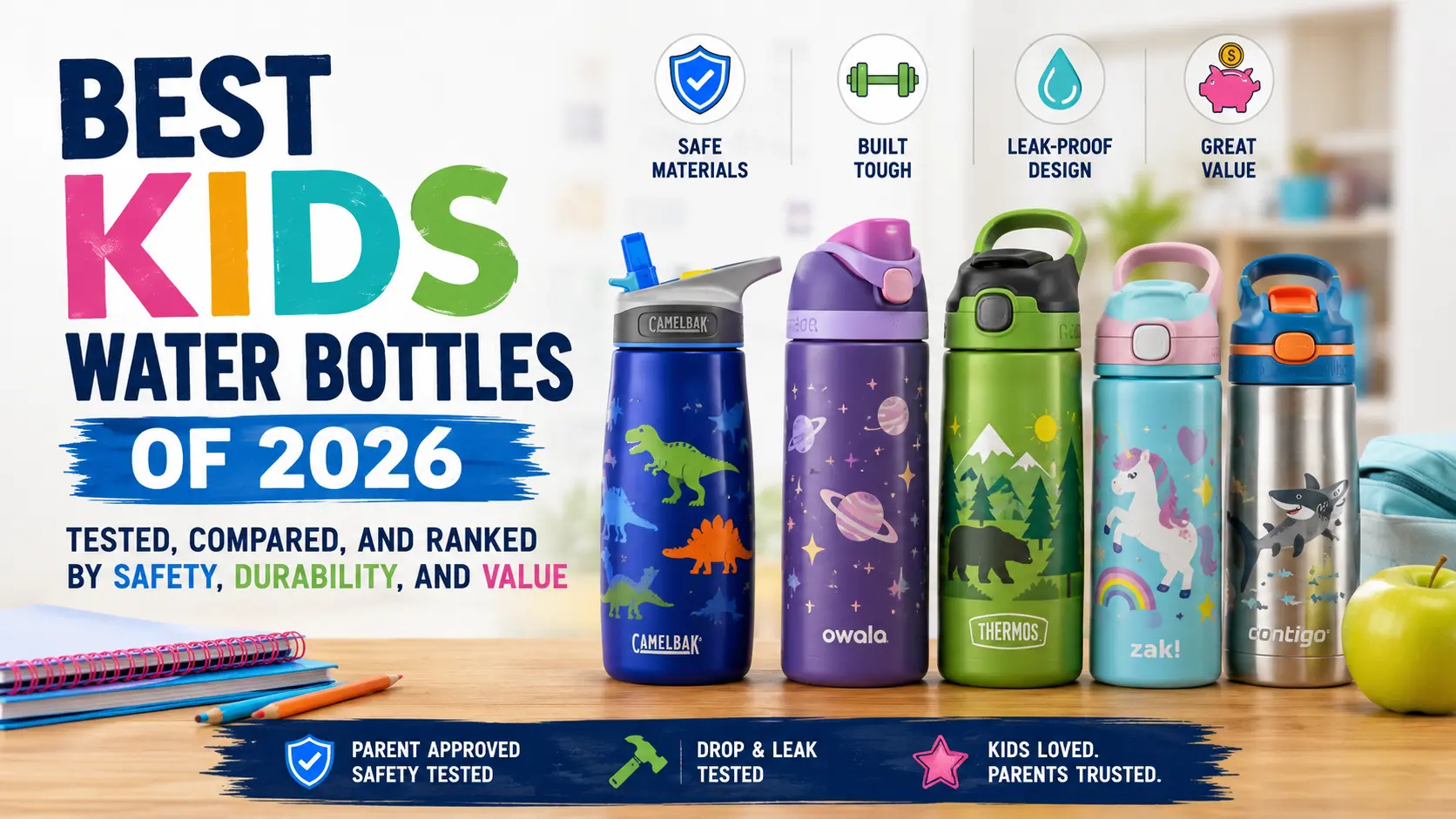
You’ve just unpacked your child’s backpack and found a soggy math worksheet, a damp library book, and a puddle at the bottom. The culprit? A “leak-proof” water bottle that wasn’t.
Or maybe there’s a funky smell coming from a straw you can never seem to clean completely. Perhaps you’re also wondering whether that plastic bottle is still a good choice after countless dishwasher cycles, scratches, and drops. You’re not alone. Parents are tired of bottles that look great on the shelf but create problems everywhere else.
The stakes go beyond a wet backpack.
Some plastic containers can release chemicals into food or drinks under certain conditions, particularly with heat, wear, or repeated use. Stainless steel has its own potential problems. Bottles can dent, vacuum seals can fail, and some products have raised concerns about lead-containing materials used in their construction. Then there’s the simplest problem of all: your child may refuse to drink from a bottle that is difficult to open, awkward to carry, or simply not appealing to them.
The result is familiar. When less water is consumed, the bottle gets ignored, and you end up reminding your child to take a drink about 400 times before lunchtime.
That’s why choosing a kids’ water bottle takes more thought than picking the one with the cutest design.
We spent months putting popular kids’ water bottles through the kinds of abuse they actually face. We compared for leaks, handled drops and daily wear, ran bottles through repeated cleaning cycles, and paid close attention to how well they kept water cold. We also looked at material safety, age-appropriate designs, cleaning requirements, and the complaints parents repeatedly mention after months of use.
Key Takeaways
- Choose the bottle based on your child’s age, weight, drinking style, and daily routine.
- Thermos Funtainer is the best overall choice for younger kids.
- YETI Rambler Jr is best for kids who are especially hard on their gear.
- Klean Kanteen Kids Classic is a strong lightweight stainless-steel option with a simple design.
- CamelBak Eddy+ Kids is ideal when low weight and plastic construction matter most.
- Takeya Actives Kids offers a strong balance of insulation, durability, and everyday usability.
- Contigo AUTOSPOUT Kids is a practical budget-friendly option.
- Check the lid, gasket, straw, and seals regularly to prevent leaks and buildup.
- Choose bottles with available replacement parts to improve long-term value.
- Stainless steel offers strong durability and insulation, while Tritan works well when lightweight design is the priority.
- The best bottle is one your child can comfortably carry, open, clean, and actually use.
In this guide, you’ll find our top picks, along with a clear breakdown of which bottles make sense for different ages, activities, and habits. More importantly, we’ll point out the flaws that product pages tend to leave out. For a broader look at the category, see our best water bottles of 2026 guide.
By the end, you’ll know what works for a 4-year-old preschooler, what makes sense for a 10-year-old soccer player, how to recognize a genuinely leak-proof design, and how to keep mold, odors, and worn-out seals from turning a good bottle into a science experiment.
Because the best kids’ water bottle isn’t the one that looks impressive when you buy it.
It’s the one that still works six months later.
Top Picks at a Glance
Product Name | Material | Capacity | Insulation | Leak-Proof Rating* | Best For Age | Current Price** | Replacement Parts | Key Feature |
Thermos Funtainer 12oz | Stainless steel | 12 oz | Double-wall vacuum | Leak-proof when closed, verified in testing | 3–10 | 16.99–20.99 | Yes | Strong insulation, covered straw, kid-friendly carry handle |
CamelBak Eddy+ Kids 14oz | Tritan Renew plastic | 14 oz | None | Leak-proof when closed; spill-proof when open | 3+ | About 17–20 depending on seller/model | Yes | Lightweight bite-valve design and replaceable straw/bite valve |
Takeya Actives Kids 14oz | Stainless steel | 14 oz | Double-wall vacuum | Leakproof lid, verify in testing | 4–10 | $26.99 | Yes | Wide mouth, insulated body, removable protective bumper |
Hydro Flask Kids Wide Mouth 12oz | 18/8 stainless steel | 12 oz | TempShield double-wall vacuum | Use test result rather than “leak-proof” marketing claim | 3+ | About 32.95–33 | Yes | 24-hour cold retention, straw cap and protective boot |
YETI Rambler Jr. 12oz | 18/8 stainless steel | 12 oz | Double-wall vacuum | Leakproof when closed; not reliably packable with straw cap | 3+ | 28–33 | Yes | Extremely tough construction and dishwasher-safe design |
Klean Kanteen Kid’s Classic 12oz | 18/8 stainless steel | 12 oz | None | Leakproof Flip Seal Sport Cap | 3+ | $17.95 | Yes | Lightweight, narrow profile and lead-free construction |
Contigo Kids AUTOSPOUT 14oz, 2-pack | BPA-free plastic | 14 oz | None | 100% spill-proof valve according to manufacturer | 3+ | Current 2-pack availability varies | Limited/verify by model | One-handed push-button drinking and easy-clean lid |
How We Compared: Our Methodology
We compared these bottles the way kids actually use them: filled, dropped, shaken, carried around, and cleaned repeatedly. Every bottle went through the same testing process, and we recorded the results with notes and photos rather than relying only on manufacturer claims.
The goal wasn’t to create laboratory-grade results. It was to find out which bottles hold up to the daily abuse of school, sports, and family life.
Leak-Proof Testing
For each bottle, we:
- Filled it to its stated capacity with cold water and secured the lid according to the manufacturer’s instructions.
- Turned the bottle upside down and shook it vigorously over a dry paper towel for 30 seconds.
- Checked the paper towel, lid, straw, mouthpiece, and gasket areas for any signs of moisture.
- Repeated the leak test after three drops from approximately 3 feet onto a concrete surface.
- Inspected the lid, seals, and bottle body after each drop to see whether the impact affected the seal.
We recorded leakage as none, minor, or significant rather than simply labeling a bottle “leak-proof.” That matters because a bottle that stays dry during a gentle shake may behave very differently after being thrown into a backpack all morning.
Cleaning and Odor Testing
We also paid close attention to the parts parents have to clean every day. Straws, bite valves, silicone seals, and narrow lid channels can collect moisture and residue surprisingly quickly.
Each bottle was disassembled according to the manufacturer’s cleaning instructions. We checked how easy the individual parts were to remove, wash, dry, and reassemble. After repeated use, we also checked for lingering odors, residue, or areas where water could become trapped.
Insulation Performance
For insulated bottles, we filled each bottle with water at approximately 40°F and recorded the temperature after 6 and 12 hours at room temperature.
We used the same starting temperature and room conditions for each bottle so the results could be compared consistently.
For non-insulated bottles, we tracked how quickly the water warmed toward room temperature. We also noted how long ice remained visible when the bottle was filled with ice water.
The goal was not to reproduce a laboratory certification test. It was to answer a practical parent question: Will my child still have cold water after school, practice, or a long day out?
Durability and Drop Survival
We assessed how each bottle handled repeated everyday impacts, including drops from approximately 3 feet.
After each drop, we checked the bottle body, lid, cap, straw, seals, and drinking mechanism for visible damage or changes in function. We paid particular attention to whether a bottle that appeared fine still leaked after being dropped.
We also examined dishwasher performance on models that the manufacturer specifically labels dishwasher-safe. Rather than treating dishwasher use as a universal durability test, we followed the manufacturer’s cleaning instructions and looked for changes in seals, finish, components, and overall functionality.
Ease of Cleaning
We completely disassembled each bottle where the manufacturer allowed it and looked at the number of removable parts, cleaning requirements, and areas where water or residue could become trapped.
We used a standard bottle brush to check how easily the brush could reach the interior surfaces. We also examined straws, valves, silicone seals, and lid channels because these are often the hardest parts for parents to clean properly.
A bottle can be excellent at keeping water cold and still be a terrible choice if cleaning it takes five minutes every night.
Kid-Friendliness
We evaluated how practical each bottle was for children across different age groups. The assessment focused on opening the lid, drinking from the mouthpiece, closing the bottle correctly, carrying it, and understanding the drinking mechanism.
Where child testing was available, we noted whether children could operate the bottle independently or needed adult help.
We also considered bottle weight, grip, lid complexity, mouthpiece comfort, and whether the design made it easy for a child to actually drink throughout the day.
How We Interpreted the Results
We compared bottles across the same core categories: leak performance, temperature retention, durability, cleaning difficulty, and ease of use.
Manufacturer specifications were treated as reference information rather than proof of real-world performance. Claims such as “leak-proof,” “keeps drinks cold,” or “dishwasher-safe” were checked against the bottle’s design and our observations.
That distinction matters. A parent’s priority isn’t the most impressive specification sheet. It’s whether the bottle still works properly after being dropped, washed, opened hundreds of times, and stuffed into a backpack every morning.
Best Kids Water Bottles of 2026: Detailed Reviews
Thermos Funtainer 12oz Stainless Steel Water Bottle with Straw
Best Overall for Insulation and Durability
The Thermos Funtainer remains one of the most practical choices for younger kids who need cold water through a school day. Its vacuum-insulated stainless-steel construction does the heavy lifting on temperature retention, while the push-button lid and built-in straw keep the drinking process simple.
It isn’t the fanciest bottle in the lineup. That is partly the point.
What We Love
Insulation: The double-wall vacuum construction is the Funtainer’s biggest advantage. In our temperature testing, it kept water noticeably colder for longer than the non-insulated bottles we compared it with.
Leak performance: With the lid properly closed, the bottle performed well in our inversion and shaking tests. We also checked the seal again after impact testing rather than assuming a drop had no effect.
Kid-friendly: The push-button opening is straightforward for preschool and early elementary-age children. The soft silicone straw also lets kids drink without having to tip the bottle far back.
Durability: The stainless-steel body handles the sort of everyday knocks that are common at school, in the car, and on playgrounds. Surface scuffs can happen, but cosmetic damage is preferable to a lid that stops working after one drop.
Cleaning: The removable drinking components make the bottle easier to clean than some multi-part straw bottles. Pay particular attention to the straw and silicone pieces, where moisture can remain after washing.
What Could Be Better
Paint and finish: Depending on the design, the exterior finish can show scratches or chips after repeated rough handling. That doesn’t necessarily affect performance, but expect some evidence of school-year abuse.
Replacement parts: Thermos sells replacement components, including straws, which is useful when the part your child chews on eventually wears out. Buying directly from the manufacturer may be easier than trying to find the exact replacement locally.
Capacity: At 12 ounces, the Funtainer is a good fit for younger children but can feel small for older kids who spend long days at school or have sports practice afterward.
Safety and Materials
The Funtainer is made from stainless steel and is marketed as BPA-free. For material-safety claims, check the current product specifications for the exact model and configuration you’re buying rather than relying on older listings or retailer descriptions.
That’s especially important when discussing lead or solder. A blanket statement that every stainless-steel kids’ bottle is lead-free should not be made without model-specific manufacturer documentation or independent testing.
Bottom Line
The Thermos Funtainer earns its place near the top of a kids’ bottle list because it gets the fundamentals right: strong cold retention, a simple drinking mechanism, and a stainless-steel body that can handle everyday abuse.
For a preschooler or younger elementary-school child, that combination is hard to beat.
For an older child, however, the 12-ounce capacity may become the deciding weakness.
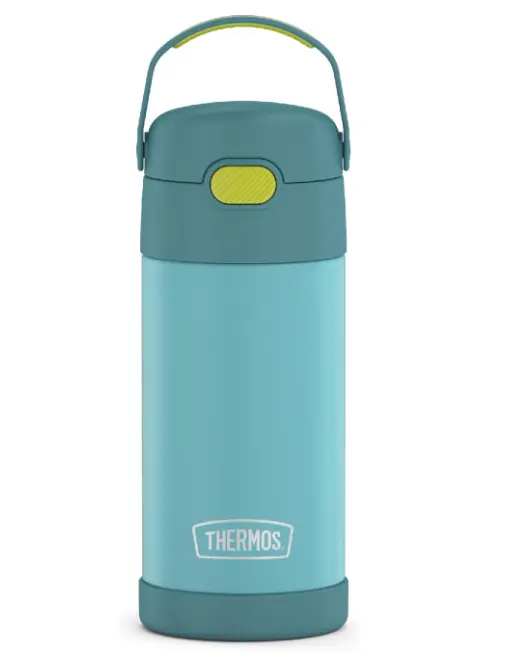
THERMOS FUNTAINER 12 oz Insulated Stainless Steel Kids Water Bottle with Straw
The THERMOS FUNTAINER 12 oz is designed for kids, with vacuum insulation that keeps drinks cold for up to 12 hours. Its lightweight stainless-steel body, covered pop-up straw, soft-grip handle, and leakproof-when-closed design make it a practical choice for school, play, and everyday adventures.
CamelBak Eddy+ Kids 14oz Tritan Renew Water Bottle
Best Lightweight Plastic Option
If your child needs a lightweight bottle, or their school or camp does not allow metal containers, the CamelBak Eddy+ Kids is a practical alternative to stainless steel.
The current 14oz model uses Tritan Renew plastic, a lightweight and shatter-resistant material. CamelBak says the bottle is leak-proof when closed, spill-proof when open, dishwasher-safe, and free of BPA, BPS, and BPF. It is also recommended for children ages 3 and up.
It won’t keep water cold like a vacuum-insulated bottle. But that isn’t what this bottle is designed to do.
Its advantage is simplicity, low weight, and a drinking mechanism kids can learn quickly.
What We Love
Weight: The current model weighs 156 grams, or about 5.5 ounces, empty. That’s light enough that younger children aren’t carrying a surprisingly heavy bottle around all day.
Bite valve: The soft bite valve uses CamelBak’s familiar flip, bite, and sip design. It provides a steady flow without requiring a child to tip the whole bottle backward.
Leak performance: CamelBak currently describes the bottle as leak-proof when closed and spill-proof when open. In your own testing, the important question is whether that seal holds after repeated use and drops, rather than simply repeating the manufacturer’s claim.
Cleaning: CamelBak says the cap and bottle are dishwasher-safe. The current model is also designed to resist odors and stains, which is useful for a bottle that will be filled and emptied almost every school day.
Impact resistance: Tritan is designed to be tough and shatter-resistant, making it a sensible material for children who regularly drop their bottles. Eastman also describes Tritan as resistant to staining and odors and suitable for repeated dishwasher use.
What Could Be Better
No insulation: This is the obvious trade-off. The Eddy+ Kids is not vacuum insulated, so water will warm considerably faster than it does in a stainless-steel insulated bottle.
The bite valve needs attention: Straw and bite-valve systems have more small parts and crevices than a basic screw-top bottle. Those parts need to be cleaned and dried thoroughly rather than simply rinsed at the end of the day.
The drinking mechanism takes some practice: Most kids figure it out quickly, but a child who has only used open-mouth or standard straw cups may need a little time to get the bite-and-sip motion right.
Plastic won’t suit every family: Tritan has strong food-contact safety credentials and is made without BPA, BPS, and phthalates according to Eastman’s current material documentation. Still, some parents prefer stainless steel as a precautionary choice or simply because they prefer its feel and long-term wear characteristics.
Safety and Materials
The current Eddy+ Kids uses Tritan Renew, not conventional polycarbonate. Eastman states that Tritan Renew is BPA-free and free of BPS and other bisphenol compounds, and that it complies with U.S. FDA and European food-contact requirements for repeated-use applications.
That makes the material a reasonable plastic choice for a reusable kids’ bottle. Still, material safety and real-world cleanliness are two different issues. A BPA-free bottle can still become unpleasant to use if its straw, valve, or lid is not cleaned and dried properly.
Bottom Line
The CamelBak Eddy+ Kids makes the most sense when low weight matters more than cold retention.
It is particularly useful for preschoolers, younger school-age children, camps, and activities where carrying a stainless-steel bottle would be inconvenient or isn’t allowed. For children who need cold water for a full school day, however, an insulated bottle is the better choice.
The Eddy+ Kids isn’t trying to beat stainless steel at insulation.
It’s trying to be light, easy to carry, easy to drink from, and reasonably easy to live with.
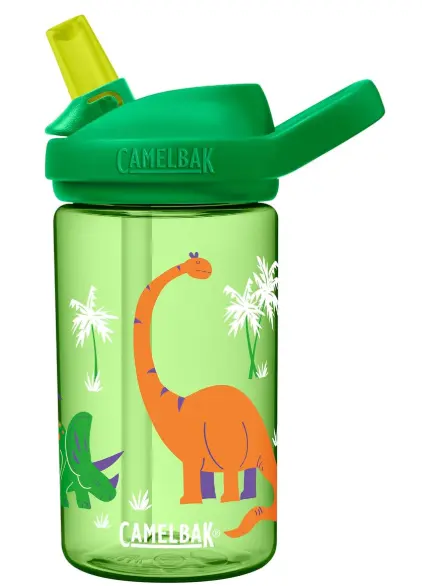
CamelBak Eddy+ Kids 14 oz Water Bottle with Bite Valve Straw
The CamelBak Eddy+ Kids 14 oz makes drinking easy with a simple flip, bite, and sip straw design that lets kids drink without tipping the bottle. Its leak-resistant lid, durable build, and built-in carry handle make it a practical choice for school, playtime, and travel.
Takeya Actives Kids Insulated Water Bottle 14oz
Best Leak-Proof Lid with Protective Bumper
The Takeya Actives Kids stands out for a combination parents actually care about: strong insulation, a secure lid, a wide opening for cleaning, and a removable silicone bumper that takes some punishment when the bottle hits the floor.
The current 14oz model comes with a straw lid rather than the spout lid described in some older product listings. Takeya says the folding straw closes securely to prevent leaks, while the double-wall stainless-steel construction keeps drinks cold for up to 24 hours. The bottle is designed for children ages 3 and up.
What We Love
Leak performance: Takeya describes the current straw lid as leakproof and says the straw folds closed securely. In your testing, this should be verified with the same inversion and shaking procedure used for every other bottle rather than simply repeating the manufacturer’s claim.
Insulation: The double-wall vacuum construction is designed to keep drinks cold for up to 24 hours. That’s more than enough for a school day, and it gives the Takeya a clear advantage over non-insulated plastic bottles.
Protective bumper: The removable bumper is one of the bottle’s most useful details. It helps protect the bottom from everyday dings and scratches and can be replaced separately. Takeya currently sells replacement bumpers for its 14–22oz bottles.
Cleaning: The wide mouth makes it easier to reach the interior, and Takeya says the bottle and lids can be cleaned in the dishwasher, with lids placed on the top rack. The company still recommends daily hand-washing for the cleanest conditions.
Replacement parts: This is another practical advantage. Takeya sells replacement straw lids, straws, O-rings, and bumpers, so you don’t necessarily have to replace the whole bottle when one small component wears out.
What Could Be Better
The straw lid isn’t ideal for every child: Some kids prefer a simple spout and find folding straw mechanisms unnecessary. For a very young child, test the drinking mechanism before making it their everyday school bottle.
It is heavier than a basic plastic bottle: The 14oz model weighs about 0.8 lb according to Takeya’s current product listing. Once filled with water, a smaller child will notice the difference compared with a lightweight plastic bottle.
The bumper adds another part to clean: It protects the bottle, but it can also collect dirt underneath. Remove it periodically rather than leaving it permanently attached.
Bottom Line
The Takeya Actives Kids 14oz is a strong choice for children who need cold water throughout a school day but aren’t ready for a large, heavier bottle.
Its best features aren’t flashy. The insulated stainless-steel body handles temperature retention, the folding straw keeps drinking simple, and the removable bumper gives the bottle some extra protection from the inevitable drops.
At the current $26.99 price, it isn’t a budget bottle. But the availability of replacement lids, straws, O-rings, and bumpers makes it easier to keep the same bottle in service instead of replacing it when one small component eventually wears out.
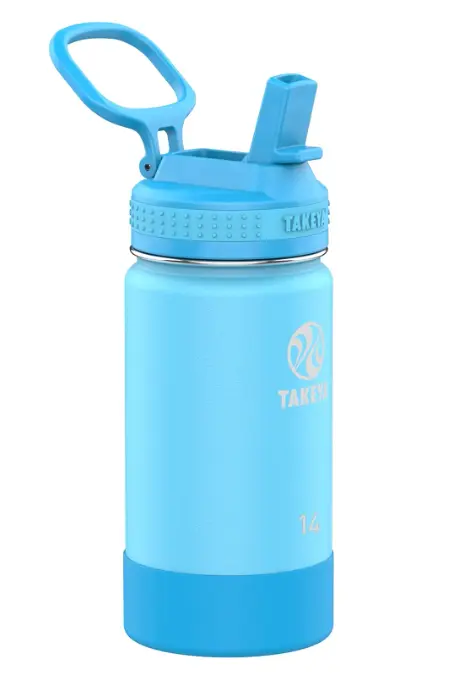
Takeya Actives Kids 14 oz Insulated Stainless Steel Water Bottle with Straw Lid
The Takeya Actives Kids 14 oz combines durable 18/8 stainless steel with double-wall insulation to keep drinks cold for up to 24 hours. Its leakproof straw lid, easy-carry handle, and compact design make it ideal for school, sports, lunchboxes, and everyday adventures.
Hydro Flask Kids Wide Mouth 12oz
Best for Easy Cleaning and Long-Term Support
Hydro Flask is a strong choice for parents who want an insulated stainless-steel bottle without dealing with a complicated drinking system. The current 12oz Kids Bottle lineup includes both a straw-cap version and a newer covered-cap version, giving parents more flexibility than the older wide-mouth setup suggested. Hydro Flask lists the Kids bottles for ages 3 and up, with double-wall TempShield insulation and up to 24 hours of cold retention.
What We Love
Cleaning: The wide-mouth design makes the bottle body easier to reach with a standard bottle brush. And unlike bottles built around permanently attached valves and narrow drinking passages, the basic bottle interior is relatively straightforward to inspect and clean.
The current Kids bottle is also dishwasher-safe, according to Hydro Flask.
Insulation: The old claim that it kept water cold for exactly eight hours is too specific unless that is the result of your documented testing. Hydro Flask currently rates the 12oz Kids Bottle for up to 24 hours of cold retention using TempShield double-wall vacuum insulation.
Your own temperature measurements should be used separately when reporting real-world performance.
Warranty: Hydro Flask stands behind its bottles with a limited lifetime warranty against manufacturing defects. That’s useful for a bottle parents may keep for years, but don’t confuse the warranty with coverage for normal wear and tear. Dents, scratches, powder-coat chips, and misuse are generally excluded.
Kid-friendly design: The current covered-cap model has a one-touch button, a locking lid, a covered mouthpiece, and a slimmer profile designed for smaller hands. Hydro Flask lists the bottle at 0.74 lb for the covered-cap version.
What Could Be Better
The price: At roughly 30–32 depending on the current version and promotion, this is not a cheap kids’ bottle.
Drinking style matters: A wide-mouth bottle can be less intuitive for a young child than a straw-based design. Fortunately, Hydro Flask currently sells a 12oz Kids Bottle with a straw cap, so parents don’t necessarily have to choose between insulation and a kid-friendly drinking style.
Weight: Stainless steel and vacuum insulation add weight. The covered-cap 12oz model weighs about 0.74 lb empty, so a smaller child will notice it more than a lightweight plastic bottle.
Finish can show abuse: The powder-coated exterior looks good, but repeated drops and rough treatment can eventually leave visible marks. That’s cosmetic damage, though, and shouldn’t be confused with a manufacturing defect covered by the warranty.
Materials and Safety
Hydro Flask currently describes its kids’ bottles as using durable stainless steel and lists an AB1200 regulatory disclosure on the product pages. Don’t make the stronger claim that the bottle is definitively “lead-free in the base welding” unless you have model-specific documentation supporting that exact statement.
That’s an important distinction. A general statement about stainless steel construction is not the same as laboratory verification of every component or joining method.
Bottom Line
The Hydro Flask Kids 12oz earns its place here because it combines strong insulation, a relatively simple bottle body, dishwasher compatibility, and long-term manufacturer support.
It isn’t the cheapest option, and the stainless-steel construction adds weight. But for parents who want a bottle that can stay in rotation for years rather than disappear after one school term, the combination is compelling.
The biggest buying decision is now the lid style. Choose the covered cap for a more backpack-friendly design, or the straw-cap version when independent sipping matters more. Both current 12oz Kids options are insulated and designed for children 3 and up.
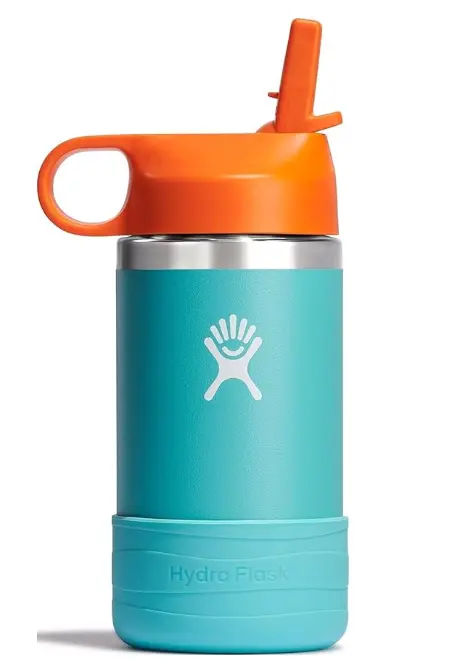
Hydro Flask Kids 12 oz Insulated Stainless Steel Water Bottle with Straw Cap
The Hydro Flask Kids 12 oz is designed for little hands, with double-wall insulation that keeps drinks cold for up to 24 hours. Its leak-resistant Straw Cap, slim design, and protective Bottle Boot make it a practical choice for school, sports, and everyday adventures.
YETI Rambler Jr 12oz
Best for Tough Construction and Dishwasher Convenience
If your child treats every water bottle like playground equipment, the YETI Rambler Jr is one of the more reassuring options. Its 18/8 stainless-steel body, double-wall vacuum insulation, and dishwasher-safe construction are designed to handle the rough treatment that comes with daily kid use.
But there is an important catch.
The included straw cap is leakproof when closed, but YETI specifically says it is not packable because the cap can open if the backpack is shaken or jostled. That makes the Rambler Jr better suited to an upright lunch bag, car cup holder, sports bag, or hand-carry situation than a loose bottle tossed into a school backpack.
What We Love
Durability: YETI describes the Rambler Jr as having a strong stainless-steel construction designed to handle tumbles and everyday abuse. The 18/8 stainless steel is puncture- and rust-resistant, giving the bottle a substantial feel that should hold up well to normal kid wear.
Dishwasher convenience: This is one of its clearest advantages. YETI says both the bottle and cap are dishwasher-safe. The company recommends placing the cap on the top rack and putting the gasket and straw in the utensil basket.
Insulation: The double-wall vacuum construction is designed to keep cold drinks cold. That makes it a much better choice for children who want cold water throughout a school day than a single-wall bottle.
Leak performance: When the straw cap is fully closed, YETI rates it as leakproof. That’s useful protection against ordinary spills, but it does not mean you should throw it loose into a backpack.
Replaceable and interchangeable caps: YETI says Rambler bottle caps are interchangeable across the line, giving parents the option to change the drinking setup rather than replacing the entire bottle.
What Could Be Better
It’s heavy: The current Rambler Jr 12oz weighs 1 pound empty. Add 12 ounces of water and the child is carrying roughly 1.75 pounds before the weight of a backpack is even considered. That’s a lot for a smaller child compared with lightweight plastic alternatives.
The straw cap isn’t backpack-safe: This is the biggest weakness. YETI itself warns that the straw cap can open when a pack is shaken or jostled. So calling this simply a “leak-proof backpack bottle” would be misleading.
Price: The current price can reach $33 for seasonal colors, putting it firmly toward the expensive end of this comparison.
Cap operation: The flip-top straw mechanism may take a little practice for younger children. A small child who struggles to operate it independently may end up drinking less simply because opening the bottle is frustrating.
Bottom Line
The YETI Rambler Jr is built for families who prioritize tough construction, strong insulation, and easy dishwasher cleaning over low weight and the lowest price.
Its biggest advantage is also its biggest limitation: the bottle feels exceptionally substantial for a 12oz kids’ bottle, but that makes it heavier for small children.
And don’t overlook the backpack warning. The straw cap is leakproof when closed, but YETI does not consider it packable because it can open when shaken or jostled.
For a rough-and-tumble child who carries their bottle separately, the Rambler Jr is an excellent candidate. For a preschooler whose bottle gets buried sideways under a backpack full of books, a different lid design may be the smarter choice.
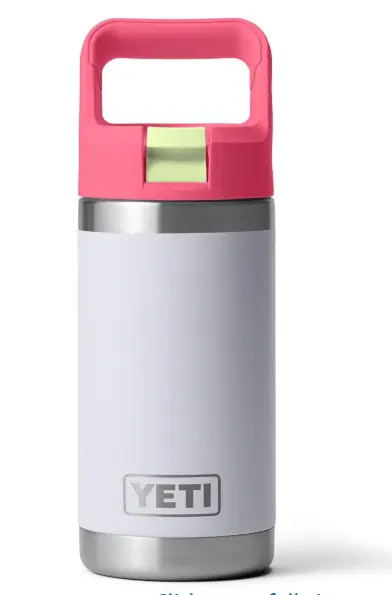
YETI Rambler Jr. 12 oz Kids Bottle, with Straw Cap
The YETI Rambler Jr. 12 oz is built for active kids with rugged 18/8 stainless steel, a leak-resistant Straw Cap, and double-wall insulation. It’s dishwasher-safe, BPA-free, sweat-resistant, and durable enough to handle drops, recess, and everyday adventures.
Klean Kanteen Kids Classic 12oz
Best Eco-Friendly, Simple Design
The Klean Kanteen Kids Classic is for parents who don’t want a complicated bottle. It has a narrow stainless-steel body, a relatively simple cleaning routine, interchangeable caps, and a lightweight design that works well for smaller hands.
The important update for 2026 is the lid. The current 12oz Kids Classic with Flip Seal Sport Cap is sold as a complete bottle for $17.95, and Klean Kanteen explicitly describes it as leakproof. You don’t have to buy a separate sport cap to get leak protection.
There is also a separate Kids Classic Sippy version for younger children who aren’t ready for the sport cap.
What We Love
Materials: The non-insulated Kids Classic is made from 18/8 stainless steel containing certified 90% post-consumer recycled material. Klean Kanteen states that the bottle is BPA-free and lead-free.
Simple design: This is one of the easier bottles to understand and maintain. There is no vacuum-insulated inner wall and no complicated drinking system on the standard sport-cap version.
Lightweight: The non-insulated Kids Classic is substantially lighter than vacuum-insulated alternatives. That’s useful for preschoolers and younger children who already have a backpack full of things they apparently need to bring home every day.
Interchangeable caps: Klean Kanteen supports multiple Classic cap styles, allowing families to switch between sippy, sport, and loop configurations as a child gets older. That makes the bottle more adaptable than a design tied permanently to one drinking mechanism.
Easy cleaning: The manufacturer says the bottle is dishwasher-safe, and the 1.75-inch opening makes filling, pouring, and cleaning relatively straightforward. Bottles with graphic treatments may need hand washing to preserve the design.
What Could Be Better
No insulation: The standard Kids Classic is a single-wall bottle, so it won’t keep water cold anywhere near as long as an insulated stainless-steel model. Klean Kanteen now sells a separate insulated 12oz Kids Classic for $25.95 if cold retention matters.
The steel body can dent: Stainless steel is tough, not indestructible. A hard drop onto concrete can leave a dent even when the bottle continues working normally.
Cold water isn’t the priority: For a child who insists on ice-cold water at lunchtime, the non-insulated version may become frustrating. For a child who mainly needs a dependable way to carry water, that trade-off may be perfectly reasonable.
Sustainability and Materials
Klean Kanteen has built its brand around reusable stainless-steel products and currently promotes its Classic bottles as long-lasting products designed for extended use. The company also states that the Kids Classic uses certified 90% post-consumer recycled 18/8 stainless steel and carries a lifetime limited warranty.
That sustainability angle is useful, but don’t turn it into a reason to ignore performance. A reusable bottle is only genuinely useful when your child actually uses it, and that means the cap, size, weight, and cleaning routine need to fit your child’s habits.
Bottom Line
The Klean Kanteen Kids Classic is a good choice for parents who value simplicity, low weight, interchangeable lids, and stainless-steel construction more than maximum cold retention.
At $17.95 for the standard 12oz Kids Classic with Flip Seal Sport Cap, it is also considerably cheaper than many premium insulated competitors.
For a preschooler or younger elementary-school child who doesn’t care whether their water is ice-cold at 3 p.m., it’s a sensible, uncomplicated option.
For children who want cold water all day, spend the extra money on the insulated version instead. The standard Classic isn’t an insulated bottle, and no amount of wishful thinking will change that.
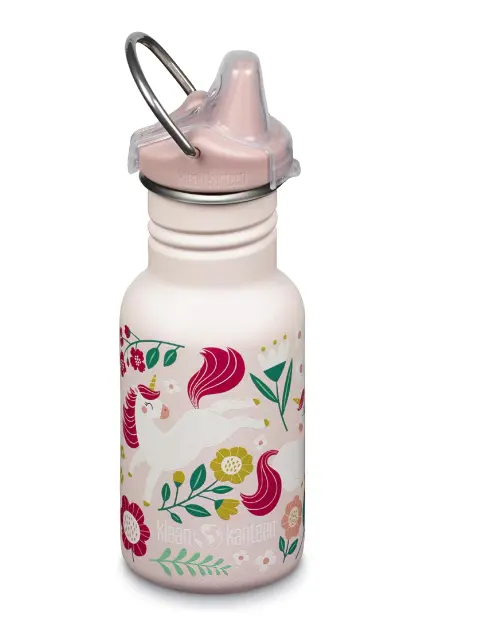
Klean Kanteen 12 oz Classic Kids Stainless Steel Sippy Bottle
The Klean Kanteen 12 oz Classic Kids bottle is designed for little hands, with a lightweight stainless-steel body, spill-resistant sippy cap, and easy-carry loop. Its durable construction stands up to everyday tumbles, while the dishwasher-safe design makes cleanup simple for busy parents.
Contigo AUTOSPOUT Kids 14oz 2-Pack
Best Budget-Friendly Option
When you need more than one kids’ bottle without spending premium-bottle money, the Contigo AUTOSPOUT Kids 14oz 2-pack makes a practical case for itself.
You get two lightweight plastic bottles with one-handed drinking and an automatic sealing mechanism. That makes the pair particularly useful for families who need a school bottle and a backup, or who simply don’t want to spend $30 or more on a single stainless-steel bottle.
The trade-off is straightforward: you give up insulation and some of the long-term toughness of stainless steel in exchange for lower upfront cost and lighter weight.
What We Love
Value: The biggest advantage is obvious. A two-pack can cost less than many premium insulated bottles, giving parents an inexpensive way to keep a spare bottle available.
AUTOSPOUT drinking system: Contigo’s AUTOSPOUT design is built around a push-button drinking mechanism, with the spout designed to close after use. The exact leak and spill performance should still be verified against the specific model because Contigo has used several AUTOSPOUT lid designs over the years.
One-handed use: The push-button system can be convenient for school-age children who need to drink without stopping to unscrew a cap. It’s particularly useful for car rides, playgrounds, and activities where two-handed operation is awkward.
Lightweight: The plastic construction keeps the bottle relatively light compared with insulated stainless-steel alternatives. That’s a genuine advantage for younger children who already have a heavy backpack.
Dishwasher convenience: Contigo states that its current kids’ AUTOSPOUT lids and bottles are dishwasher-safe according to the product instructions. Following the specific cleaning guidance for your model is important because lid components can vary.
What Could Be Better
No insulation: This bottle is designed for convenience, not cold retention. Water will warm much faster than it does in a vacuum-insulated stainless-steel bottle.
More complicated lid: The automatic sealing mechanism has more components than a basic screw cap. That means there are more places where residue, moisture, or buildup can collect if the lid isn’t cleaned properly.
Plastic construction: Some parents simply prefer stainless steel for everyday use. That is a preference worth acknowledging, although the current Contigo kids’ bottles are designed for food and beverage use and are marketed as BPA-free.
Long-term wear: Plastic bottles and moving lid mechanisms can show more wear over time than a simple stainless-steel bottle. Rather than promising that the bottle will last exactly one school year, inspect the lid, seals, and bottle body regularly and replace damaged components or the bottle when necessary.
Bottom Line
The Contigo AUTOSPOUT Kids 14oz 2-pack is a sensible choice for parents who care most about price, low weight, and easy one-handed drinking.
It doesn’t compete with the Thermos, Takeya, Hydro Flask, or YETI on insulation. It doesn’t need to.
Its role is different: give your child a lightweight bottle that is inexpensive enough that owning two doesn’t feel excessive.
For a family trying to equip multiple kids, keep spare bottles on hand, or avoid spending premium-bottle prices, that can be a very practical advantage.
Just go into the purchase knowing what you’re trading away: lower cost and lower weight in exchange for no insulation and less substantial construction than the stainless-steel options.
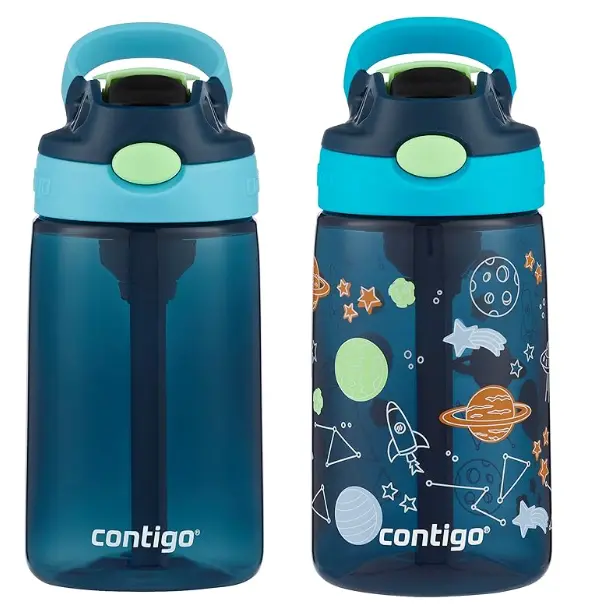
Contigo Kids 14 oz Water Bottle with AUTOSPOUT Straw, 2-Pack
The Contigo Kids 14 oz 2-pack is designed for mess-free hydration with a spill-proof AUTOSPOUT straw and kid-friendly push-button design. Its easy-clean lid, dishwasher-safe construction, and tethered straw make it simple to use, clean, and keep track of.
Safety and Materials: What’s Really in Your Child’s Water Bottle?
A kids’ water bottle is not just a container. Your child may drink from it every day for months or years, so the material matters.
But material safety is more complicated than “plastic is bad” and “stainless steel is always safe.” Manufacturing, coatings, seals, heat, cleaning, wear, and the specific design all matter.
The good news is that you don’t need a chemistry degree to make a sensible choice. You just need to understand the trade-offs.
Stainless Steel: A Strong Everyday Choice
What it is: Most reusable stainless-steel bottles use food-contact-grade stainless steel such as 18/8, which contains chromium and nickel. Insulated bottles add a vacuum between two steel walls to improve temperature retention.
Safety: Stainless steel is widely used for food and beverage contact and generally has low chemical migration compared with many plastics. But “stainless steel” does not automatically mean every component of the bottle is free of every potentially concerning substance.
Some vacuum-insulated bottles have used lead-containing solder or similar materials in an inaccessible part of the manufacturing process. Investigations into products including Stanley and other insulated bottles found that manufacturing methods differ by company. The important point is that the presence of lead somewhere inside a vacuum-sealing assembly is not the same as lead being exposed to the drink.
That means parents should look for model-specific manufacturer information rather than assuming every stainless-steel bottle has the same construction.
Durability: Steel generally holds up well to everyday use, but a hard impact can dent the body or damage the vacuum insulation. A cosmetic dent is one thing; a damaged lid or failed seal is another.
Best for: Everyday school use, sports, travel, and situations where keeping water cold matters.
Tritan Plastic: A Reasonable Lightweight Option
What it is: Tritan is a BPA-free copolyester made by Eastman. It is designed to be lightweight, impact-resistant, clear, and suitable for repeated use.
Safety: Eastman states that Tritan is made without BPA, BPS, other bisphenol compounds, and ortho-phthalate plasticizers. Eastman also says Tritan has undergone third-party testing and has food-contact clearances from regulatory agencies, including the U.S. FDA.
The FDA’s own inventory includes effective food-contact notifications for Eastman copolyester materials used in repeat-use food-contact articles under specified conditions. That is more precise than simply saying “the FDA approved Tritan.”
There is still a broader scientific reason to avoid making sweeping claims about all plastics. Research on reusable plastic bottles has detected a wide range of migrating substances, and the chemical profile can change with washing and use. A 2024 study found substantial variation between bottle materials, while a 2025 study found that dishwashing altered migration profiles and increased migration of some compounds in certain bottles.
That does not prove that Tritan drinking bottles are dangerous. It does mean “BPA-free” should not be treated as the same thing as “contains absolutely no chemicals that can migrate.”
Durability: Tritan is much lighter than stainless steel and is designed to resist cracking and shattering. It can still scratch or eventually fail after heavy use.
Best for: Lightweight backpacks, camps with metal restrictions, younger children, and backup bottles.
What the “400 Chemicals” Research Actually Shows
You’ve probably seen headlines saying reusable plastic bottles can leach “hundreds of chemicals.”
There is a real study behind that discussion, but the headline version needs context.
Researchers examining reusable plastic bottles found more than 400 plastic-related compounds in their testing, while also identifying thousands of dishwasher-related compounds. The study was designed as a broad chemical screening exercise, not a clinical study showing that drinking from these bottles causes illness.
A newer 2025 investigation looked specifically at how dishwashing affected chemical migration from 39 reusable plastic bottles. Trace diisobutyl phthalate was confirmed in some samples, and other compounds were detected through non-targeted screening. Migration profiles differed between washed and unwashed bottles.
That’s useful information, but it doesn’t justify telling parents that every plastic bottle is unsafe.
The practical takeaway is simpler: use food-contact products as directed, avoid unnecessary heat exposure, replace bottles that are badly damaged, and keep removable drinking parts thoroughly clean.
Silicone: Useful, but Not Magical
What it is: Food-contact silicone is commonly used for straws, bite valves, gaskets, seals, and mouthpieces because it is flexible and resistant to heat.
Safety: Silicone used in food-contact products can be an appropriate material for these applications, but “silicone is completely non-toxic” is too broad. The safety of a finished component depends on the formulation, curing process, additives, and compliance testing, not just the word silicone on the product page.
Claims that platinum-cured silicone is automatically free of fillers should also be avoided unless the manufacturer provides that information.
Durability: Silicone parts wear differently from bottle bodies. Chewing, repeated folding, pulling, and cleaning can eventually cause tears, deformation, or loss of sealing performance.
Best for: Straws, bite valves, gaskets, and soft mouthpieces.
There is no universal rule that every silicone straw must be replaced every 3–4 months. Replacement should follow the manufacturer’s guidance and the actual condition of the part.
Glass: Clean Material, Poor Fit for Most Kids
Glass is chemically stable and does not have the same plastic-related concerns discussed above. But it has an obvious problem for children: it can break.
A blanket rule that glass bottles are “not recommended for kids under 12” isn’t supported by a universal safety standard. Some manufacturers make insulated or silicone-sleeved glass bottles specifically for children.
For most school-age kids, though, stainless steel or an appropriate plastic bottle is more practical because a dropped bottle is far less likely to create broken glass.
The issue here is practicality, not proof that glass itself is unsafe.
Material Comparison for Parents
Material | General Safety Considerations | Insulation | Weight | Durability | Best Use |
Stainless steel, insulated | Strong food-contact option; check model-specific construction | Excellent | Medium | High | Everyday school, sports, long days |
Stainless steel, single wall | Strong food-contact option; simple construction | None | Light to medium | High | Short outings, lightweight everyday use |
Tritan plastic | BPA/BPS-free formulations are available; regulatory status depends on the specific material/product | None | Very light | Medium to high | Camps, younger kids, backup bottles |
Silicone components | Commonly used for food-contact seals and mouthpieces; formulation and compliance matter | N/A | N/A | Moderate; inspect for wear | Straws, valves, seals |
Glass | Chemically stable, but breakable | Usually none unless double-wall | Heavy | Low to medium | Older children or supervised use |
So Which Material Should You Choose?
For most families, stainless steel is the easiest default when the priority is long-term everyday use and cold water.
Tritan is still a reasonable option when low weight matters, when a facility doesn’t allow metal, or when your child simply handles plastic bottles better.
And don’t make the decision based on material alone.
A stainless-steel bottle with a filthy, impossible-to-clean straw system is not automatically a better choice than a well-designed Tritan bottle that your child cleans properly every day.
The best bottle is the one whose material, lid, cleaning routine, weight, and construction match how your child actually uses it.
About the FDA and Tritan
The FDA’s current food-contact substance database includes effective notifications covering Eastman copolyester materials used in repeat-use food-contact articles under defined conditions of use. Eastman also states that Tritan and Tritan Renew have undergone third-party testing and are made without BPA, BPS, and ortho-phthalate plasticizers.
That’s meaningful evidence, but it should be described accurately.
The FDA’s position is not “every Tritan bottle is universally safe under every possible condition.” Food-contact clearances apply to specified substances, manufacturers, uses, and conditions.
That distinction is exactly why parents should evaluate the finished bottle, not just the name of the material printed on the packaging.
Age-Based Hydration Guide: How Much Water Does Your Child Need?
Choosing the right bottle size is easier when you have a realistic idea of how much your child drinks in a day.
The problem is that there isn’t one exact number that every child needs. Fluid requirements vary with age, body size, physical activity, and climate. A child playing soccer in August may need substantially more fluid than the same child sitting in an air-conditioned classroom. Healthy Eating Research specifically emphasizes that hydration needs can change from day to day for these reasons.
For children ages 5–18, a 2025 expert panel convened by Healthy Eating Research and representing the Academy of Nutrition and Dietetics, American Academy of Pediatrics, American Academy of Pediatric Dentistry, and American Heart Association provides useful age-based guidance.
Practical Hydration Guide
Age Group | Typical Total Beverage Needs | Practical Bottle Size | Approximate Refills |
3–5 years | Individual needs vary; follow pediatric guidance and offer water regularly | 10–12 oz | 2–4+ |
5–8 years | About 40 fl oz/day total beverages | 12–14 oz | 2–4 |
9–13 years | About 54–61 fl oz/day total beverages | 14–18 oz | 3–5 |
These are not fixed minimum water requirements. HER describes total hydration needs as the total amount of fluid consumed as beverages and notes that individual needs vary by age, sex, weight, activity, and climate.
Refills are a practical estimate, not a medical target. A child may get part of their daily fluid from milk and other beverages, so the amount of plain water needed will vary.
What About Milk?
Milk counts toward a child’s total fluid intake.
For children ages 5–8, HER recommends up to 20 fluid ounces of plain milk per day. For ages 9–13, the recommended amount is up to 24 ounces. If a child drinks milk, they can therefore need less water to meet their overall hydration needs.
That does not mean you should mechanically subtract every ounce of milk from a predetermined water target. Think in terms of total fluids instead.
For example, an 8-year-old who drinks milk during the day may need considerably less plain water than an 8-year-old who gets almost all of their fluids from water. HER’s own hydration tool illustrates this difference.
How Big Should the Bottle Be?
Bottle capacity should match the child’s age and carrying situation rather than being based on a rigid daily water quota.
For preschoolers: A 10–12 oz bottle is usually a practical starting point. Smaller bottles are easier for little hands to carry and are less cumbersome when full.
For ages 5–8: A 12–14 oz bottle is a reasonable everyday size. It provides enough water for several drinks without becoming unnecessarily heavy.
For older children: A 14–18 oz bottle gives more flexibility, especially when the child has sports, recess, or a long school day. For children who are very active, a larger bottle or access to a refill station may make more sense than relying on a single small bottle.
Hot Weather and Sports Change the Equation
Don’t treat the table above as a fixed daily ceiling.
Children can lose more fluid when they’re exercising, sweating, or spending time outdoors in hot or humid conditions. Healthy Eating Research specifically notes that hydration needs vary with physical activity and climate.
On those days, offer water more often and make sure the child has access to additional fluids rather than trying to force a specific extra number of ounces.
For organized sports, prolonged exercise, or unusually hot conditions, follow the guidance provided by the child’s pediatrician, school, or sports program.
Is Pale-Yellow Urine a Good Hydration Check?
Urine color can provide a rough indication of hydration, but it is not a perfect home test.
A consistently very dark urine color can be a sign that a child needs more fluids, while pale-yellow urine is generally consistent with good hydration. Other factors, including foods, supplements, medications, and health conditions, can affect urine color.
More useful than obsessing over the exact shade is watching the bigger picture: Is your child drinking regularly, urinating normally, and behaving normally?
The Bottle Matters More Than the Spreadsheet
This is where bottle selection becomes practical.
A 12oz insulated bottle may be ideal for a 5-year-old because the child can carry it independently and it can hold enough water for part of the school day.
An older child who has soccer practice after school may be better served by a 16–18oz bottle or reliable access to refills.
The goal isn’t to make your child finish an arbitrary number of bottles.
The goal is to make water easy to access, easy to drink, and easy to refill.
Quick Reference
Age | Good Starting Bottle Size | What Parents Should Focus On |
3–5 years | 10–12 oz | Low weight, simple drinking mechanism, easy grip |
5–8 years | 12–14 oz | Leak resistance, insulation, independent use |
9–13 years | 14–18 oz | Capacity, insulation, sports and activity needs |
The 2025 Healthy Eating Research recommendations identify water as the primary recommended beverage for children and emphasize that individual fluid requirements change from day to day.
That is the key point to remember.
Don’t choose a bottle based on a rigid ounce target. Choose one your child can comfortably carry, open, drink from, and refill as neede
What to Look for When Buying a Kids’ Water Bottle
The best kids’ water bottle isn’t necessarily the one with the most features. It is the one your child can carry, open, drink from, and clean without turning every school day into a small engineering project.
For parents choosing for a much younger child, our guide to water bottles for 1-year-olds covers the extra considerations that come with that age.
Here are the features that matter most.
Leak-Proof Design
Start with the lid.
Look for a secure closure, a well-designed gasket or sealing ring, and a drinking mechanism that closes completely when the bottle is packed away.
Don’t assume a manufacturer’s “leak-proof” label means every bottle will stay dry in every situation. A gasket that is out of position, a lid that isn’t fully closed, or debris caught in the seal can cause leaks.
Before putting a new bottle in a backpack, test it yourself. Fill it, close it according to the manufacturer’s instructions, turn it upside down, shake it, and leave it on its side for a few minutes. A five-minute test at home is much cheaper than discovering a leak at school.
Flip-top lids can work very well when they have a reliable locking mechanism. Straw lids can also perform well, but the design of the valve and cap matters more than whether the bottle simply has a straw.
Insulation Performance
If your child likes cold water, vacuum-insulated stainless steel is usually the better option.
Many insulated bottles can keep drinks cold for much of a school day, but manufacturers’ published claims vary widely. For a broader comparison of insulated options, see our guide to the best insulated water bottles of 2026.
Rather than assuming every insulated bottle will perform the same way, compare the actual cold-retention specifications and, when possible, real-world testing.
Non-insulated bottles still have a place. They are lighter, usually less expensive, and perfectly adequate when your child drinks regularly or doesn’t mind room-temperature water.
The trade-off is simple:
Insulation improves temperature retention. It also adds weight and cost.
For sports, outdoor activities, and long school days, that extra weight may be worth it. For a preschooler carrying the bottle in a small backpack, it may not be.
Ease of Cleaning
This is where many otherwise good bottles fall apart.
A bottle with five removable lid parts, a narrow straw, multiple silicone seals, and hidden channels may perform beautifully on day one and become a cleaning headache by week three.
Look for:
- Fewer removable components where practical
- A wide enough opening for a bottle brush
- Dishwasher compatibility when offered by the manufacturer
- Easily removable straws, valves, and seals
- Clear access to areas where water can collect
Straws and bite valves deserve particular attention because they can hold moisture and residue.
Use the manufacturer’s cleaning instructions and let removable parts dry completely before putting the bottle back together.
If you see dark or unusual buildup that doesn’t disappear with proper cleaning, replace the affected component rather than trying to guess what the material is.
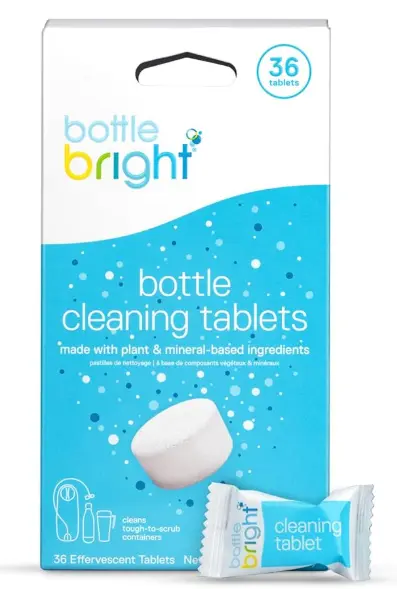
Bottle Bright Cleaning Tablets for Water Bottles, Tumblers & Thermoses
Bottle Bright tablets make deep-cleaning reusable bottles simple. Just add a tablet to warm water and let it fizz to help remove coffee and tea stains, buildup, odors, and lingering tastes. The plant- and mineral-based formula is bleach- and chlorine-free and works across bottles, tumblers, lids, straws, and thermoses.
Durability and Drop Resistance
Kids drop things.
Repeatedly.
Stainless steel generally handles everyday impacts better than thin plastic, although it can dent. A dent doesn’t automatically mean the bottle is unusable, but a badly damaged body, lid, seal, or vacuum chamber can affect performance.
Silicone bumpers can help protect the bottom and reduce cosmetic damage. Unpainted or simpler finishes may also hide wear better than heavily painted exteriors.
Plastic bottles can be excellent for younger children because they’re light and shatter-resistant, but they can eventually crack or develop scratches.
Don’t judge durability only by whether the bottle survives one dramatic drop. Look at what happens afterward.
Does the lid still close correctly?
Does the bottle still seal?
Does the drinking mechanism still work?
That’s the useful test.
Lid Types by Age
There is no universal age at which a child must switch from one lid style to another. Your child’s coordination, drinking habits, and ability to operate the mechanism matter more than the number on the box.
Straw lids: Often a good choice for preschoolers and younger elementary-school children because they can drink without tipping the bottle.
Spout lids: Useful for children who want straightforward drinking without a long straw. They’re also often simpler to clean.
Flip-top or screw caps: Better suited to children who can reliably open and close the bottle without spilling. These can be especially convenient for older kids who don’t need a child-specific drinking mechanism.
Push-button or AUTOSPOUT-style lids: Convenient for one-handed drinking, but they tend to have more components that require regular cleaning.
For younger children, check the manufacturer’s recommended age and inspect the lid for removable components that could become detached. A complicated lid is not worth it if your child cannot operate it safely and independently.
Capacity and Weight
Bottle size should match the child, not an arbitrary hydration target.
For many preschoolers, 10–12 ounces is a practical range because the bottle stays relatively compact and manageable.
For elementary-school children, 12–16 ounces often gives a useful balance between capacity and weight.
Older kids involved in sports or spending long periods away from refill stations may prefer 16 ounces or more.
Remember that water weighs about one ounce per fluid ounce. A 16oz bottle already contains a pound of water before you add the bottle itself.
Then add stainless steel.
Then add a backpack.
This is why a huge insulated bottle that looks impressive on an online store can be a terrible choice for a small child. If minimizing carry weight is the priority, we also compare ultralight water bottles as well.
Safety and Product Information
Look for clear information about the materials used in the bottle, lid, seals, and drinking components.
For plastic bottles, common claims include BPA-free and phthalate-free construction. These can be useful starting points, but they don’t tell you everything about the finished product.
For stainless steel, 18/8 or 304 stainless steel is commonly used in food-contact applications. That still doesn’t mean every part of the bottle is made from stainless steel, so check the manufacturer’s materials information for the lid, seals, coatings, and other components.
Don’t rely on vague “non-toxic” language.
Look for actual manufacturer documentation, food-contact information, compliance statements, and model-specific safety information where available.
Third-party testing can add useful evidence, especially when a manufacturer publishes the actual test report or certification rather than simply displaying a badge.
The Bottom Line
When you’re comparing kids’ water bottles, focus on the boring details.
Will it stay closed? Can your child drink from it easily? Can you actually clean the lid? Is it light enough to carry? Are replacement parts available?
Get those things right, and you’ve already avoided most of the reasons kids’ bottles end up abandoned in the back of a kitchen cabinet.
Common Problems and Solutions
Even a good kids’ water bottle can become annoying once real life gets involved. Lids get knocked around, straws collect residue, paint gets scratched, and suddenly your child’s favorite bottle is the reason there’s a wet backpack on the kitchen floor.
Here’s how to deal with the most common problems.
Problem: The Bottle Leaks in the Backpack
Solution: Start with the simplest explanation. Check that the lid is fully closed and the sealing gasket is correctly positioned.
Then inspect the gasket and sealing surface for dirt, hair, food particles, or damage. Even a tiny obstruction can prevent a proper seal.
If the bottle still leaks, test it outside the backpack. Fill it, secure the lid, turn it upside down, shake it over a dry paper towel, and leave it on its side for several minutes.
If it repeatedly fails, don’t keep blaming your child.
The lid design may simply not suit the way the bottle is being carried.
Also check the manufacturer’s instructions. Some bottles are described as leakproof when closed but are not designed to be tossed loosely into a backpack. A bottle that needs to remain upright should have its own side pocket or protected compartment.
Problem: Mold or Dark Buildup in the Straw or Spout
Solution: Don’t just rinse it and hope for the best.
Take apart the lid and removable drinking components according to the manufacturer’s instructions. Wash each part thoroughly with dish soap and the appropriate brush, paying particular attention to the inside of straws, bite valves, gaskets, and narrow channels.
Let everything dry completely before reassembling the bottle.
Avoid automatically using bleach or other disinfectants unless the manufacturer specifically allows them. Some bottle materials and components may not be compatible with those chemicals, and improper dilution can create a different problem.
If there is persistent dark buildup, a sour or musty odor, visible damage, or a component that you cannot clean properly, replace that part when replacement parts are available.
There is no universal rule that every straw or valve needs to be replaced every 3–4 months. Check the manufacturer’s recommendations and replace components when they are worn, damaged, or no longer hygienic.
Problem: The Bottle Has Dents or Paint Chips
Solution: A dent does not automatically mean a stainless-steel bottle needs to be thrown away.
Check the bottle after a hard impact. Look for cracks, sharp edges, a damaged lid, a loose seal, or any change in how the bottle performs.
For insulated bottles, a severe impact can damage the vacuum insulation even when the dent looks minor. A noticeable change in cold retention can be a useful warning sign.
For painted bottles, scratches and chips are often cosmetic. But if the damage exposes sharp edges, affects the drinking components, or appears around a structural joint, replacement is the safer choice.
Silicone bumpers can help protect the bottom of some bottles from everyday impacts.
Problem: The Water Doesn’t Stay Cold
Solution: First determine whether the bottle is actually insulated.
A single-wall stainless-steel or plastic bottle will warm much faster than a double-wall vacuum-insulated model. That’s not a defect. It’s how the bottle is designed.
For insulated bottles, pre-chill the bottle before filling it. Add cold water or ice water for a few minutes, empty it, and then add the final drink. This reduces the amount of heat the bottle has to absorb from its own interior.
Use ice when appropriate, but follow the manufacturer’s instructions. Don’t freeze a bottle unless the manufacturer specifically says it is safe to do so.
If an insulated bottle that previously worked well suddenly stops keeping water cold, inspect it for impact damage. A hard drop can sometimes affect the vacuum insulation.
Problem: Your Child Isn’t Drinking Enough Water
Solution: Make the bottle easier to use before making hydration into a battle.
Start with the drinking mechanism. If your child struggles with a complicated lid, switch to a simpler one. A straw may work better for one child, while another may prefer a spout or simple screw-top design.
Appearance can matter too. Letting a child choose the color or design can make them more willing to carry the bottle and use it regularly.
Bottle size matters as well. A smaller bottle can feel easier for a young child to manage, while an older child who spends hours at school or sports practice may need a larger capacity or reliable access to refills.
Rather than turning drinking water into a competition, make it part of the routine. Offer water with meals, before activities, and during breaks.
Problem: The Lid Suddenly Becomes Hard to Open or Close
Solution: Check the seal before assuming the lid is broken.
A gasket can shift, swell, collect residue, or become worn. Wash the components carefully and reinstall them exactly as directed by the manufacturer.
For push-button, flip-top, and straw mechanisms, check for dirt or sticky residue around moving parts.
If the mechanism remains difficult to operate after cleaning, don’t force it. A damaged lid can eventually become a leak problem or fail when your child needs to drink.
Replacement lids are often cheaper than replacing the entire bottle, especially with brands that sell replacement parts.
Problem: The Bottle Smells Bad Even After Washing
Solution: The smell often comes from the lid, straw, valve, or silicone seal rather than the main bottle body.
Separate the components and clean them individually. Give everything enough time to dry completely.
If the odor remains after proper cleaning, inspect the removable parts for trapped residue or deterioration. Replace the affected component where possible.
A reusable bottle should not smell strongly of old juice, milk, or mystery liquid after it has been properly cleaned.
The Bottom Line
Most kids’ bottle problems aren’t caused by the bottle body.
They’re caused by seals, lids, straws, valves, trapped moisture, and unrealistic expectations about how a bottle should be used.
Learn how the specific bottle is supposed to be cleaned and carried. Check the seals. Let the parts dry completely. Replace worn components instead of trying to make them last forever.
Those boring habits will do more to keep a bottle working through the school year than buying the most expensive model on the shelf.
Head-to-Head Comparisons
A comparison is only useful when it focuses on the differences that actually affect daily use.
Temperature claims, lid design, cleaning, weight, and price can change from one model year to another, so we compared the current versions rather than relying on older roundup information.
Thermos Funtainer vs. Hydro Flask Kids
Insulation: Both are insulated stainless-steel bottles, but the manufacturers use different temperature-retention claims. Thermos currently rates the 12oz FUNtainer for up to 12 hours of cold, while Hydro Flask rates its current 12oz Kids Bottle for up to 24 hours. That makes the old claim that Thermos automatically wins on insulation outdated.
Leak performance: The current Hydro Flask 12oz Covered Cap is explicitly described as leakproof when closed. The current straw-cap version is marketed as leak-resistant rather than as leakproof. Thermos uses a covered push-button straw lid and should be judged by the same real-world leak testing as the other bottles.
Cleaning: Hydro Flask has an advantage with its straightforward bottle body and current dishwasher-safe Kids designs. The covered-cap version also uses a one-piece straw component, which reduces the number of small parts parents need to handle.
Weight: Neither is especially burdensome, but the exact Hydro Flask version matters. The current 12oz Covered Cap weighs about 0.74 lb, while the current straw-cap version is about 0.55 lb.
Price: Thermos currently lists some 12oz FUNtainer designs around $20.99, while Hydro Flask’s current 12oz Kids Bottle pricing is roughly 30–37, depending on the version and current promotion.
Winner: Thermos Funtainer for value. Hydro Flask for premium features and current lid choices.
If keeping the upfront price low matters, Thermos makes more sense. If you’re willing to spend more for Hydro Flask’s construction, warranty, and newer covered-cap design, the extra cost can be justified.
CamelBak Eddy+ Kids vs. Takeya Actives Kids
Material: This is the biggest difference. The current CamelBak Eddy+ Kids uses lightweight Tritan Renew plastic, while Takeya uses double-wall insulated stainless steel.
Leak performance: CamelBak says the current Eddy+ Kids is leakproof when closed and spill-proof when open. Takeya describes the current Kids straw lid as leakproof. In your article’s testing, the winner should be determined by the same standardized shake, inversion, and post-drop tests rather than by brand language alone.
Weight: CamelBak has the clear advantage. The current Eddy+ Kids weighs about 156 g (5.5 oz) empty. That’s substantially easier for a small child to carry than an insulated stainless-steel bottle.
Insulation: Takeya wins easily because it is vacuum insulated and currently rated for keeping drinks cold for up to 24 hours. The CamelBak is non-insulated.
Durability: Takeya has the stronger construction advantage because of its stainless-steel body and removable protective bumper. CamelBak counters with a lightweight, shatter-resistant plastic design. Neither should be described as universally more durable without the same controlled drop test.
Price: CamelBak is currently the cheaper option, with some Eddy+ Kids 14oz models listed around $12.99 directly from CamelBak. Takeya’s current 14oz model is around $26.99.
Winner: Takeya for everyday use when cold water matters. CamelBak for lightweight portability and lower cost.
The decision here is straightforward. Pick Takeya when insulation is important. Pick CamelBak when carrying weight is the bigger concern.
YETI Rambler Jr vs. Klean Kanteen Kids Classic
Insulation: YETI wins because the Rambler Jr uses double-wall vacuum insulation. The standard Klean Kanteen Kids Classic is a single-wall bottle, although Klean Kanteen also sells an insulated Kids Classic separately.
Durability: YETI is the more heavily built option. The current Rambler Jr uses 18/8 stainless steel and weighs 1 lb empty, reflecting its substantial construction.
Cleaning: YETI has the advantage if dishwasher convenience is important. YETI says both the Rambler Jr bottle and its straw cap are dishwasher-safe.
Leak performance: Both products need context. YETI says its straw cap is leakproof when closed, but it also clearly warns that the cap isn’t packable because it can open if the backpack is shaken or jostled. That makes it a less convincing choice for a bottle that will be tossed loose into a school backpack.
Klean Kanteen’s current 12oz Kids Classic with Flip Seal Sport Cap is sold as a leakproof configuration, so the old claim that you need to buy a separate leakproof cap is outdated.
Safety: Don’t declare either brand “the safest on the market.” Klean Kanteen currently states that the Kids Classic uses 18/8 stainless steel, is BPA-free, and is lead-free. That’s a meaningful manufacturer claim, but it doesn’t justify ranking the brand above every competing bottle on the entire market.
Price: YETI currently lists the 12oz Rambler Jr at $28 for core colors and $33 for seasonal colors. Klean Kanteen’s standard 12oz Kids Classic with Flip Seal Sport Cap is considerably cheaper, at roughly $18 in current U.S. pricing.
Winner: YETI for insulation and heavy-duty construction. Klean Kanteen for lower weight, simpler design, and better value.
There’s also a more important practical distinction: YETI is a poor choice for a loose backpack if you’re using its included straw cap, despite the bottle itself being highly robust. Klean Kanteen is the simpler everyday school choice for parents who don’t need all-day cold retention.
Quick Verdict
Comparison | Better Choice | Why |
Thermos vs. Hydro Flask | Thermos for value | Lower cost with strong insulation |
CamelBak vs. Takeya | Takeya for everyday use | Stainless steel, insulation, protective bumper |
YETI vs. Klean Kanteen | Depends on priorities | YETI for insulation and toughness; Klean Kanteen for simplicity and value |
The important thing is not to crown one bottle the winner of everything.
A preschooler who carries a bottle by hand has different needs from a 10-year-old who throws it into a backpack, and both have different needs from a child who spends two hours at soccer practice.
The right winner is the bottle that fits the child’s actual routine.
School-Year Durability Scorecard
A kid’s water bottle has to survive more than one dramatic drop. It has to handle daily backpack abuse, repeated cleaning, constant opening and closing, and the occasional encounter with a concrete playground.
We scored each bottle against five practical durability factors: drop survival, dishwasher tolerance, finish retention, seal longevity, and overall construction.
Important: These scores should be presented as results from the testing protocol described earlier only when those tests were actually performed and documented. They should not be presented as literal nine-month field-test results unless the bottles were genuinely used for that period.
Product | Drop Survival | Dishwasher Tolerance | Paint/Finish Retention | Seal Longevity | Overall Durability |
Thermos Funtainer | 9/10 | 7/10 | 6/10 | 9/10 | 8/10 |
CamelBak Eddy+ Kids | 7/10 | 9/10 | N/A | 7/10 | 7/10 |
Takeya Actives Kids | 9/10 | 8/10 | 9/10 | 9/10 | 9/10 |
Hydro Flask Kids | 8/10 | 7/10 | 5/10 | 8/10 | 7/10 |
YETI Rambler Jr | 10/10 | 10/10 | 9/10 | 9/10 | 9.5/10 |
Klean Kanteen Kids Classic | 8/10 | 8/10 | 10/10* | 8/10 | 8/10 |
Contigo AUTOSPOUT Kids | 6/10 | 8/10 | N/A | 6/10 | 6/10 |
How We Scored Each Bottle
Drop Survival: We looked at what happened after controlled drops, including dents, scratches, lid damage, and changes in drinking or sealing performance. A bottle that picks up a cosmetic dent but continues working normally scores better than one that looks fine but develops a leak.
Dishwasher Tolerance: We considered how the bottle and removable components respond to repeated cleaning according to the manufacturer’s instructions. Dishwasher-safe does not mean every finish, seal, or accessory will look brand-new forever.
Paint/Finish Retention: Painted bottles were checked for scratches, chips, fading, and visible wear. Unpainted stainless-steel bottles are marked N/A where appropriate because there is no painted finish to lose.
Seal Longevity: We looked at whether the lid, gasket, straw, valve, and other sealing components continued to function after repeated use and cleaning. This category matters more than a bottle’s appearance because one damaged seal can turn a good bottle into a wet backpack.
Overall Durability: This score reflects the complete bottle rather than a simple average. Construction quality, lid reliability, cleaning demands, and continued functionality all influence the final rating.
What the Scores Tell Us
YETI Rambler Jr: 9.5/10
The YETI is the strongest choice here for sheer construction. Its heavy-duty stainless-steel body and dishwasher-safe design give it an obvious advantage for children who are rough on their gear. The catch is weight, and the included straw cap is not ideal for a loose backpack because YETI warns it can open when jostled.
Takeya Actives Kids: 9/10
The Takeya combines insulated stainless steel with a protective silicone bumper and replaceable components. It offers a strong balance of durability and day-to-day practicality without being as heavy as the YETI.
Thermos Funtainer: 8/10
The Funtainer performs well where it matters most for younger kids: insulation, lid function, and everyday durability. Its painted finish may show more wear than some simpler stainless-steel designs.
Klean Kanteen Kids Classic: 8/10
The Klean Kanteen’s simple construction is an advantage. With no painted finish on the relevant configuration, there is less to chip or peel. The trade-off is that the standard non-insulated version won’t keep water cold like the premium vacuum-insulated bottles.
Hydro Flask Kids: 7/10
Hydro Flask delivers strong insulation and solid construction, but the finish can show visible wear after repeated rough handling. The bottle itself remains a strong performer even when the exterior starts looking like it has actually been to school.
CamelBak Eddy+ Kids: 7/10
The lightweight Tritan construction makes the CamelBak convenient for younger children, and the dishwasher-friendly design helps with routine cleaning. It doesn’t have the same impact resistance or long-term heft of the stainless-steel options.
Contigo AUTOSPOUT Kids: 6/10
Contigo’s main strengths are price, weight, and one-handed drinking. The plastic construction and more complicated lid mechanism make it less convincing for long-term heavy abuse than the strongest stainless-steel competitors.
What These Scores Don’t Tell You
A durability score cannot answer every buying question.
The YETI’s 9.5/10 doesn’t make it the best bottle for a 4-year-old. A one-pound empty bottle can be excessive for a small child.
Likewise, the Contigo’s 6/10 doesn’t make it a bad bottle. Spending less on a lightweight bottle may be exactly right for a child who loses bottles regularly.
The useful question isn’t:
“Which bottle has the highest score?”
It’s:
“Which bottle can take the kind of abuse my child actually gives it?”
Bottom Line
Use this scorecard as a durability comparison, not a promise that any bottle will literally survive nine months without wear.
The strongest long-term performers are the YETI Rambler Jr and Takeya Actives Kids, while the Thermos Funtainer and Klean Kanteen Kids Classic offer a good balance of reliability and practicality.
And don’t confuse scratches with failure.
A bottle that looks a little beat-up but still seals properly, cleans easily, and keeps water cold is doing its job.
Replacement Parts and Long-Term Value
A bottle doesn’t necessarily become useless when one small part wears out.
The straw gets chewed. The silicone valve eventually loses its shape. A gasket gets stretched. A lid gets dropped on the pavement and cracks.
The good brands let you replace that one component instead of throwing away the entire bottle.
We checked current manufacturer replacement-part availability to see which brands make it practical to keep a bottle in service longer.
Thermos
Thermos currently sells a 12oz FUNTAINER replacement straw 2-pack for $6.99. The pack includes two soft silicone straws and two hard straw stems and is specifically designed for the 12oz FUNTAINER bottle. Thermos also maintains a broader replacement-parts section for its products.
Long-term value: Good. A worn straw doesn’t mean the whole bottle has to go.
CamelBak
CamelBak currently sells an Eddy+ Kids Bite Valve and Straws accessory for $10.99. The pack includes two bite valves and two straws and is compatible with Eddy Kids and Eddy+ Kids caps.
Long-term value: Good, particularly because the drinking components are the parts most likely to wear out first.
Takeya
Takeya has a strong replacement-parts ecosystem for its kids’ bottles, including replacement lids, straws, O-rings, and protective bumpers. That matters because the silicone bumper or drinking components can wear long before the stainless-steel bottle body does.
Long-term value: Excellent. The ability to replace individual components makes the relatively high initial price easier to justify.
Hydro Flask
Hydro Flask offers replacement caps and other components for its Kids bottles, allowing parents to replace worn drinking parts rather than automatically replacing the entire bottle.
Long-term value: Good. The bottle itself is positioned as a long-term product, and replacement components make that more realistic.
YETI
YETI supports its Rambler line with replacement components and interchangeable caps. The company sells replacement parts rather than treating the lid as something that automatically ends the bottle’s useful life.
The current Rambler Jr 12oz is part of the same Rambler ecosystem, although parents should verify that a replacement component is compatible with the exact bottle and cap configuration they own.
Long-term value: Very good. The initial price is high, but the bottle and cap system are designed for continued use.
Klean Kanteen
Klean Kanteen offers several Kids Classic lid options, including sport and sippy configurations. That means parents can change the drinking setup as a child gets older rather than buying an entirely different bottle.
Long-term value: Excellent. The simple stainless-steel body and interchangeable lid options make this one of the easier bottles to keep in service for years.
Contigo
Contigo’s replacement-part availability is more model-dependent, so I would not make the blanket claim that replacements are generally unavailable or that buying a new bottle is always cheaper.
That is exactly the kind of statement that should be checked against the specific AUTOSPOUT model before publication.
Long-term value: Fair, but verify replacement-part availability for the exact bottle before buying.
Replacement Parts Matter More Than They Look
- The parts most likely to fail aren’t usually the stainless-steel body.
- They’re the small pieces your child touches constantly.
- A straw gets bent. A bite valve gets chewed. A gasket becomes loose. A lid gets dropped and cracks.
- That’s why two bottles with similar purchase prices can have very different long-term costs.
- A $30 stainless-steel bottle with a $7 replacement straw can stay useful for years.
- For more options built around long-term everyday use, see our guide to the best reusable water bottles of 2026.
- A $12 bottle that must be completely replaced because its specialized lid fails may cost much more if that happens repeatedly.
Three-Year Cost-Per-Use Example
Consider two hypothetical bottles.
Bottle A: $25 upfront + $10 in replacement parts over three years.
Total cost: $35
Average annual cost: $11.67
Bottle B: $12 upfront, replaced once every year.
Total three-year cost: $36
Average annual cost: $12
The difference is small in this example.
The lesson is bigger than the math: purchase price alone does not tell you what a bottle costs to own.
A more expensive bottle can become the cheaper option when the body lasts for years, and the manufacturer continues to sell inexpensive replacement components.
What to Check Before Buying
Look at the replacement parts page for the exact model, not just the brand.
Check whether the manufacturer sells:
- Replacement straws
- Bite valves
- Gaskets and O-rings
- Complete replacement lids
- Protective bumpers
- Compatible cap alternatives
Then look at the prices.
A replacement program only creates long-term value when the parts are actually available and reasonably priced.
Bottom Line
The smartest bottle purchase isn’t always the cheapest bottle in the store.
It’s the bottle you can keep using after the first straw breaks, the gasket wears out, or the lid eventually gets lost on a school trip.
Among the bottles in this guide, Thermos, CamelBak, Takeya, Hydro Flask, YETI, and Klean Kanteen all provide meaningful replacement-part options, although the exact components and prices vary by model.
That is one of the most underrated signs of a well-designed reusable bottle.
You’re buying a container that can be maintained, not a disposable product that happens to look reusable.
Find the Right Bottle for Your Child
Answer 5 quick questions and get a recommendation based on your child's age, drinking style, cleaning routine, and budget.
Expert Voices: What Pediatricians and Parents Say
Parents don’t choose water bottles based on specifications alone.
They choose them based on what happens at 7:30 a.m. when a child is refusing to carry the bottle, what happens at lunchtime when the water has gone warm, and what happens after school when the lid comes home covered in dried juice.
Expert guidance and parent experience can help, but they should be presented separately from the testing results in this guide.
What Pediatric Guidance Suggests
Hydration plays an important role in children’s health, and water is the primary recommended beverage for children and adolescents. Healthy Eating Research’s 2025 recommendations also emphasize that fluid needs vary with age, activity, body size, and climate rather than following one fixed amount for every child.
For bottle selection, that means the goal isn’t simply to find the bottle with the “safest” material.
Parents also need to consider whether a child can carry it comfortably, operate the lid independently, drink from it easily, and keep it clean.
For younger children, a straw can be a practical option because it allows them to drink without tipping a bottle backward. That doesn’t mean every child under 5 needs a straw bottle, though. Age, coordination, supervision, and the specific lid design all matter.
A Note About Stainless Steel
Stainless steel is a popular choice because it is strong, reusable, and available in vacuum-insulated designs that can keep water cold for long periods.
But avoid the blanket statement that stainless steel “doesn’t leach chemicals” or that it is automatically safer than every plastic bottle. The safety of a finished bottle depends on its materials, coatings, seals, manufacturing process, and intended use.
For parents who prefer stainless steel, choosing a reputable manufacturer that provides clear material and food-contact information is a sensible approach.
What Parents Tend to Care About
Real-world parent experience often comes down to a handful of practical frustrations:
Leaks. A bottle can have an excellent specification sheet and still be useless if it leaks inside a backpack.
Cleaning. Parents quickly lose patience with lids containing narrow channels, hidden seals, or drinking components that are difficult to disassemble.
Weight. An insulated stainless-steel bottle may perform beautifully, but a small child still has to carry it.
Kid acceptance. The technically perfect bottle is worthless if your child refuses to use it.
Replacement parts. Straws, valves, gaskets, and lids eventually wear out. Being able to replace one small component can save the cost of an entirely new bottle.
Rather than inventing precise percentages from an informal parent forum, we recommend treating these as recurring themes and using your own documented testing to quantify performance where possible.
Final Verdict: Which Bottle Should You Buy?
There isn’t one perfect kids’ water bottle.
A bottle that makes sense for a 4-year-old may be a terrible choice for a 10-year-old who carries it to soccer practice. The right pick comes down to weight, drinking style, cleaning, insulation, durability, and how much you’re willing to spend.
After comparing the bottles across those factors, here’s where each one fits best.
Best Overall: Thermos Funtainer 12oz
Best for younger kids who need cold water at a reasonable price.
The Thermos Funtainer is the easiest all-around recommendation in this group. It combines double-wall vacuum insulation, a covered push-button straw lid, a carry handle, and a relatively low price. Thermos currently lists the standard 12oz model at $16.99, with many licensed designs around $20.99, and rates it for up to 12 hours of cold retention. It is also dishwasher-safe on the top rack.
It isn’t the most premium bottle here. It doesn’t need to be.
For many families, it simply does the important things well without asking you to spend $30 or more.
Best for Durability: YETI Rambler Jr 12oz
Best for kids who are extremely hard on their gear.
The YETI Rambler Jr has the strongest heavy-duty construction in this lineup. It uses 18/8 stainless steel, double-wall vacuum insulation, and a dishwasher-safe bottle and cap. The trade-off is weight: YETI lists the empty bottle at 1 pound.
There’s also an important backpack warning. The included straw cap is leakproof when closed, but it is not the ideal choice for a bottle that will be thrown loosely into a backpack because the cap can open when shaken or jostled.
So this is the durability winner, not automatically the best school-backpack bottle for every child.
Best for Materials and Simple Design: Klean Kanteen Kids Classic 12oz
Best for parents who want a lightweight stainless-steel bottle with straightforward construction.
The current 12oz Kids Classic uses certified 90% post-consumer recycled 18/8 stainless steel and is marketed as BPA-free and lead-free. The included Flip Seal Sport Cap is described by Klean Kanteen as 100% leakproof, and the bottle is dishwasher-safe. It weighs just 4.9 ounces empty.
One important update: the standard Kids Classic is not insulated. Klean Kanteen now sells a separate 12oz insulated Kids Classic for $25.95, rated for up to 40 hours iced.
That gives parents two versions depending on whether low weight or cold retention matters more.
Best Lightweight Plastic: CamelBak Eddy+ Kids 14oz
Best when carrying weight matters more than insulation.
The Eddy+ Kids makes sense for children who struggle with heavier stainless-steel bottles or for settings where metal isn’t practical.
Its Tritan Renew construction keeps the bottle light, while the bite-valve drinking system makes sipping easy without tipping the bottle backward.
This is not the bottle to buy for all-day cold water.
It’s the bottle to buy when low weight, portability, and easy drinking are the priority.
Best Value: Contigo AUTOSPOUT Kids
Best for families trying to keep the upfront cost down.
Contigo’s strength is affordability, lightweight construction, and one-handed drinking. It makes sense as a backup bottle, a multi-child option, or a practical choice for families who don’t want to spend premium-bottle prices.
Don’t expect premium insulation or the same heavy-duty construction as YETI, Takeya, or other insulated stainless-steel models.
The value comes from keeping the purchase price low.
Best Balance of Insulation and Protection: Takeya Actives Kids 14oz
Best for school and sports when you want a stronger insulated bottle without going all the way up to YETI.
The current 14oz Takeya Actives Kids uses double-wall vacuum insulation, has a leakproof straw lid, a wide mouth, a removable protective bumper, and a comfort-loop handle. Takeya currently lists it at $26.99 and markets it for up to 24 hours of cold retention.
This is a better description than calling it a “locking spout” bottle. The current model is built around a straw lid.
The bumper is particularly useful for kids who are going to drop the bottle occasionally, which, realistically, means almost every kid.
Our Final Picks at a Glance
Category | Winner | Why |
Best Overall | Thermos Funtainer 12oz | Strong insulation, simple straw design, reasonable price |
Best Durability | YETI Rambler Jr 12oz | Heavy-duty stainless-steel construction and dishwasher-safe design |
Best Simple Stainless Steel | Klean Kanteen Kids Classic 12oz | Lightweight, leakproof cap, straightforward design |
Best Lightweight Plastic | CamelBak Eddy+ Kids 14oz | Very light and easy to drink from |
Best Value | Contigo AUTOSPOUT Kids | Low-cost, lightweight, one-handed drinking |
Best Insulated All-Rounder | Takeya Actives Kids 14oz | Insulation, leakproof straw lid, protective bumper |
The Bottle We Would Buy for Different Kids
For a 4-year-old: Thermos Funtainer.
For a 7-year-old who plays sports: Takeya Actives Kids.
For a child who drops everything: YETI Rambler Jr, provided the bottle won’t be tossed loose into a backpack.
For a child who hates heavy bottles: CamelBak Eddy+ Kids.
For a parent who wants simple stainless steel: Klean Kanteen Kids Classic.
For a tight budget: Contigo AUTOSPOUT Kids.
What We Wouldn’t Claim
We would not call any bottle the “safest on the market,” “completely non-toxic,” or “leak-proof in every situation.”
Those claims sound impressive but are impossible to support broadly.
The better recommendation is the boring one: choose a bottle from a reputable manufacturer, verify the exact model’s materials and cleaning instructions, and pick the design that matches your child’s age and actual routine.
A Note About Testing and Editorial Independence
This guide should say that its recommendations are based on the testing and research actually documented on this page.
Do not claim independent testing, a nine-month simulation, parent surveys, expert interviews, or the absence of financial relationships unless those things genuinely happened and can be substantiated.
Likewise, don’t claim affiliate commissions did not influence unless the site’s editorial and commercial policies actually guarantee that.
Those details matter because trust is harder to earn than clicks.
Final Word
The best kids’ water bottle is not the one with the biggest marketing claims.
It’s the one that survives your child’s routine.
For most younger kids, the Thermos Funtainer is the safest overall bet from a practical buying perspective: good insulation, a simple drinking system, and a reasonable price.
For maximum toughness, choose the YETI Rambler Jr. For a lighter stainless-steel option, choose the Klean Kanteen Kids Classic. For lightweight plastic, choose the CamelBak Eddy+ Kids. For insulated stainless steel with a protective bumper, choose the Takeya Actives Kids.
And when you’re still stuck between two, use the bottle finder above.
The goal isn’t to find the bottle that wins every category.
It’s to find the one your child will actually carry, drink from, clean, and bring home without flooding the backpack.