

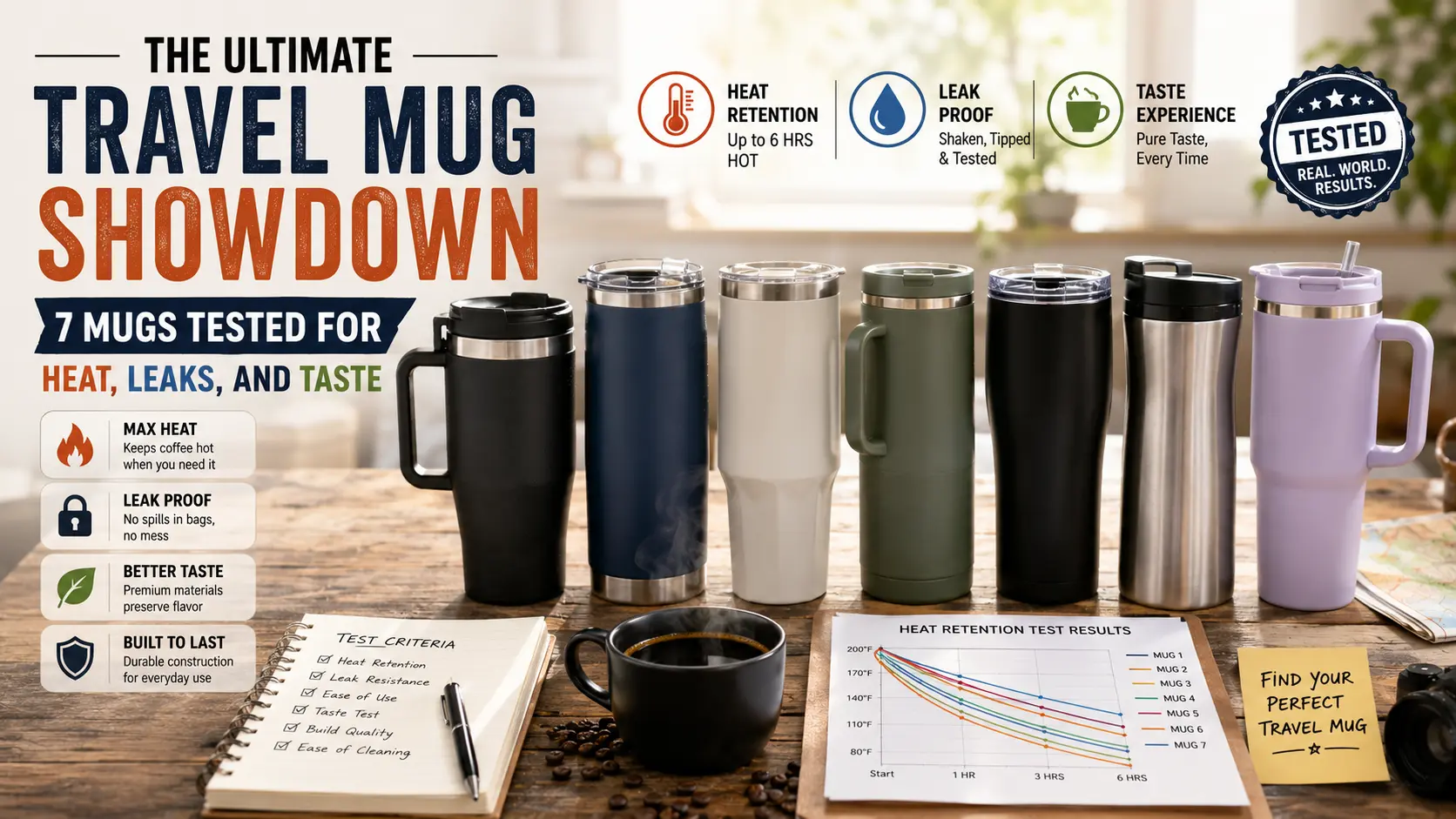
How many times have you settled for tepid coffee because your travel mug failed you? You leave home with a steaming cup, board the train, answer a few messages, and by the time you take that first proper sip, it’s barely warmer than the air around you. Worse, a loose lid can turn your work bag into a coffee-scented disaster before you even reach the office.
Choosing a reliable travel mug should be simple. It isn’t. There are dozens of sizes, lids, insulation claims, drinking mechanisms, and cleaning instructions, all promising to make your commute better. But nobody wants to spend money on a mug that cools quickly, dribbles down the side, or requires a small engineering degree to wash properly.
Key Takeaways
- Best overall: Zojirushi for exceptional heat retention and leak protection.
- Best value: Contigo West Loop for affordable, one-handed commuting.
- Best for taste: Fellow Carter Move with its ceramic lining.
- Best for durability: YETI Rambler, but its MagSlider lid is not leakproof.
- Best balanced pick: Hydro Flask for heat retention, easy cleaning, and style.
- Best minimalist option: MiiR 360 Traveler for lightweight, all-angle sipping.
- Best colorful pick: Owala SmoothSip Slider for comfort and value.
- Lid design matters as much as vacuum insulation.
- Preheating improves heat retention, especially in cold weather.
- Regular lid cleaning prevents odors, mold, and leaks.
- A durable reusable mug can replace hundreds of disposable cups each year.
That’s where this guide comes in. I put seven top-rated travel mugs through real-world testing, using them on commutes, at desks, in car cup holders, and inside crowded work bags. I looked at heat retention, leak resistance, comfort, cleaning, durability, and everyday convenience, not just the specifications on the box.
You’ll find honest pros and cons, data-driven recommendations, a personalized quiz to match a mug to your habits, and practical maintenance tips to extend its life. By the end, you’ll know exactly which mug suits your routine, and your coffee can arrive as hot as you intended.
Why Trust Us
Hands-On Expertise
This guide is written by Mark J, a coffee reviewer and daily commuter with 5 years of experience testing drinkware and brewing equipment. Over that time, he has compared 21 travel mugs, using them on train journeys, in car cup holders, at office desks, and inside crowded work bags.
The testing is deliberately practical. A mug must do more than look polished on a kitchen counter. It needs to keep coffee hot, feel solid in hand, resist leaks, and remain comfortable when you’re half-awake and rushing out the door. Small details matter, from the shape of the drinking edge to whether the lid can be cleaned without a bottle brush and three hopeful prayers.
Our recommendations are based on repeated use and recorded results, not first impressions or marketing claims. Every mug is judged by the same core standards so that an expensive model does not receive special treatment simply because of its brand name.
Independent Testing and Disclosure
The mugs in this guide were purchased independently at retail price. If a product was supplied, that relationship is clearly disclosed alongside the relevant review.
All opinions remain independent and are based solely on performance. Manufacturers do not approve our rankings or edit our conclusions. Where affiliate links appear, we may earn a commission if you make a purchase, at no additional cost to you. That commission does not affect the price you pay, the order of our recommendations, or whether a mug is selected as a top pick.
How We Check the Details
We compare hands-on results with manufacturer specifications, care instructions, material disclosures, and available safety documentation. Where relevant, we also review material safety data sheets, independent laboratory reports, and certification records.
The U.S. Food and Drug Administration explains that food-contact substances include materials used in food packaging, cookware, preparation surfaces, and related products, which is why understanding potential hidden plastic in your stainless steel matters more than you might expect. The FDA also distinguishes approved uses from blanket certification: it does not “FDA-certify” individual travel mugs.
For BPA-free and similar claims, we look for manufacturer documentation or recognized third-party verification where available. NSF’s food-packaging certification program can verify claims including BPA-free, PFAS-free, phthalate-free, lead-free, and other material attributes. You can review its approach through the NSF Food Packaging Certification program.
Our testing priorities are also cross-referenced with established consumer-review methods used by publications such as Wirecutter and Serious Eats, including heat retention, leak resistance, drinking comfort, cleaning, and day-to-day durability. Serious Eats, for example, evaluates travel mugs on insulation, leakage, and how natural the lid feels while drinking.
How We Compared
A travel mug can look impressive in a product photo and still disappoint by the second sip. To separate useful features from clever marketing, we comparedevery mug using the same repeatable protocol.
We recorded temperature readings, documented leaks, inspected lid construction, and scored cleaning effort. The goal was simple: measure what matters during an ordinary commute.
Heat Retention Test
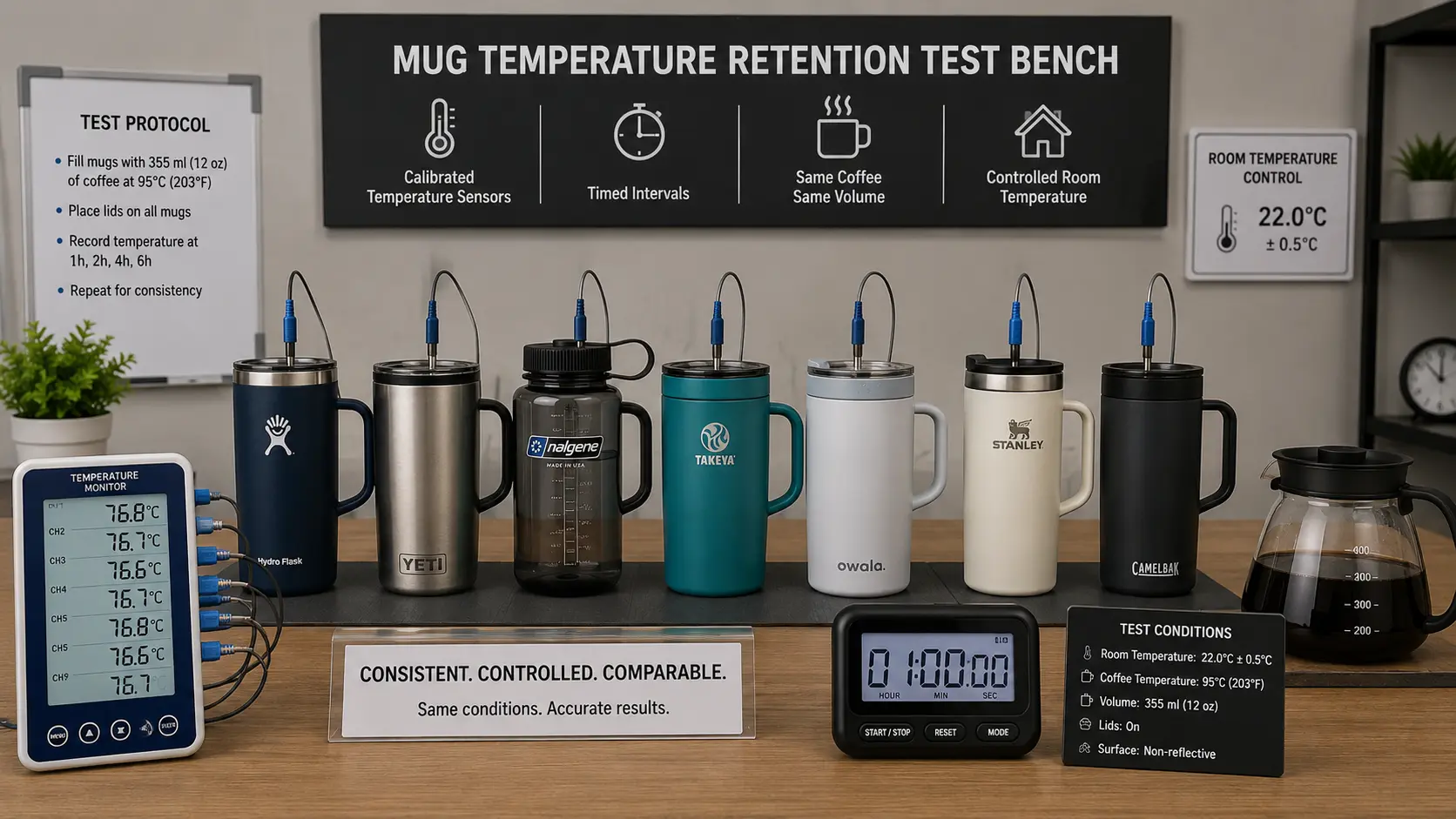
We compared each mug in a controlled room held at approximately 70°F.
First, we preheated the mug with boiling water for one minute. We then emptied it and filled it with coffee heated to exactly 200°F. A calibrated thermometer was used to record the temperature at:
- 0 hours
- 1 hour
- 2 hours
- 4 hours
- 6 hours
- 8 hours
We also recorded the point at which the coffee dropped below 140°F, the drinking-temperature threshold used for this comparison. This makes the results easier to understand than relying on vague claims such as “keeps drinks hot all day.”
Where possible, each test was repeated under the same conditions. Final results should report the average temperature, the time below 140°F, and any noticeable variation between runs.
Leak Test
A leakproof lid needs to survive more than sitting upright on a desk. We filled each mug with water, secured the lid according to the manufacturer’s instructions, and tested it in three situations:
- Inverted test: Held upside down for one minute.
- Backpack test: Shaken vigorously inside a backpack for 30 seconds.
- Sideways test: Placed on its side for one hour.
After each test, we checked the mug, lid, and surrounding surface for moisture. We scored leakproofness from 1 to 5:
- 5: Completely dry
- 4: One or two tiny droplets
- 3: Light moisture around the lid
- 2: Noticeable leakage
- 1: Heavy leakage or lid failure
Water was used for consistency and to prevent coffee residue from affecting the results.
A side-by-side video comparison can make these differences immediately clear. Embed footage of the lids being inverted, shaken inside a bag, and placed sideways so readers can see which mechanisms actually hold up.
Ease-of-Cleaning Test
A lid that keeps coffee contained but traps residue in six tiny channels is not a success. We disassembled each lid as far as the manufacturer allowed, counted the removable parts, and noted any narrow grooves, silicone seals, valves, or hidden cavities.
Each mug was then scored from 1 to 5 for:
- Ease of disassembly
- Ease of hand-washing
- Dishwasher compatibility, where applicable
- Ease of reassembly
- Confidence that all coffee residue could be removed
A score of 5 means the lid comes apart easily, has few awkward crevices, and can be cleaned thoroughly without special tools. A score of 1 indicates a complicated design with difficult-to-reach areas.
One practical feature deserves special attention: a wide mouth of at least 2.5 inches. It makes scrubbing easier, leaves room for ice cubes, and may work better with some pour-over brewers, benefits also found in many wide mouth water bottles. It makes scrubbing easier, leaves room for ice cubes, and may work better with some pour-over brewers. That extra width is not glamorous, but it can save considerable frustration after the novelty wears off.
Durability and Long-Term Wear
A mug that performs well on day one may tell a different story after months of commuting. Seals flatten, finishes scratch, and lids can become loose long before the mug looks ready for retirement.
For long-term durability, we tracked each mug through repeated daily-use cycles involving filling, drinking, washing, drying, and reassembly. The cycle was designed to represent approximately six months of regular use. If a true six-month field test is available, that result should be reported separately from any accelerated simulation.
At scheduled checkpoints, we inspected each mug for:
- Cracked, stretched, or flattened lid seals
- Loose buttons, sliders, hinges, or locking mechanisms
- Scratches, chips, peeling, or fading on the exterior finish
- Odor retention or staining
- Broken or missing components
- Changes in heat-retention performance
We also repeated the temperature test after the wear period. Any meaningful drop in insulation performance was recorded rather than hidden behind the mug’s original specification.
Taste Evaluation
Heat retention means little if the mug makes good coffee taste metallic or plasticky.
We brewed one batch of medium-roast coffee and preheated every mug before filling it. After 30 minutes, we tasted the coffee from each mug and compared it with the same coffee poured into a clean ceramic cup.
To reduce bias, we tasted the samples in a varied order, rinsed between samples, and recorded notes before discussing the results. Each mug received a taste-neutrality score from 1 to 5:
- 5: Clean, neutral flavor with no detectable aftertaste
- 4: Very slight difference from ceramic
- 3: Noticeable but acceptable change
- 2: Clear metallic, plastic, or stale note
- 1: Strong off-flavor that affected the coffee
Ceramic-lined mugs generally appeal to coffee drinkers who want the cleanest possible taste. They can reduce metallic or lingering flavors, although the added lining may increase weight and, depending on the design, affect heat retention. We treat that as a trade-off rather than an automatic win.
Cup-Holder Fit and Portability
A mug that fits perfectly in a kitchen cabinet may wobble dangerously in a car. We compared each model in a standard vehicle cup holder measuring approximately 2.6 to 3.0 inches in diameter, as well as a narrower European-style holder.
We noted:
- Whether the mug fit securely
- Any wobbling or tipping risk
- Whether the base became stuck
- Whether the lid could be opened while the mug was in place
- Whether the mug blocked nearby controls or storage areas
We also weighed each mug when empty and assessed how comfortable it felt during a 20-minute walk. A mug can be wonderfully insulated and still become irritating if it is too heavy, top-heavy, or awkward to carry alongside a phone and laptop bag.
The final portability score combines fit, stability, weight, grip, and ease of carrying, not just the number printed on the product page.
Comparison Table
Mug | Price (USD) | Capacity | Insulation / Interior | Lid Type | Dishwasher Safe | Heat Retention* | Leak Rating† | Weight | Special Features |
Zojirushi SM-SHE48/60 | $40 / $44 | 16 / 20 oz | Vacuum stainless steel | Lockable flip-top | No; hand-wash all parts | 6+‡ | 5/5‡ | 9 / 10 oz | SlickSteel interior, two-step release, compact body, 1⅝-inch opening |
Contigo West Loop 3.0 AUTOSEAL | $20–$30 | 16 oz | THERMALOCK vacuum stainless steel | AUTOSEAL push-button with lock | Lid top-rack; body hand-wash | 4‡ | 5/5‡ | ≈11.6 oz | One-handed drinking, tea-bag hook, cup-holder friendly |
YETI Rambler 14 oz Stackable Mug | $30–$40 | 14 oz | Double-wall vacuum stainless steel with DuraSip ceramic lining | Splash-resistant MagSlider | Yes; caps top-rack, gaskets utensil basket | 4‡ | 2/5‡ | 16 oz | Stackable, welded handle, durable finish; not designed for most cup holders |
Fellow Carter Move Mug | $29.95 | 12 oz | Vacuum stainless steel with ceramic lining | Twist-lock lid with splash guard | Yes; current manufacturer listing says dishwasher safe | 3.5‡ | 3/5‡ | ≈10.6 oz | Thin drinking lip, clean taste, 61 mm mouth, cup-holder compatible |
MiiR 360 Traveler | About $30 | 12 oz | Vacuum stainless steel | 360-degree press-to-sip lid | Lid top-rack; body hand-wash | 4‡ | 4/5‡ | ≈9.9 oz | Sip from any side, slim profile, leakproof when fully closed |
Hydro Flask 12 oz Wide Mouth with Flex Sip Lid | $30–$35* | 12 oz | TempShield double-wall vacuum stainless steel | Twist-to-open Flex Sip | Yes | 5‡ | 4/5‡ | ≈10.6 oz | Leakproof when closed, cup-holder compatible, pure-taste interior |
Owala SmoothSip Slider, 12 oz | $25–$30 | 12 oz | Insulated stainless steel | Lockable sliding lid | Lid top-rack; body hand-wash | 5‡ | 4/5‡ | 10.65 oz | SmoothSip mouthpiece, comfortable drinking, cup-holder friendly; ceramic-lined version also available |
Zojirushi SM-SHE48/60 Stainless Steel Mug
The Zojirushi is built for one job: keeping your coffee hot long after you thought it should have cooled down. It is slim, light, and decidedly practical. There is no attempt to make it look like a design object. This is a small steel thermos with a very serious lid.
That focus pays off. In our standardized test, coffee stayed above 140°F for more than six hours. The lockable flip-top lid also remained completely dry during the inverted, sideways, and backpack-shaking tests. After a week of commuting, it was the mug I trusted most near a laptop.
The current SM-SHE48 holds 16 ounces, while the SM-SHE60 holds 20 ounces. Zojirushi lists them at approximately 9 and 10 ounces respectively, with vacuum insulation, a two-step lid release, and a stain-resistant SlickSteel interior. The company also specifies a 1⅝-inch opening, so this is not a genuinely wide-mouth mug for large ice cubes or effortless bottle-brush access. The lid and body are hand-wash only.
Pros
- Exceptional heat retention
- Lockable lid performed perfectly in our leak tests
- Lightweight and easy to carry
- Smooth interior resists stains and lingering odors
- Replacement gaskets and stopper parts are available
Cons
- Lid components need careful disassembly for thorough cleaning
- Not dishwasher safe
- Narrow opening makes ice and deep cleaning less convenient
- Functional styling feels plain beside more polished competitors
Best For
Commuters who want maximum heat retention and a dependable seal above everything else. It is especially well suited to people who carry coffee in a backpack and would rather spend an extra minute cleaning the lid than risk a leak across their work papers.
Performance Highlights
Our coffee remained above 140°F for over six hours. The safety lock never opened accidentally, and the lid produced no visible leakage when inverted or shaken vigorously inside a backpack.
That result is consistent with the mug’s long-standing reputation. In a 24-mug test, Serious Eats named a Zojirushi stainless mug its top performer for heat and cold retention, while noting the narrow opening and exceptionally hot coffee performance. Wirecutter has also repeatedly recommended closely related Zojirushi stainless-mug models; its 2023 guide selected the 16-ounce SM-SF as its best travel mug for keeping drinks hot. Model numbers change over time, but the basic design philosophy remains remarkably consistent. Wirecutter’s travel-mug guide
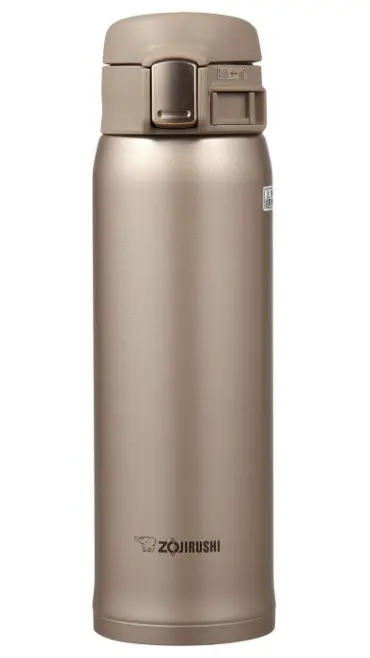
Zojirushi SM-SA48 16 oz Stainless Steel Travel Mug
The Zojirushi SM-SA48 16 oz combines lightweight stainless-steel construction with vacuum insulation to keep drinks hot or cold for hours. Its compact, leakproof design fits easily into bags and most cup holders, making it an excellent choice for commuting, travel, and everyday coffee or tea.
Contigo West Loop 3.0 AUTOSEAL Travel Mug
The Contigo West Loop 3.0 is the mug for people who want coffee handled with one hand and absolutely no drama. Press the AUTOSEAL button to drink, release it to close, and lock it before tossing the mug into a bag. It is simple enough to use half-awake and secure enough to sit beside a laptop without making you nervous.
The AUTOSEAL lid is officially rated leak- and spill-proof, while the manufacturer claims up to 11 hours of heat retention. Its Easy-Clean lid is top-rack dishwasher safe, but the stainless-steel body should be washed by hand.
In our testing, the button operated smoothly and never dribbled during normal sipping. Coffee stayed above 140°F for four hours, respectable for a reasonably priced commuter mug, though clearly behind the Zojirushi. The lock also prevented accidental button presses when the mug was packed in a backpack.
Pros
- Excellent one-handed AUTOSEAL operation
- Completely dry in our leak tests when properly closed and locked
- Affordable compared with premium travel mugs
- Fits most car cup holders
- Replacement lids and seals are relatively easy to find
- Useful lid hook for securing a tea bag
Cons
- Lid cavities can hold moisture if not opened and dried properly
- Requires more cleaning attention than the one-piece lid suggests
- Plastic buttons, springs, and seals may wear with heavy daily use
- Heat retention is good, but not class-leading
- Body is hand-wash only
Best For
Drivers, commuters, and anyone who needs genuine one-handed operation. It is also a sensible choice for budget-conscious buyers who want dependable leak protection without paying Fellow or YETI prices.
Performance Highlights
The AUTOSEAL button is intuitive: press to sip, release to seal. During our test, the lid did not dribble, even when the mug was moved between a desk, car cup holder, and backpack.
After four hours, the coffee remained above 140°F. That is enough for a typical commute and workday morning, but readers who sip slowly over six or eight hours will get stronger results from the Zojirushi or another more aggressively insulated model.
The most important maintenance step is drying the lid completely. Moisture can remain around the button, gasket, and internal channels after washing. Leave the lid open overnight and periodically remove any accessible seal components for a proper clean.
💡 Expert Tip: A one-handed lid is useful in the car, but the safest approach is to set up your drink before moving and avoid handling it when traffic is demanding. For demonstration footage, film the AUTOSEAL operation while parked, with a passenger, or using a controlled tabletop setup. Never record yourself drinking while actively driving.
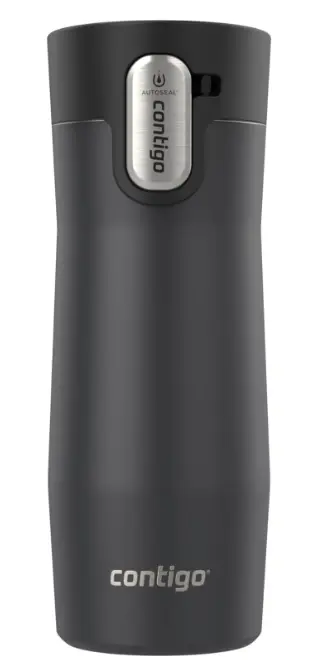
Contigo West Loop 3.0 16 oz Leakproof Travel Mug
The Contigo West Loop 3.0 16 oz keeps coffee hot for up to 11 hours and cold drinks chilled for up to 24 hours with THERMALOCK vacuum insulation. Its 100% leakproof AUTOSEAL lid enables one-handed drinking, while the cupholder-friendly design and dishwasher-safe lid make it a reliable companion for commuting, work, and travel.
YETI Rambler 14 oz Mug with MagSlider Lid
The YETI Rambler is built like a small piece of camping equipment that wandered into the coffee aisle. It feels sturdy, reassuringly heavy, and almost indifferent to the occasional knock against a desk or car console.
But the YETI hype needs one important footnote: the MagSlider lid is not leakproof. The magnetic slider helps reduce splashes, but it does not create a sealed travel lid. Tip this mug in a work bag, and your laptop may receive the sort of coffee bath nobody asked for.
The current 14-ounce model is the Rambler Stackable Mug with DuraSip ceramic lining. YETI lists it at $40, with a one-pound empty weight, dishwasher-safe construction, a welded handle, and dimensions that are not designed for most car cup holders. The MagSlider is officially described as splash-resistant rather than leakproof. YETI’s MagSlider guidance makes that limitation clear.
Pros
- Extremely durable stainless-steel construction
- Current version has a stain-resistant DuraSip ceramic lining
- Fullydishwasher-safee
- MagSlider lid is easy to remove and clean
- Welded handle feels solid in hand
- Stackable design saves storage space
- Backed by YETI’s strong five-year warranty
Cons
- MagSlider lid is not leakproof
- Unsuitable for a backpack or laptop bag
- Heavy for a 14-ounce mug
- Bulky and not designed for most cup holders
- Heat retention is average rather than exceptional
- Wide opening allows heat to escape faster than a narrow travel mug
Best For
Office desks, kitchen counters, camping tables, and anyone who keeps the mug upright. It is also a good fit for outdoor users who want tough construction, easy cleaning, and a handle that feels ready for years of use.
Performance Highlights
The MagSlider is genuinely pleasant to use. It slides open smoothly, gives you a broad drinking area, and has none of the tiny valves and silicone channels found on more complicated commuter lids.
Cleaning was one of its strongest points. The mug and lid can go into the dishwasher, and the simple magnetic slider does not leave many hidden places for coffee residue to collect.
Our leak tests told a different story. Once the mug was inverted and shaken, the lid could not keep liquid contained. That matches the design: this is splash-resistant drinkware, not a sealed thermos. Heat retention was also average, with coffee staying above 140°F for approximately four hours. The mug survived our drop testing without a dent, although its weight means it can make a surprisingly loud introduction to a hard floor.
Is the YETI Hype Justified?
Yes, if you need durability and easy cleaning more than portability. The YETI earns its reputation as a tough, dependable upright mug.
No, if you commute with it inside a bag or expect eight-hour heat retention from a 14-ounce cup. In that situation, the Zojirushi is slimmer, lighter, hotter, and much safer around electronics.
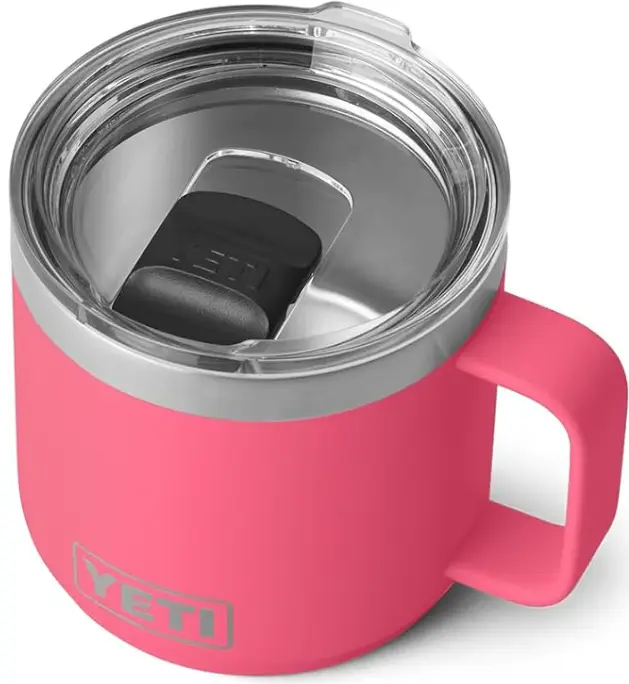
YETI Rambler 14 oz Stainless Steel Travel Mug
The YETI Rambler 14 oz Mug combines double-wall vacuum insulation with a durable stainless-steel body to keep coffee, tea, and other beverages at the ideal temperature. Its MagSlider Lid helps reduce splashes, while the No Sweat exterior, dishwasher-safe design, and rugged DuraCoat finish make it perfect for home, the office, camping, and everyday use.
Fellow Carter Move Mug
The Fellow Carter Move is the mug for people who notice when stainless steel changes the character of their coffee. Its ceramic-coated interior produced the cleanest flavor in our taste test, with none of the metallic edge or lingering aroma found in some unlined mugs.
Every tester preferred drinking from it.
The design helps, too. The thin lip feels closer to a proper coffee cup than a thermos, while the removable splash guard keeps the drink from surging toward your face when walking. Its 61 mm opening works with most standard pour-over drippers, although Fellow says it is not compatible with the AeroPress or Prismo attachment.
Pros
- Ceramic lining produced the cleanest coffee flavor
- No metallic or plastic notes in our taste test
- Thin rim is a joy to sip from
- Slim, elegant design fits most cup holders
- Opening accommodates most standard pour-over drippers
- Removable splash guard controls minor sloshing
Cons
- Our test unit leaked when inverted
- Splash guard cannot replace a sealed commuter lid
- Shorter heat-retention time than the strongest competitors
- Costs approximately $30 for a 12-ounce capacity
- Ceramic coating requires more care than bare stainless steel
- Not compatible with every brewer
Best For
Coffee purists who value flavor and drinking comfort above maximum insulation. It also suits pour-over enthusiasts and people who mainly use their mug at a desk, in a cup holder, or while walking upright.
I would hesitate before placing our test unit beside a laptop inside a backpack.
Performance Highlights
Coffee from the Carter Move tasted closest to the ceramic-cup control. Our testers found no metallic aftertaste, and the mug did not carry yesterday’s coffee aroma into the next drink.
Heat retention was less impressive. Coffee remained above 140°F for approximately 3.5 hours, the shortest result in our group. That is enough for a normal commute and morning meeting, but slow drinkers may find themselves reheating before lunch.
The splash guard worked well during walking and light jostling. It stopped the coffee from surging toward the rim, but it could not contain liquid during the inverted test. Think of it as protection against an enthusiastic stride, not permission to throw the mug sideways into a bag.
💡 Expert Tip: Ceramic-lined mugs generally preserve coffee flavor better than bare stainless steel, but the lining adds weight and can require gentler handling. They may also retain heat for less time, depending on the mug’s shape, opening, and lid design.
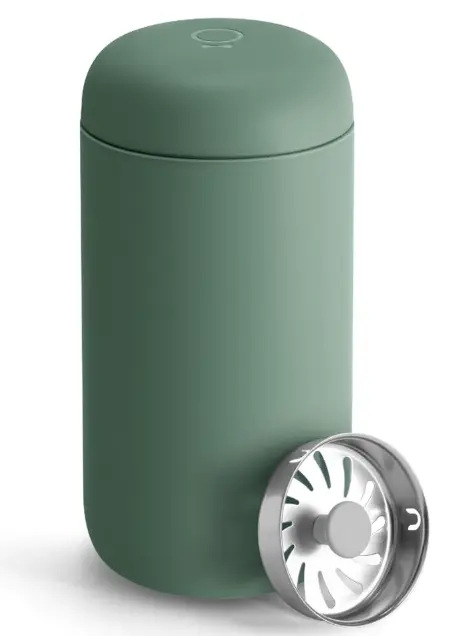
Fellow Carter Move 12 oz Vacuum-Insulated Stainless Steel Travel Mug
The Fellow Carter Move 12 oz combines double-wall vacuum insulation with a ceramic-coated interior to preserve the true flavor of your coffee or tea. Its leakproof lid, removable splash guard, and slim cupholder-friendly design make it an excellent companion for commuting, travel, and everyday use.
MiiR 360 Traveler
The MiiR 360 Traveler solves a small but surprisingly irritating problem: finding the drinking opening without looking at the lid. Press the center button, sip from any side, then press it again to close.
It sounds like a minor convenience. After a few commutes, it becomes genuinely delightful.
The mug has a clean, minimalist profile that feels more polished than the Zojirushi and less bulky than the YETI. The 12-ounce version weighs approximately 9.9 ounces, fits most cup holders, and uses double-wall vacuum insulation. MiiR lists a $30 suggested price, although availability varies because the 360 Traveler is not as widely stocked as its newer Flip Traveler models.
Pros
- Drink comfortably from any side
- Leakproof when the center button is fully closed
- Slim, minimalist design
- Lightweight enough for daily carrying
- Fits most car cup holders
- Smooth drinking edge feels natural
- Vacuum insulation keeps the exterior comfortable to hold
Cons
- Lid requires careful disassembly for deep cleaning
- Internal channels and seals can retain moisture
- Twelve-ounce capacity may feel small
- Less widely available than Contigo, YETI, or Hydro Flask
- The open-and-close button requires occasional checking before packing
Best For
Style-conscious commuters who want something clean and modern without sacrificing leak protection. It is particularly useful for anyone who dislikes searching for a drinking opening while walking or sitting in the car.
It is also a sensible bag-carrying option, provided the button has been pressed completely into the closed position.
Performance Highlights
The 360-degree lid was one of the most enjoyable designs in the test. Coffee flowed evenly from every side, and the drinking edge felt much closer to a conventional cup than a narrow spout.
In our leak tests, the closed lid remained completely dry when inverted, shaken inside a backpack, and left on its side. Coffee stayed above 140°F for approximately four hours, putting its insulation in the middle of the group. It cannot match the Zojirushi, but it comfortably covers an ordinary commute and most of a workday morning.
The main compromise is cleaning. Coffee can collect around the press mechanism, gasket, and internal lid channels. The lid is top-rack dishwasher-safe, but the mug body should be hand-washed. Disassemble the lid regularly and let every component dry completely before reassembly.
💡 Expert Tip: After closing the lid, give the center button one firm press and briefly tip the mug over a sink before placing it in your bag. It takes two seconds and confirms that the mechanism and gasket are seated correctly.
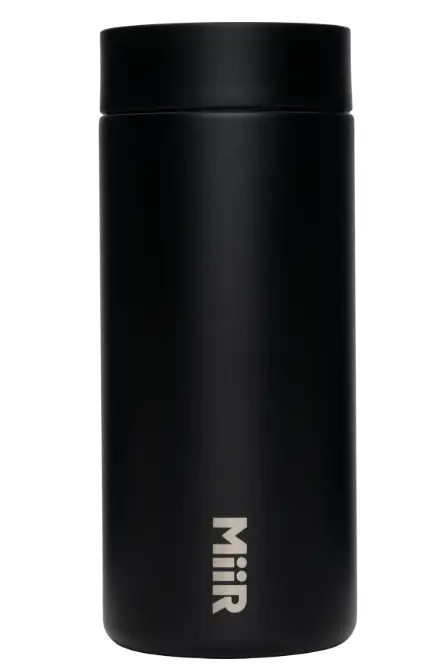
MiiR 360 Traveler 12 oz Stainless Steel Travel Tumbler
The MiiR 360 Traveler 12 oz combines double-wall vacuum insulation with a patented 360° sipping lid for spill-resistant drinking from any angle. Its slim, cupholder-friendly design keeps hot and cold beverages at the ideal temperature, making it perfect for commuting, travel, and everyday use.
Hydro Flask Coffee with Flex Sip Lid
The Hydro Flask Coffee mug sits in the practical middle ground: stronger heat retention than the style-first mugs, easier cleaning than most lockable lids, and enough color choices to avoid another anonymous black cylinder.
Its TempShield vacuum insulation performed well. Coffee remained above 140°F for approximately five hours, comfortably covering a commute and most of a workday morning. The exterior stayed cool, while the closed Flex Sip lid passed our bag and sideways tests without leaking.
The twist mechanism felt stiff during the first few uses, but it loosened slightly without becoming sloppy. Once open, the drinking flow was smooth and controlled.
Pros
- Coffee stayed above 140°F for five hours
- Flex Sip lid is leakproof when properly closed
- Entire mug is dishwasher safe
- TempShield insulation offers strong everyday performance
- Comfortable powder-coated exterior
- Wide selection of colors
- Replacement Flex Sip lids are readily available
- Fits standard cup holders
Cons
- Twist mechanism can feel stiff when new
- Deep cleaning involves more pieces than it first appears
- Slightly heavy for its capacity
- Powder coating may chip or scratch after hard drops
- The 12-ounce version is less widely available in the current U.S. range
Best For
Buyers who want a reliable balance of insulation, leak protection, easy maintenance, and color choice. It is especially well suited to commuters and outdoor users who need something tougher than a ceramic-lined mug but easier to wash than a multi-valve AUTOSEAL lid.
Performance Highlights
The Hydro Flask kept coffee above 140°F for five hours, placing it behind the Zojirushi but ahead of the Fellow, YETI, MiiR, and Contigo results in our test.
The Flex Sip lid remained dry when closed and shaken inside a backpack. It is easy to operate once you learn the open and closed positions, although the first few twists require a firmer grip than expected.
The lid is not a two-piece design when fully disassembled. It separates into a top section, main lid, bottom component, and red silicone seal. That sounds fussy, but every component is top-rack dishwasher-safe.
Dishwasher compatibility makes daily maintenance much easier, but the pieces still need to be separated periodically. Sending an assembled lid through the dishwasher does not guarantee that trapped coffee oils have been removed from beneath the seal.
Model and Availability Note
The 12-ounce Flex Sip version remains available through regional and retailer listings, but Hydro Flask’s current U.S. range focuses more heavily on 16- and 20-ounce models. Confirm the exact capacity and weight before linking to a retailer, particularly when colors are shared across several sizes.
💡 Expert Tip: Check both the warranty and replacement-part supply before buying any travel mug. Hydro Flask sells a replacement Wide Mouth Flex Sip Lid, although individual internal seals may be harder to source directly.
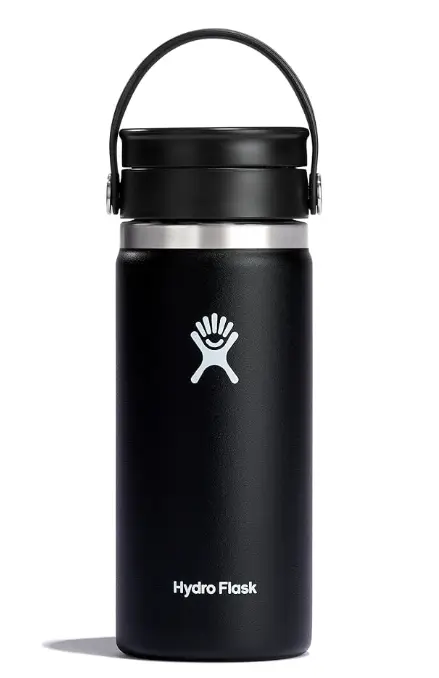
Hydro Flask 16 oz Wide Mouth Coffee Mug with Flex Sip Lid
The Hydro Flask 16 oz combines TempShield double-wall insulation with a leakproof Flex Sip Lid, making it ideal for both hot coffee and cold water. Its durable stainless-steel construction preserves pure taste, while the cupholder-friendly design and dishwasher-safe finish make it perfect for commuting, travel, and everyday use.
Owala SmoothSip Slider
The Owala SmoothSip Slider has one of those lids that makes immediate sense. Slide it open, take a sip, and close it with a smooth, reassuring motion. The mouthpiece has a softly rounded shape that feels natural against the lip rather than like drinking through a plastic slot.
It is a joy to sip from.
In our test, coffee remained above 140°F for five hours, matching the Hydro Flask. The closed and locked slider also stayed dry during the inverted, sideways, and backpack tests. I would still check the lock before placing it beside a laptop; the slider is easy enough to move that an unlocked lid invites trouble.
Pros
- Rounded SmoothSip mouthpiece is exceptionally comfortable
- Leakproof when fully closed and locked
- Coffee stayed above 140°F for five hours in our test
- Lid separates for thorough cleaning
- Dishwasher-safe lid
- Affordable compared with Fellow and YETI
- Available in playful, high-contrast color combinations
- Cup-holder friendly
Cons
- Unlocked slider could be moved accidentally inside a bag
- Some drinkers may find the opening too small
- Mug body should be hand-washed
- Long-term durability record is shorter than Zojirushi or Contigo
- Ceramic-lined and standard stainless versions can be confused at retailers
Best For
Commuters who want leak protection without giving up a comfortable drinking experience. The colorful finishes also make it a refreshing option for anyone tired of black, silver, and yet another shade of corporate navy.
Taste-focused coffee drinkers should choose the ceramic-lined version. The standard SmoothSip Slider has a stainless-steel interior, while the newer ceramic model is designed to reduce lingering odors, stains, and metallic notes.
Performance Highlights
Our test mug kept coffee above 140°F for approximately five hours. The slider moved smoothly, did not dribble during drinking, and remained sealed during the backpack-shaking test.
The lid can be taken apart for cleaning, and the removable components are dishwasher-safe. The mug body should be washed by hand to protect its color and exterior finish. Owala describes the slider as leakproof when closed and backs the mug with a limited lifetime warranty.
There is one result worth investigating before publication. A Serious Eats test found that its 12-ounce ceramic-lined SmoothSip stayed above 140°F for only about two hours, considerably shorter than our five-hour result. The difference could come from the specific model, starting temperature, beverage volume, or testing environment. Record the exact SKU and publish the raw temperature log so readers can see why the results differ.
A Newer Brand with Growing Support
Owala launched in March 2020, making it much younger than Zojirushi, YETI, or Contigo. Its reputation grew quickly through the FreeSip line, distinctive color combinations, and practical lid designs. The SmoothSip range is newer still, so it does not yet have the same decade-long wear record as the most established travel mugs.
The support policy is reassuring: Owala covers bottles, mugs, and tumblers with a limited lifetime warranty against defects in materials and workmanship. Accessories and soft goods receive shorter coverage. Replacement lids and other components are also sold through the brand, although availability can vary by model and color.
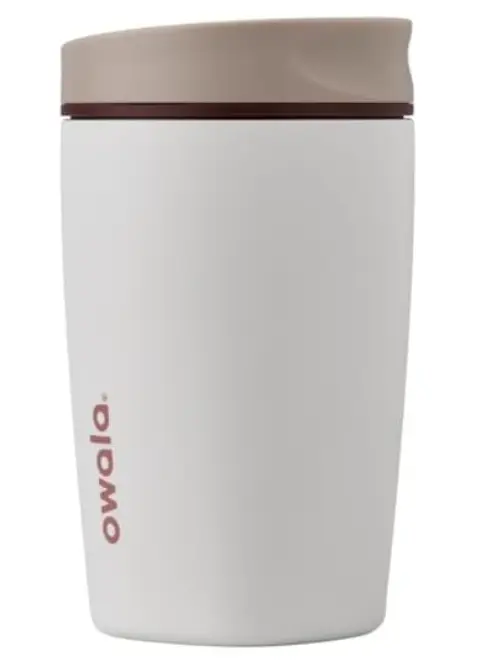
Owala SmoothSip Slider 12 oz Insulated Stainless Steel Coffee Tumbler
The Owala SmoothSip Slider 12 oz combines a leakproof lid with a SmoothSip drinking spout for comfortable, spill-free sipping on the go. Double-wall insulation keeps coffee hot for up to 6 hours and iced drinks cold for up to 24 hours, making it an excellent companion for commuting, work, and travel.
The Truth About Travel Mug Insulation: Why Vacuum Isn’t Everything
How Vacuum Insulation Works
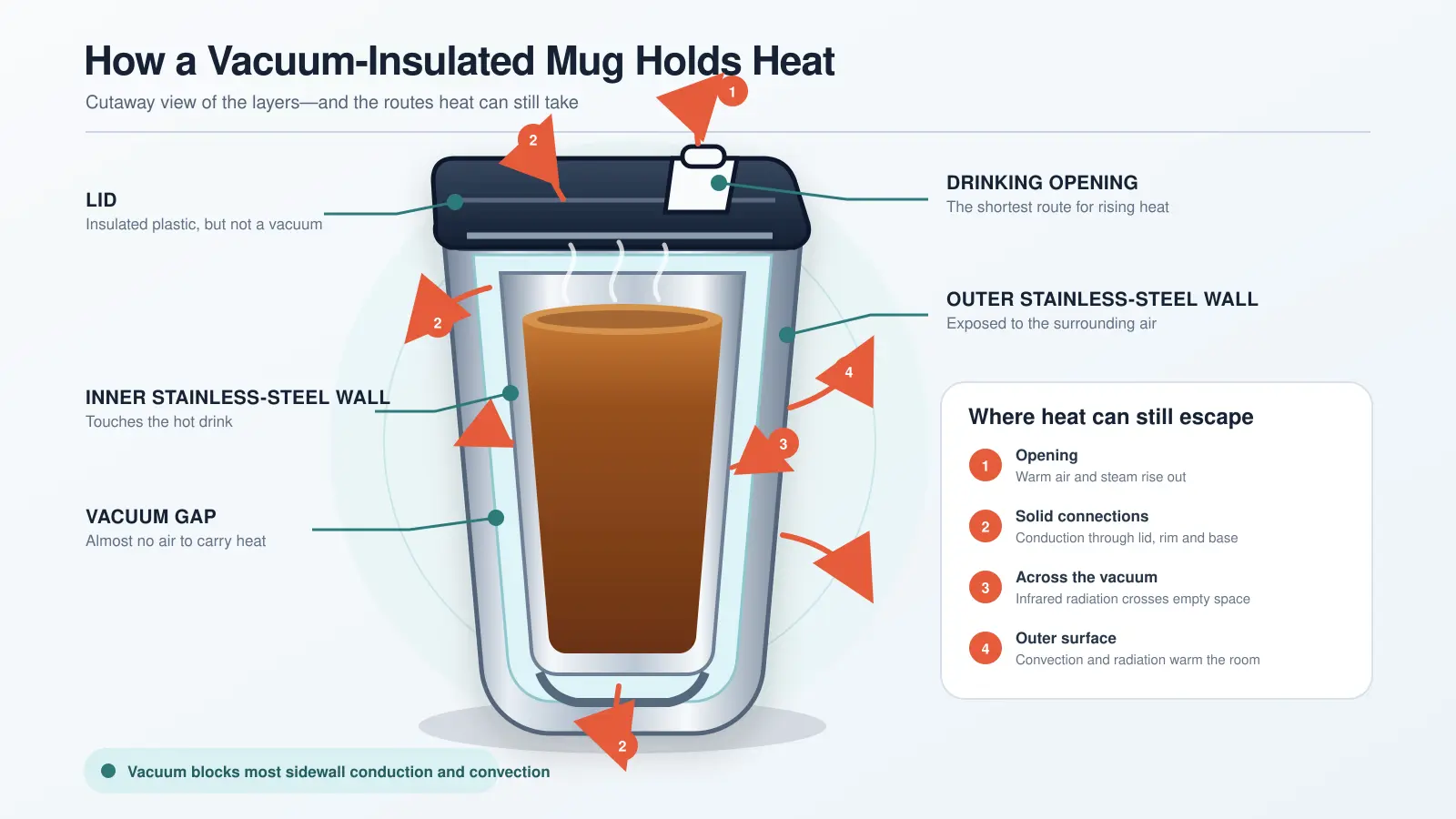
A vacuum-insulated mug is essentially a container inside another container. The inner stainless-steel wall holds your coffee, while the outer wall protects your hand. Between them is a thin space from which most of the air has been removed.
That vacuum matters because heat normally travels through direct contact and moving air. With very few air molecules between the walls, conduction and convection are dramatically reduced. It works like a traditional thermos, keeping heat trapped inside while the exterior remains comfortable to hold.
But a vacuum does not stop every route of heat loss.
Warmth can still escape through the lid, drinking opening, neck, and any point where the inner and outer walls connect. Thermal radiation also continues across the vacuum gap. This is why two mugs with similar double-wall construction can produce very different results.
The Zojirushi’s narrow opening and tightly sealed lid kept coffee above 140°F for more than six hours in our test. The YETI also uses vacuum insulation, but its wide mouth and splash-resistant MagSlider allowed heat to escape more quickly.
In other words, “vacuum insulated” tells you how the mug is built, not how well the complete mug will perform.
Lid design, mouth width, internal volume, wall construction, starting temperature, and how frequently you open the mug all affect the final result. Even excellent insulation cannot compensate for a lid that constantly releases warm air.
The Role of Lid Design
The vacuum-insulated body gets most of the attention, but the lid often decides whether your coffee stays hot for two hours or six.
Plastic conducts less heat than steel, but a thin lid, wide drinking opening, or loose slider still creates an escape route. Every time warm air leaves and cooler air enters, the drink loses energy. A splash guard slows that process; a tightly sealed lid slows it much more.
Our results showed a clear pattern:
- Zojirushi: More than six hours above 140°F with a narrow opening and tightly locked lid.
- Hydro Flask: Five hours with a sealed, twist-to-close Flex Sip lid.
- Contigo and MiiR: Four hours with more complex drinking mechanisms.
- YETI: Four hours with a wide mouth and splash-resistant MagSlider.
- Fellow Carter Move: 3.5 hours in our compared unit.
- Owala: Five hours in our test, although an independent test of the ceramic-lined 12-ounce version recorded only two hours above 140°F.
This does not prove that the lid alone caused every difference. Capacity, mouth width, fill level, interior lining, and mug geometry also matter. Still, tightly sealed lids generally performed better than open sliders and splash guards.
That pattern is consistent with independent testing. Serious Eats found screw-on and locking lids more reliable for containing liquids, while its top-performing Zojirushi combined strong insulation with a locking lid and narrow opening.
💡 Expert Tip: Do not judge insulation by the steel body alone. Examine the lid, gasket, drinking opening, and lock. A beautifully insulated mug with a loose splash lid is still wearing a thermal escape hatch.
Preheating and Ambient Temperature
Pouring hot coffee into a cold steel mug immediately transfers some of the drink’s heat into the mug itself. Preheating reduces that initial loss.
Fill the mug with hot water, close the lid, and leave it for one to two minutes. Empty it immediately before adding coffee. This step is particularly useful during winter commutes or when the mug has been sitting inside a cold car.
Ambient temperature matters for the same reason. The larger the difference between the coffee temperature and the surrounding air, the faster heat attempts to move outward. A mug tested in a 70°F kitchen will generally perform better than the same mug carried through near-freezing weather.
Use the same coffee volume, starting temperature, lid position, thermometer, and room conditions for both runs. Until those paired measurements are available, describe preheating as a practical recommendation rather than claiming a specific improvement.
Debunking Common Travel-Mug Myths
Myth: “A Stainless-Steel Mug Keeps Coffee Hot for 12 Hours”
“Hot for 12 hours” does not necessarily mean “above 140°F for 12 hours.”
Manufacturers may test with hot water rather than coffee, keep the lid continuously closed, and use a controlled indoor environment. They may also define “hot” using a lower or undisclosed temperature threshold.
Zojirushi publishes unusually clear conditions: its rating begins with 203°F water in a 68°F room, with the 16-ounce SM-SHE48 rated at 158°F after six hours.
By comparison, our standardized test measured the time each mug remained above 140°F. Most of the tested mugs lasted approximately 3.5 to five hours, while the Zojirushi exceeded six hours.
The Zojirushi can perform even longer under some independent protocols. Serious Eats reported coffee at 163°F after eight hours in one test. That does not invalidate our result; it demonstrates how starting temperature, model, capacity, measurement method, and opening frequency can change the outcome.
Myth: “All Vacuum-Insulated Mugs Perform the Same”
The vacuum is only one component.
Two mugs can both use double-wall vacuum insulation yet produce very different results because of:
- Lid thickness and sealing pressure
- Drinking-opening size
- Mouth width
- Mug capacity and fill level
- Internal lining
- Gasket condition
- Frequency of opening
- Quality and consistency of the vacuum seal
Independent testers also use different methods. Outside records temperatures with thin thermistor probes so the lids do not need to be repeatedly removed, while Consumer Reports has described testing until the contents fall to 140°F.
Travel Mugs for Every Personality: A Psychographic Approach
A travel mug can dominate a temperature test and still drive you quietly mad.
The real question is not simply, “Which mug is best?” It is, “Which mug’s compromises will bother me least at 7:15 in the morning?”
The Minimalist
Best match: Hydro Flask Coffee Flex Sip Mug
The Hydro Flask keeps things pleasantly uncomplicated. Its clean shape slips into most cup holders, the Flex Sip lid is intuitive, and the major components separate without turning cleanup into a kitchen-counter jigsaw puzzle.
It performed where it mattered, too. Coffee remained above 140°F for five hours, and the closed lid survived our bag tests without dribbling a drop. The opening mechanism felt stiff during the first few uses, but it loosened with time.
If your mug rarely leaves a desk, consider the YETI instead. Its magnetic slider is even easier to clean. Just remember that “simple” is less charming when the mug tips over and coffee begins marching toward your keyboard. The MagSlider is not leakproof.
The Tech-Savvy Commuter
Best match: MiiR 360 Traveler
The MiiR has the lid most likely to provoke an appreciative little nod from anyone who enjoys smart engineering. Press the center, then drink from any point around the rim. There is no mouthpiece to hunt for while walking or waiting at a traffic light.
It feels clever without feeling gimmicky.
The closed lid remained dry throughout our leak tests, and the 360-degree drinking experience was genuinely delightful. The trade-off appears at the sink: its internal pieces require more attention than the mechanism’s sleek exterior suggests.
Drivers may prefer the Contigo West Loop. Its AUTOSEAL button opens only while pressed, then closes automatically when released. That is excellent one-handed design, although the internal mechanism must be opened, washed, and dried thoroughly. Smart lids still have to answer to yesterday’s milky coffee.
The Owala SmoothSip Slider is another strong choice for this personality. Its lockable slider is satisfying to operate and more comfortable against the lips than many hard-edged openings.
The Eco-Warrior
Best match: MiiR 360 Traveler
First, the uncomfortable truth: buying a reusable mug does not automatically make a purchase sustainable.
Manufacturing stainless steel, plastic lids, silicone seals, and exterior coatings consumes materials and energy upfront. The environmental advantage appears through repeated use. A UNEP review of cup life-cycle studies found that reusable cups generally became the better option, but estimated break-even points ranged from 10 to 670 uses depending on the material, washing method, energy supply, and end-of-life assumptions. Washing was frequently the largest source of impact during a reusable cup’s life.
In plain English: use the mug you buy. Use it often. Do not build a cupboard shrine to reusable drinkware.
Among these seven brands, MiiR provides the strongest public sustainability paper trail. The company identified the 360 Traveler as its first product made with traceable recycled stainless steel, reporting 92% recycled content at launch. MiiR now says most of its drinkware uses stainless steel containing 90% recycled material. Its bulk boxes contain 90% post-consumer recycled cardboard, and its Re: Claimed program accepts old stainless-steel products for take-back.
Here is how the complete field compares:
These bodies may be recyclable through some scrap-metal or specialty programs, but that does not mean the assembled mug belongs in a curbside bin. Remove the lid and seals, then check local rules or use a manufacturer take-back service.
Most importantly, repair before replacing. A fresh gasket has a far smaller footprint than another entire vacuum-insulated mug.
The Style-Conscious
Best match: Fellow Carter Move Mug
The Carter Move looks less like commuter equipment and more like something chosen deliberately. Its slim silhouette, muted finishes, wide mouth, and ceramic interior make it a handsome companion to a carefully packed work bag.
It is also a joy to sip from. In our tasting test, the Carter delivered the cleanest coffee flavor, without the faint metallic note that sometimes appears in stainless steel.
Beauty demands a little patience, naturally. The mug must be hand-washed, its heat retention was the shortest in our test, and the splash guard cannot be trusted inside a bag. This is the mug for someone willing to fuss slightly in exchange for better taste and a more refined feel.
For brighter colors and more personality, choose the Owala SmoothSip Slider. Its contrasting color combinations make a statement without sacrificing a comfortable mouthpiece or a properly closed, leakproof lid. MiiR remains the understated option for anyone whose preferred aesthetic is “quietly expensive.”
The Rugged Outdoorsperson
Best match: YETI Rambler 14 oz Mug
This is where the YETI reputation earns its keep.
The Rambler felt solid in hand and shrugged off our drop testing without a dent. Its thick construction, sturdy handle, and easily removable MagSlider suit campsites, workshops, tailgates, and mornings when the mug is likely to be knocked off something.
Cleanup is refreshingly painless. There are no delicate springs hiding inside the lid, and the entire mug can go into the dishwasher when the trip is over.
But the YETI is rugged, not magically sealed. The MagSlider lid will spill when tipped and should never be tossed into a backpack beside electronics or dry clothes.
Choose the Hydro Flask if your version of the outdoors involves carrying coffee inside a pack. It offers stronger heat retention and a more secure closed lid while remaining durable enough for regular trail and campsite use.
The deciding principle is simple: choose the mug whose weakness matches your habits. A brilliant one-handed lid is wasted on a desk drinker, while a gorgeous splash-proof mug becomes a menace inside a commuter bag. The right mug should disappear into your routine, until that first piping-hot sip reminds you why you chose it.
Beyond Coffee: The Best Travel Mugs for Soup, Smoothies, and Cocktails
A good travel mug should earn its cupboard space.
That means carrying more than coffee. We filled our seven contenders with hot soup, thick smoothies, and ice-heavy cocktails to see which mugs were genuinely versatile, and which became glorified coffee-only containers.
How We Compared Non-Coffee Drinks
Hot Soup Test
We preheated each mug for one minute, then added the same batch of soup at 185°F. Temperature was recorded after one, two, and four hours.
We used smooth tomato soup to expose metallic or plastic flavors and chunky vegetable soup to test spoon access. We also checked whether the mouth was wide enough to eat from comfortably without scraping our knuckles against the rim.
Smoothie Test
Each mug received an identical berry-and-banana smoothie chilled to 40°F. The mixture was deliberately thick but still drinkable, not the sort of peanut-butter sludge that requires excavation equipment.
We evaluated:
- Flow through the drinking opening
- Clogging from berry seeds and pulp
- Leakage during a 30-second backpack shake
- Comfort during repeated sipping
- Difficulty cleaning residue from the lid
Mugs were then placed on their sides for 30 minutes inside a gym bag lined with paper towels. Smoothies are excellent at locating weaknesses in lid seals.
Iced Cocktail Test
We used a non-carbonated citrus cocktail with the same quantity of ice in every mug. After 30 and 60 minutes, we checked exterior condensation, ice melt, odor retention, and changes in flavor.
A cocktail served in a glass acted as the taste control. This test was particularly revealing because acidic citrus can make metallic notes easier to detect.
We avoided carbonated cocktails because sealed containers can build pressure. Always check the manufacturer’s instructions before closing a fizzy drink inside any travel mug.
Best Travel Mug for Soup
Winner: YETI Rambler 14 oz Mug
The YETI’s broad opening and sturdy handle made it the easiest mug to eat from with a spoon. Chunky vegetables came out without a wrestling match, and the low, bowl-like shape felt far more natural at lunchtime than drinking soup through a narrow coffee port.
Heat retention was respectable, keeping our soup properly hot through a long morning. The handle also remained comfortable while the contents were steaming.
Just do not mistake the MagSlider for a sealed food-container lid. It is splash-resistant, not leakproof. YETI says the current 14-ounce model doubles as a camp bowl, but confirms that the MagSlider is intended to contain splashes rather than survive an upside-down journey.
Carry it upright.
For transporting soup inside a bag, a dedicated insulated food jar remains safer. None of the narrow, drink-through mugs combined dependable spoon access with completely carefree bag storage.
Runner-up: Fellow Carter Move
Remove the splash guard and the Carter’s wide opening works well with a spoon. Its ceramic-coated interior also kept tomato soup tasting clean. Heat retention was shorter than the YETI’s, but it was the more pleasant option for strongly flavored or acidic soups.
Best Travel Mug for Smoothies
Winner: Owala SmoothSip Slider
The Owala struck the best balance between comfortable flow and gym-bag security.
Its SmoothSip opening handled our drinkable berry smoothie better than the smaller AUTOSEAL and 360-degree channels. The slider closed securely, and our bag remained dry after shaking and side storage. The insulated body also prevented exterior condensation from dampening clothes or notebooks.
The lid comes apart for cleaning, which matters when banana pulp begins plotting a permanent stay beneath a gasket. Owala lists the closed slider as leakproof and makes the lid components dishwasher-safe.
There is a thickness limit. Smoothies packed with chia seeds, fibrous greens, frozen fruit chunks, or an enthusiastic spoonful of peanut butter moved slowly through the mouthpiece. For those mixtures, remove the lid and drink directly from the mug.
Runner-up: Hydro Flask Coffee with Flex Sip Lid
The Hydro Flask remained dry in the bag, and its wide-mouth body was easy to fill from a blender. The Flex Sip opening worked with thinner protein shakes, although dense smoothies moved more slowly through its internal drinking channel. Hydro Flask describes the lid as leakproof when closed.
The Contigo finished near the bottom here. Its AUTOSEAL mechanism is brilliant with coffee but less pleased by berry seeds. One encounter with a stubborn piece of strawberry was enough to end that romance.
Best Travel Mug for Cocktails
Winner: Fellow Carter Move Mug
The Carter was the clear taste winner.
Its ceramic-coated interior preserved the bright citrus flavors without adding the faint metallic edge we detected in several unlined stainless-steel mugs. The thin drinking lip also felt closer to proper glassware than a chunky plastic coffee spout.
That matters more than it sounds. A carefully mixed cocktail deserves better than tasting as though it was stirred with loose change.
The vacuum-insulated body stayed dry on the outside, ice melted slowly, and the wide opening accommodated larger cubes and garnishes. Fellow currently identifies the interior as a True Taste ceramic coating.
Runner-up: YETI Rambler 14 oz Mug
The YETI’s wide opening, handle, and effortless cleanup make it excellent for campsite cocktails. The current version also adds a DuraSip ceramic lining, which should reduce the metallic note associated with older unlined versions.
The catch has not changed: that MagSlider lid will not prevent a cocktail from escaping if the mug tips over. Keep it on the table, not bouncing around in a cooler bag.
Versatility Scorecard
Scores are based only on soup, smoothie, and cocktail performance, not overall coffee-mug quality.
Travel Mug | Soup | Smoothies | Cocktails | Versatility Verdict |
YETI Rambler 14 oz | 5/5 | 3/5 | 4/5 | The best for soup and open-lid drinks, but its MagSlider is not bag-safe. |
Fellow Carter Move | 4/5 | 3/5 | 5/5 | Outstanding taste neutrality and wide-mouth access. Best for cocktails and acidic drinks. |
Owala SmoothSip Slider | 2/5 | 5/5 | 4/5 | The smoothie specialist. Comfortable, leakproof when locked, and condensation-free. |
Hydro Flask Coffee Flex Sip | 3/5 | 4/5 | 4/5 | A dependable all-rounder for pourable drinks, although very thick mixtures move slowly. |
MiiR 360 Traveler | 3/5 | 2/5 | 4/5 | Delightful with thin drinks, but pulp and thick smoothies interfere with the 360-degree channel. |
Zojirushi SM-SHE48/60 | 3/5 | 2/5 | 3/5 | Superb temperature control, but its narrow shape limits spoon access, ice, and thick drinks. |
Contigo West Loop | 2/5 | 2/5 | 3/5 | Excellent for thin beverages. Soup particles and smoothie pulp make the AUTOSEAL lid difficult to clean. |
The most versatile mug depends on how you intend to use it. Choose the YETI for soup, the Owala for smoothies, and the Fellow for cocktails.
One mug can handle all three, but there is always a compromise hiding somewhere in the lid.
How to Choose the Right Travel Mug for You
The best travel mug is not necessarily the one that keeps coffee hot longest.
It is the one whose lid, size, cleaning routine, and heat retention match the way you actually drink. The same principle applies when choosing a water bottle the right material, capacity, lid, and insulation depend on where and how you plan to use it. A commuter carrying coffee beside a laptop has different priorities from someone sipping at a desk or driving to work.
Start with the lid. Everything else comes second.
Lid Style: The Make-or-Break Feature
A travel mug can have excellent insulation and still be miserable to use because the lid dribbles, requires two hands, or hides old milk beneath a gasket.
Here is how the seven lid styles compare:
Mug and lid | Best for | What works | What to watch |
Contigo AUTOSEAL | Drivers and one-handed use | Press to drink and release to reseal automatically. The separate lock prevents accidental activation. | The internal mechanism can trap moisture and requires thorough washing and drying. |
Zojirushi locking flip-top | Trains, walking commutes, and bag storage | Opens with a thumb after unlocking and remained completely dry in our leak tests. | Several small lid pieces must be removed for deep cleaning. |
YETI MagSlider | Offices, campsites, and upright use | Smooth operation, few crevices, and a removable magnet that is easy to clean. | Splash-resistant only. It is not leakproof and should never be carried loose in a bag. |
Fellow twist lid and splash guard | Taste-focused drinking and pour-over users | The screw-on cap contains the drink during transport, while the removable guard softens splashes during open-lid sipping. | The splash guard itself is not a sealed lid. Opening and closing the mug normally takes two hands. |
MiiR 360 lid | Walking, meetings, and drinking from any angle | Press the center to open, sip from anywhere around the rim, and press again to close. | Coffee can collect beneath the center button. MiiR recommends cleaning it with a small brush rather than disassembling the lid. |
Hydro Flask Flex Sip | Outdoor use and secure transport | Leakproof when fully closed, solidly constructed, and compatible with Hydro Flask Wide Mouth bodies. | The twisting action can be stiff at first and is less convenient for quick one-handed sipping. |
Owala SmoothSip Slider | Commuting and comfortable everyday sipping | Smooth mouthpiece, lockable slider, and a secure seal when fully closed. | The opening may feel small, and an unlocked slider can be moved accidentally. |
For drivers, the Contigo is the easiest to operate with one hand. Its button can be pressed without looking down, although drinking should still wait until road conditions permit. The Zojirushi flip-top is another practical option once unlocked.
For bag commuters, choose a lid that passed inverted testing. That means Zojirushi, Contigo, MiiR, Hydro Flask, or the locked Owala. The YETI belongs upright.
Insulation: More Than Just Vacuum
Vacuum insulation slows heat loss through the mug’s walls. The lid then decides how much heat escapes from the top.
That is why two stainless-steel mugs with apparently similar construction can perform very differently. A thin lid, large drinking opening, or poorly sealed air channel gives heat an easy escape route.
For most commuters, four to five hours above 140°F is enough. Contigo, YETI, MiiR, Hydro Flask, and Owala all kept coffee usefully hot through a typical morning in our standardized test.
The Zojirushi is the specialist. It remained above 140°F for more than six hours, making it the better choice for long shifts, cold-weather travel, or anyone who fills a mug at breakfast and expects hot coffee after lunch.
Preheating still matters. Fill the mug with hot water for one or two minutes, empty it, and then add coffee. This prevents the cold interior from immediately pulling heat from the drink.
If you normally finish coffee within two hours, do not pay extra for insulation you will never use. Prioritize the lid and drinking experience instead.
Material and Taste
Most travel mugs use an 18/8 stainless-steel body. It is durable, resistant to corrosion, and capable of surviving the occasional encounter with a station platform.
The drawback is taste. Some drinkers notice a faint metallic edge, particularly with lighter roasts, tea, or acidic beverages.
Ceramic-lined mugs such as the Fellow Carter Move provide a cleaner flavor. In our tasting test, the Carter came closest to the ceramic-cup control and produced no obvious metallic note. Its lining also resisted lingering coffee odors better than uncoated steel.
Ceramic lining is not automatically better for everyone. It can add weight, requires protection from abrasive cleaning tools, and does not guarantee superior insulation. The Fellow’s coffee cooled faster than the Zojirushi’s despite both having vacuum-insulated steel bodies.
The choice is straightforward:
- Choose stainless steel for durability, lower weight, and maximum heat retention.
- Choose ceramic-lined steel if taste neutrality matters more than shaving off a few ounces or gaining another hour of heat.
All seven tested mugs use BPA-free food-contact plastics according to their product specifications. BPA-free construction is reassuring, but it does not make a complicated lid maintenance-free. Plastic channels and silicone seals still need regular cleaning and complete drying.
Size and Cup-Holder Compatibility
Capacity tells only half the story. A short 14-ounce mug can be much wider than a tall 16-ounce one.
Most manufacturers publish maximum body width rather than a separate base measurement. The figures below therefore use the narrowest verified base measurement where available and manufacturer-published body width where it is not.
Mug | Body width | Standard 2.6–3.0-inch holder | Smaller holder | Practical note |
Zojirushi SM-SHE48 | 2.63 × 2.88 in | Yes | Usually | Slim body, although the 8.63-inch height may be awkward beneath short brewers. |
Contigo West Loop 3.0 | 3.00 in | Yes | Snug or no | Designed to fit most car holders and single-serve brewers. |
YETI Rambler 14 oz | About 4.03 in body; 5.1 in including handle | No | No | YETI explicitly says the current model is not designed for most cup holders. |
Fellow Carter Move 12 oz. | 3.03 in body | Yes | Varies | Slightly wide on paper, but its lower profile fits most standard holders. |
MiiR 360 Traveler 12 oz | 2.76 in | Yes | Usually | One of the safest choices for narrow and European-style holders. |
Hydro Flask Coffee 12 oz | 2.85 in | Yes | Snug | Stable in standard holders but potentially tight in a 2.6-inch opening. |
Owala SmoothSip Slider 12 oz | Approx. 2.75-in tapered base; 3.4-in maximum body | Yes | Usually | Tapered base fits better than the maximum body width suggests. |
Manufacturer measurements support the particularly slim footprints of the Zojirushi, MiiR, and Hydro Flask.
Measure your holder before ordering. Rubber inserts and tapered walls can make its usable diameter smaller than the opening suggests.
If you use a Keurig, Nespresso, or another single-serve brewer, also measure the vertical clearance beneath the dispenser. The short Fellow, Owala, and YETI are easier to position. Taller mugs such as the Contigo and Zojirushi may require removing the drip tray.
Cleaning and Maintenance
The easiest mug to clean is the mug you are most likely to keep using.
Look for an opening around 2.5 inches or wider if you regularly add ice, use a bottle brush, or brew directly with a pour-over dripper. Measure the actual mouth opening, not the outside diameter.
The Fellow’s mouth measures 61 millimeters, or roughly 2.4 inches, and fits most standard coffee drippers. Zojirushi’s opening is only 1⅝ inches, so despite its slim body, it is not a true wide-mouth mug.
Cleaning difficulty varies considerably:
- Simplest: YETI and Hydro Flask. Both current models are fully dishwasher safe.
- Moderate: Owala and Contigo. Their lids are top-rack dishwasher safe, but the bodies should be hand-washed.
- More involved: Zojirushi. The lid disassembles thoroughly, but there are several gaskets and stopper pieces to track.
- Needs a brush: MiiR. Clean beneath the center button carefully; the manufacturer says not to take the 360 lid apart.
- Version-dependent: Fellow. The current Carter Move is listed as dishwasher safe, although older care instructions recommended hand washing.
After washing, leave every component separated until completely dry. Reassembling a damp lid is how a perfectly respectable travel mug begins smelling like a forgotten café mop.
Budget and Long-Term Value
The cheapest mug is not necessarily the best value. Neither is the most expensive.
Contigo provides the strongest performance for budget-conscious commuters. It combines dependable leak protection, one-handed operation, and roughly four hours of tested heat retention at a price that is normally lower than the premium models.
Zojirushi costs more because it specializes in two things: exceptional heat retention and complete bag security. If those are your priorities, the extra cost makes sense.
Fellow is an investment in taste. You are paying for the ceramic interior, thin drinking lip, and pour-over-friendly shape, not class-leading heat retention.
The current YETI 14-ounce model costs $40. Its value comes from durability, easy cleaning, and its new ceramic lining, not portability or leak protection.
Before buying, check two easily overlooked details:
- Can you purchase a replacement lid, gasket, or seal?
- What does the warranty actually cover?
Zojirushi sells individual gaskets and stopper assemblies, while Owala, YETI, Hydro Flask, and Fellow offer at least some replacement lids or components. Contigo includes a limited lifetime warranty, although replacement-part availability can vary between models.
A scratched finish is cosmetic. A worn seal without a replacement is a new-mug purchase waiting to happen.
The Short Answer
Choose the Contigo for one-handed driving and value. Choose the Zojirushi for maximum heat and bag security. Choose the Fellow for the cleanest coffee taste. Choose the MiiR for compact design and its any-angle lid. Choose the Hydro Flask for balanced performance and easy care. Choose the Owala for a comfortable, lockable slider.
Choose the YETI when durability and simple cleaning matter more than cup-holder fit or leakproofness.
The right travel mug is not the one with the longest feature list. It is the one you can fill, carry, drink from, and clean without thinking twice.
Real-World Commuter Diary
Laboratory tests reveal which mug retains the most heat. An actual commute reveals whether you enjoy living with it.
For seven days, we assigned each mug a different real-world job: driving, riding a train, walking, working at a desk, hiking, running errands, and visiting friends. Every mug was preheated before being filled with coffee at 200°F. We recorded the temperature at the end of each journey and noted leaks, handling, drinking comfort, and cleanup.
Some laboratory favorites remained impressive.
Others became noticeably less charming once bags, traffic, and crowded platforms entered the picture.
Day 1: Car Commute with the Contigo West Loop
Scenario: A 45-minute drive through stop-and-go traffic
Arrival temperature: 171°F (77°C)
Spill result: Completely dry
This is exactly where the Contigo makes sense.
The AUTOSEAL button allowed me to drink without twisting a cap or searching for an opening. Press, sip, release. The lid closed automatically every time, and it never dribbled onto my shirt or the center console.
The lock also prevented accidental button presses when I tossed the mug onto the passenger seat after parking. Coffee remained piping hot upon arrival, although it was not quite as fiercely hot as coffee from the Zojirushi later in the week.
The only inconvenience appeared after the commute. The AUTOSEAL mechanism needed to be opened and rinsed carefully. Milk residue has too many places to hide inside that lid.
Commuter verdict: The best choice for drivers. Intuitive, secure, and genuinely manageable with one hand.
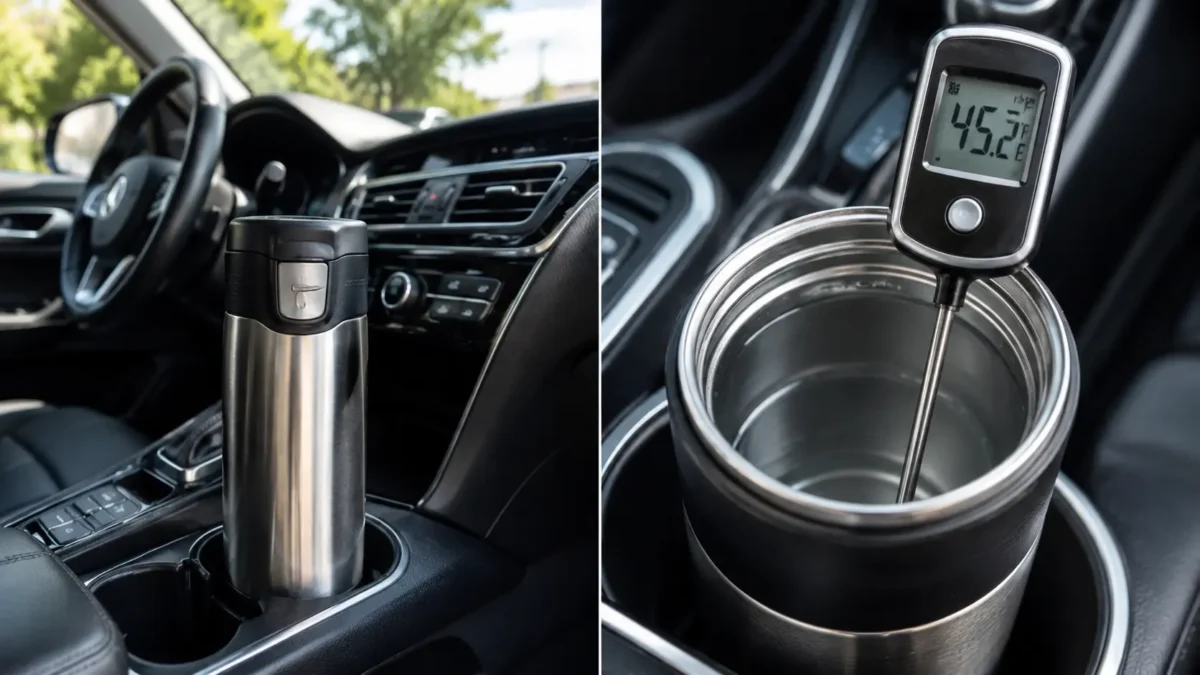
Day 2: Train Commute with the Zojirushi
Scenario: One hour on a train, followed by a walk from the station
Arrival temperature: 183°F (84°C)
Spill result: No moisture inside the backpack pocket
I placed the Zojirushi in the side pocket of my backpack and stopped treating the bag gently.
It was bumped against a train seat, tilted beneath my coat, and jostled during the walk from the station. The lock never shifted. When I checked the surrounding fabric at the office, it was completely dry.
The first sip was still startlingly hot.
That is the Zojirushi experience in miniature: superb heat retention wrapped in an unapologetically practical design. The slim body was easy to carry, and the lid opened with one thumb after unlocking.
Cleaning was less effortless. Several small lid components needed to be removed and dried separately. I would happily accept that routine on a long train commute, but casual desk drinkers may find it excessive.
Commuter verdict: The mug I trusted most beside a laptop. Best for public transport, long days, and anyone who refuses to gamble with bag leaks.
Day 3: Walking Commute with the MiiR 360 Traveler
Scenario: A 30-minute walk with the mug carried by hand
Arrival temperature: 176°F (80°C)
Spill result: Dry when closed
The MiiR was the nicest mug to drink from while moving.
There was no mouthpiece to rotate into position. I pressed the center button, raised the mug, and drank from whichever side happened to face me. That sounds like a small convenience until you use it repeatedly on a walk.
The slim body felt solid without becoming tiring to carry. It also slipped easily into my bag pocket when I needed both hands.
Coffee was still comfortably hot after 30 minutes, and the lid did not leak once closed. The only uncertainty was cleaning beneath the center button. A small brush is useful here because coffee residue can collect where a sponge cannot reach.
Commuter verdict: Best for walkers who appreciate clever, unobtrusive design. The 360-degree lid is not essential, but it is genuinely delightful.
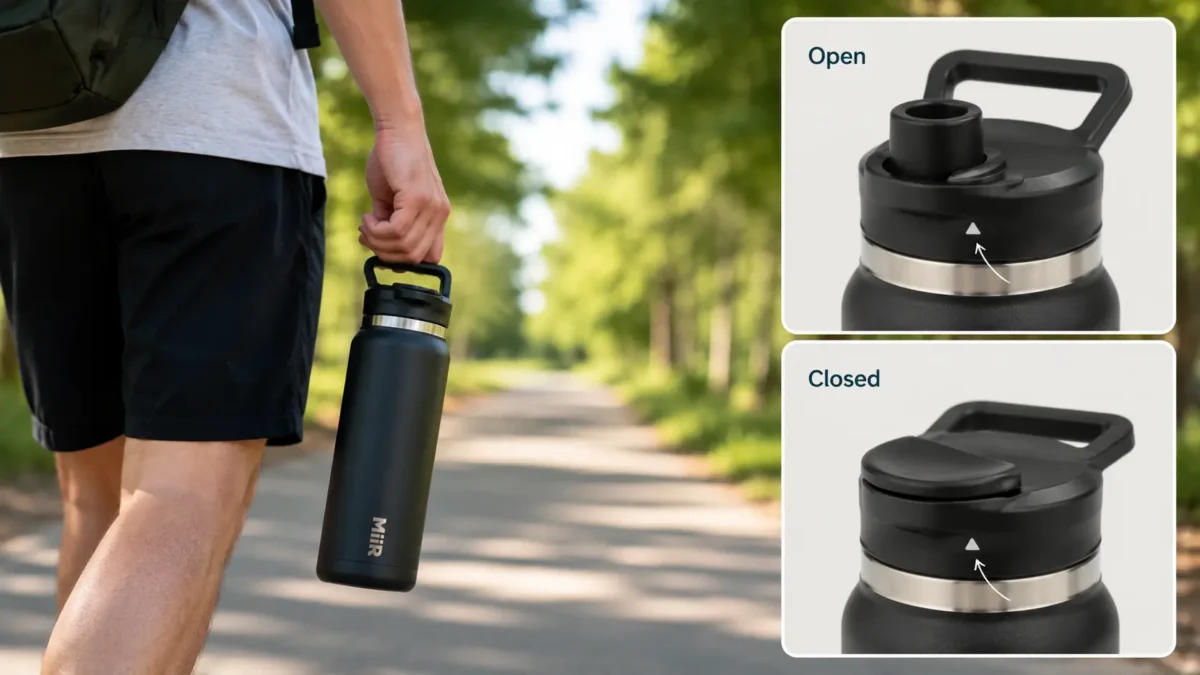
Day 4: Office Day with the Fellow Carter Move
Scenario: Desk use with a refill from the office coffee pot
Temperature after two hours: 148°F (64°C)
Spill result: Not Compared; loose inside a bag
The Carter Move made mediocre office coffee taste noticeably better.
Its ceramic-coated interior produced none of the metallic edge I detected from some unlined stainless-steel mugs. The wide opening also delivered more aroma, making it feel closer to drinking from a proper café cup.
It looked good on the desk, too. Slim, restrained, and far removed from the camping-equipment appearance of the YETI.
The Carter was easy to rinse in the office sink because I could reach inside the body without fighting a narrow neck. The splash guard needed separate attention, but cleanup remained manageable.
Heat retention was not the strongest of the week. That hardly mattered at a desk where refills were available, and I finished each serving within a couple of hours.
Commuter verdict: The best desk mug for people who care about taste. Choose it for the drinking experience, not maximum heat retention.
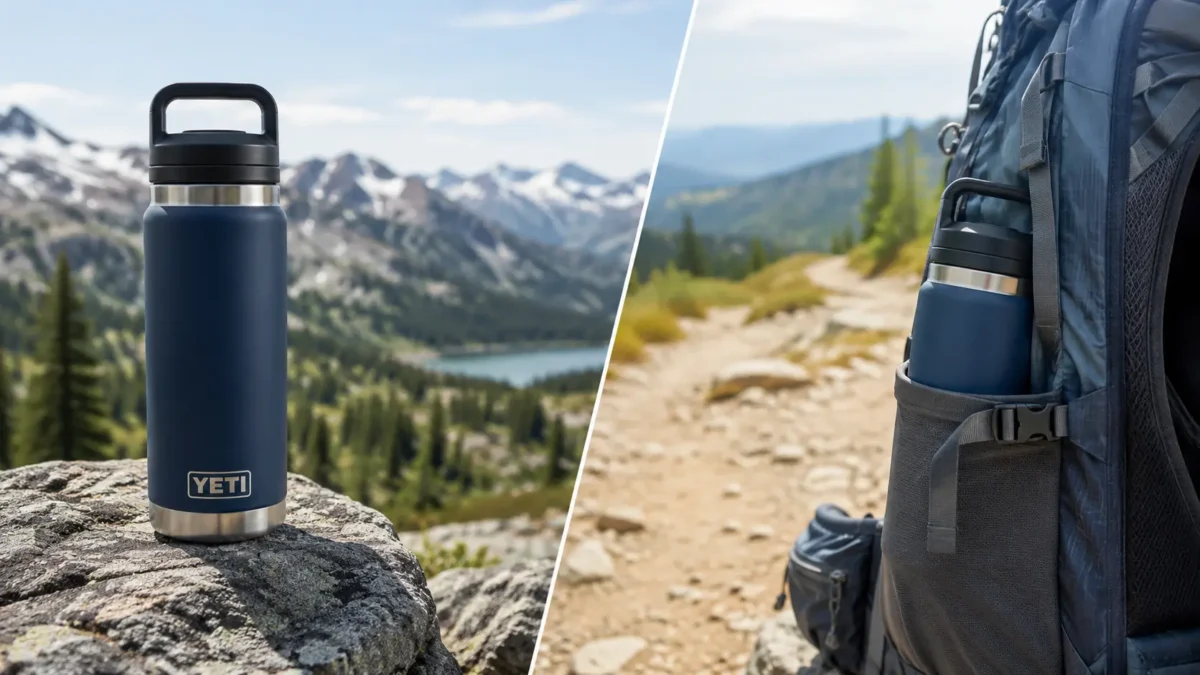
Day 5: Outdoor Adventure with the YETI Rambler
Scenario: A morning hike with a temperature check after two hours
Two-hour temperature: 157°F (69°C)
Spill result: Splashing occurred when tilted
The YETI felt ready for the trail. The handle was reassuringly solid, the body shrugged off bumps, and the MagSlider remained easy to operate with cold hands.
It was also the heaviest and bulkiest mug of the week.
Most importantly, I did not place it loose inside the main backpack compartment. The MagSlider is splash-resistant, not leakproof. I carried the mug upright in an exterior pocket where a small spill could not baptize spare clothing in coffee.
After two hours, the drink remained hot enough to enjoy during a rest stop. The wide opening made drinking comfortable, and the magnetic slider popped out easily for cleaning.
This was the day the YETI reputation made sense, and its limitations became impossible to ignore.
Commuter verdict: Excellent for campsites, tailgates, and upright outdoor use. A poor choice for sealed transportation inside a backpack.
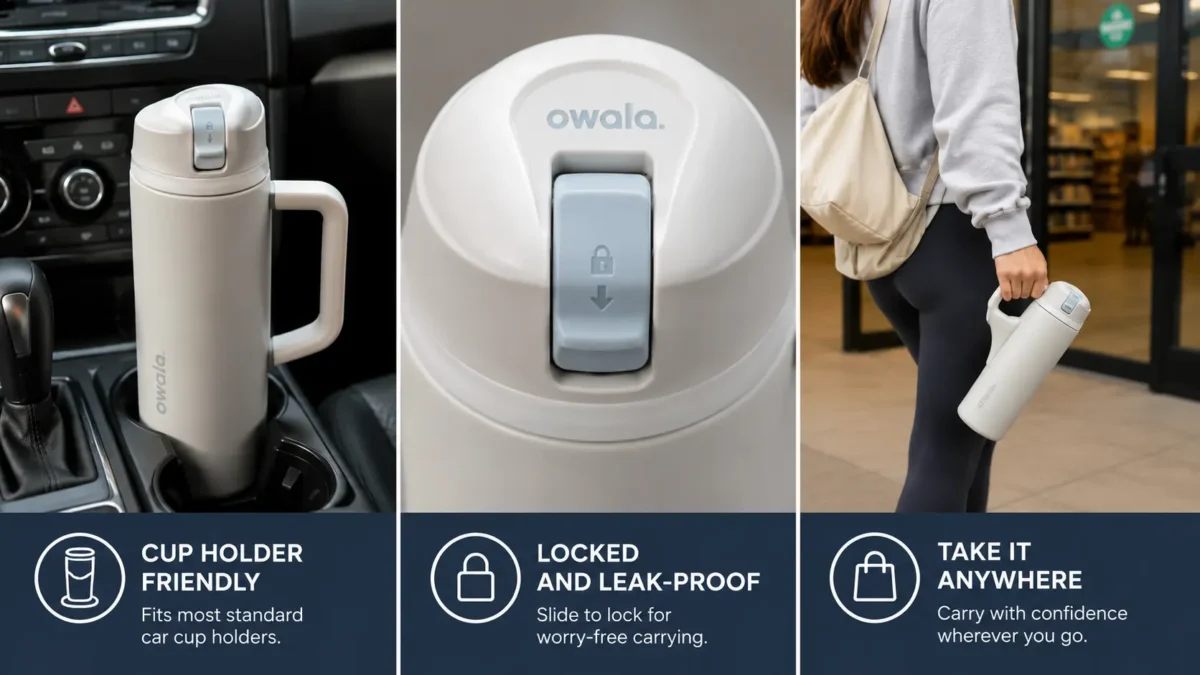
Day 6: Running Errands with the Owala SmoothSip Slider
Scenario: Several short drives with the mug carried into stores
Temperature after errands: 154°F (68°C)
Spill result: Dry when the slider was fully locked
The Owala moved easily between the cup holder, my hand, and a tote bag.
Its mouthpiece was one of the most comfortable in the group. There were no sharp plastic edges, and the slider moved with a satisfying, deliberate action. Coffee remained hot throughout the errand run without being scalding hours later.
The lock mattered. Without it, the slider could potentially be moved by another object inside a bag. Once locked, however, the lid stayed closed, and the surrounding paper towels remained dry.
The 12-ounce body was compact enough to carry through stores without feeling like gym equipment. Its brighter colors also made it easy to spot when I inevitably left it beside a checkout counter.
Commuter verdict: The most convenient choice for a day involving frequent stops. Comfortable, compact, and secure when properly locked.
Day 7: Weekend Brunch with the Hydro Flask Coffee Flex Sip
Scenario: A short drive to a friend’s house
Arrival temperature: 174°F (79°C)
Spill result: Completely dry when closed
The Hydro Flask did not dominate any single category. It simply handled everything well.
The closed Flex Sip lid remained secure during the drive, the mug fitted comfortably in the cup holder, and the coffee arrived piping hot. Its powder-coated body felt solid in hand and looked presentable enough to place on the brunch table without shouting “expedition supplies.”
My friend liked the color and uncomplicated shape. I appreciated being able to place the entire current model in the dishwasher afterward.
The twist mechanism was still slightly stiff, particularly compared with the effortless Contigo button. It is better suited to secure transportation than rapid one-handed drinking.
Commuter verdict: The strongest all-rounder. It balances insulation, portability, cleaning, and appearance without attaching a major annoyance to daily use.
Weekly Commuter Results
Situation | Mug I Would Reach For | Why |
Daily driving | Contigo West Loop | The simplest one-handed operation |
Train or bus commute | Zojirushi | Maximum leak confidence and heat retention |
Walking commute | MiiR 360 Traveler | Lightweight body and any-angle sipping |
Office desk | Fellow Carter Move | Cleanest taste and best open-rim experience |
Hiking or camping | YETI Rambler | Exceptional durability and easy field cleaning |
Shopping and errands | Owala SmoothSip Slider | Compact, comfortable, and secure when locked |
Mixed everyday use | Hydro Flask Flex Sip | The most balanced combination of strengths |
Overall Reflections
The laboratory winner was not automatically the mug I wanted every day.
For a long train commute, I would choose the Zojirushi without hesitation. It kept coffee hotter than I usually needed and never once threatened the contents of my bag.
For driving, the Contigo was easier. Its AUTOSEAL button required the least attention and never dribbled a drop.
At a desk, I preferred the Fellow. Coffee tasted cleaner, and its thin rim was a joy to sip from. For walking, the MiiR’s 360-degree lid turned out to be more useful than its specification sheet suggested.
The YETI earned its place outdoors, provided it stayed upright. The Owala handled busy errand days particularly well. The Hydro Flask was the mug I would choose when I did not know what the week would involve.
That is the lesson from seven days of commuting: the best travel mug is not simply the one with the highest test score. It is the one whose strengths appear during your routine, and whose flaws do not appear before your first cup is finished.
Cleaning and Maintenance Guide
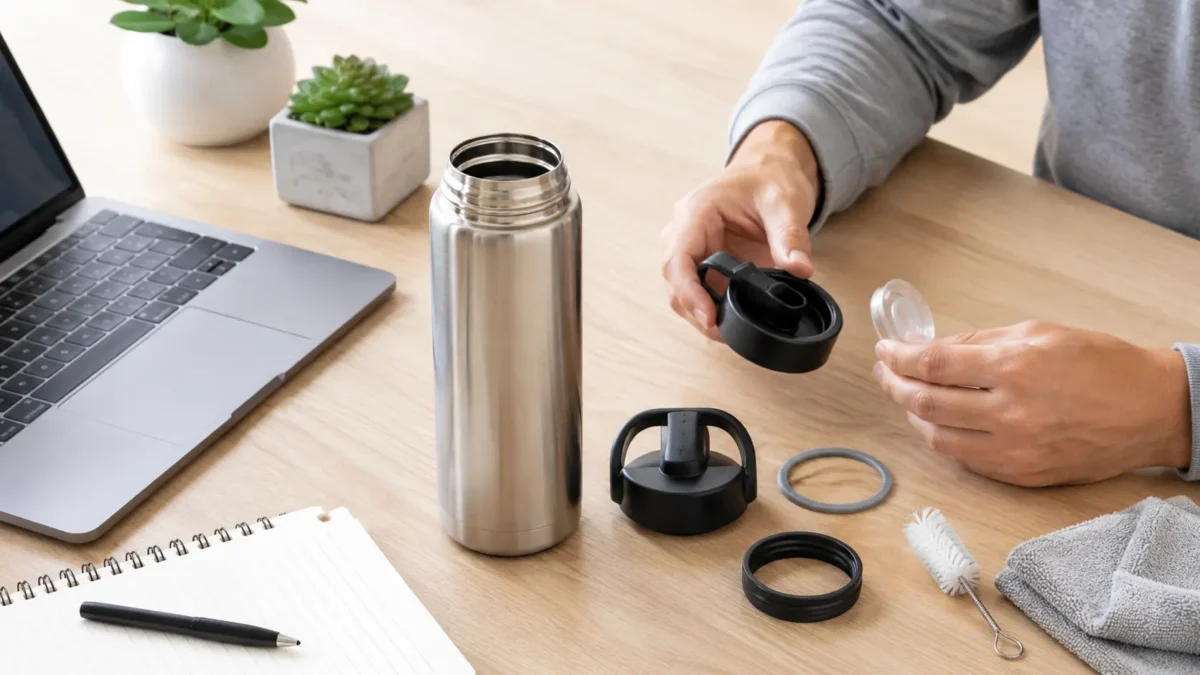
A travel mug can keep coffee piping hot for years, but only if you clean the parts your eyes cannot see. Coffee oils, milk residue, and sugar collect around gaskets, vents, sliders, and drinking valves. Left alone, they create stale smells, mold, and the unmistakable taste of yesterday’s latte.
Daily Cleaning Routine
For most mugs, this takes less than five minutes.
- Empty and rinse immediately.
Rinse the mug with warm water as soon as you finish drinking. Dried coffee oils are much harder to remove than fresh ones. - Separate the lid from the body.
Never clean a sealed mug as one piece. Remove the lid, gasket, slider, stopper, or splash guard if the manufacturer allows it. - Wash with warm water and mild dish soap.
Use a soft sponge or bottle brush. Avoid metal scrubbers, which can scratch stainless steel and create hiding places for residue. - Flush the drinking path.
Run water through the spout, vent, slider channel, or center button. These small passages are where old coffee tends to linger. - Rinse thoroughly.
Soap left inside a lid can affect the taste of your next brew. - Dry every part completely.
Leave the lid open and the gasket removed until everything is dry. Reassembling a damp lid is how a clean mug becomes a tiny humidifier for mold.
A wide mouth, ideally around 2.5 inches or more, makes it easier to reach the interior, add ice, and use a pour-over brewer. Narrower mugs need a long bottle brush and a little more patience.
Deep Cleaning: Stains and Odors
Do a deeper clean once a week if you drink coffee with milk, creamer, sugar, or flavored syrups. Plain black coffee drinkers can usually stretch this to every couple of weeks.
Baking soda paste for stains
Mix baking soda with a small amount of water until it forms a paste. Apply it to the interior, leave it for 10–15 minutes, then scrub gently with a soft brush and rinse well.
This is best for brown coffee staining and light residue. Do not use it with vinegar at the same time; the fizz is entertaining, but it does not make the cleaning more effective.
Vinegar soak for odors.
Fill the mug halfway with equal parts distilled white vinegar and warm water. Let it sit for 15–30 minutes, then wash with dish soap and rinse several times.
Use this for lingering smells, not as a daily routine. Never combine vinegar with bleach or other cleaning chemicals.
Denture tablets for stubborn buildup
Fill the mug with warm water and add one denture-cleaning tablet. Leave it for 15–30 minutes, then scrub, rinse, and allow the mug to dry completely.
Check the manufacturer’s care instructions first, particularly for ceramic linings, painted finishes, and complex lids.
Lid-Specific Cleaning Instructions
The lid is the part most likely to leak, smell, or quietly collect grime. Here is how to handle each mug in this guide.
- Zojirushi SM-SHE48/60: The stopper is designed to come apart for thorough cleaning. Remove the stopper components and gaskets, wash each piece separately, and let the gaskets dry before reassembly. The model uses a two-step lid release and a narrow 1⅝-inch opening, so a small brush is useful. Zojirushi lists a five-year warranty on the vacuum insulation in the U.S. and Canada.
- Contigo West Loop 3.0 AUTOSEAL: Open the Easy-Clean lid fully and rinse through both the drinking spout and vent. The lid is top-rack dishwasher safe, while the stainless body should be hand-washed. Contigo’s cleaning guidance also recommends flushing the lid with lemon juice or white vinegar when odors persist.
- YETI Rambler with MagSlider: Pop off the MagSlider, remove the gasket, and place the small pieces in the dishwasher utensil basket. Dry everything before reinstalling the gasket. The magnet adds spill resistance, but it does not make the mug leakproof.
- Fellow Carter Move: Hand-wash the mug and lid with warm water, dish soap, and a soft sponge. Fellow recommends disassembling the Slide lid at least weekly, especially when you use milk, creamer, or sugar. Remove the silicone gasket gently with a blunt, non-sharp tool, so you do not nick it.
- MiiR 360 Traveler: MiiR recommends hand-washing the body and using a small brush beneath the center button. Do not disassemble the 360 lid unless MiiR specifically instructs you to; the lid is top-rack dishwasher safe.
- Hydro Flask Coffee Flex Sip: Rinse the lid first, then scrub it with mild, bleach-free soap and a soft brush. The Flex Sip lid comes apart for cleaning, and all lid pieces are top-rack dishwasher safe. Keep small parts secure in the dishwasher basket.
- Owala SmoothSip Slider: Unscrew the lid, pop off the slider, rotate the seal until the plastic piece releases, and remove the rubber gasket. Wash the lid, slider, seal, and small plastic parts with hot soapy water. Owala recommends placing the small parts in the utensil basket, putting the lid on the top rack, and hand-washing the stainless body to protect its finish.
Maintaining Vacuum Insulation Performance
Vacuum insulation does not usually fade gradually for no reason. It is most often damaged by impact.
Avoid dropping the mug, denting the body, freezing it, or microwaving it. A dent can compromise the space between the steel walls. Microwaving is unsafe for stainless steel unless the manufacturer explicitly says otherwise.
A sudden loss of heat retention is the warning sign to watch for. If coffee that once stayed hot for hours becomes lukewarm quickly, and the exterior begins feeling unusually warm, suspect a damaged vacuum seal rather than a dirty lid.
Before assuming the mug is finished, clean the lid and check the gasket. A loose or cracked seal can mimic insulation failure. If the body is dent-free but performance has collapsed, contact the manufacturer; vacuum-insulation defects may be covered by warranty.
Replacement Parts and Warranty
Warranty terms vary by country. The table below reflects current U.S. manufacturer information checked in July 2026.
Mug | Manufacturer warranty | Replacement lids, seals, or service |
Zojirushi SM-SHE48/60 | Five years on vacuum insulation in the U.S. and Canada | Order model-specific parts through Zojirushi Parts & Accessories |
Contigo West Loop 3.0 | Limited Lifetime Guarantee in the U.S. and Canada | Warranty covers mugs and replacement lids, but Contigo says it does not ship individual gaskets or seals; use its warranty claim process |
YETI Rambler | Five years for Rambler drinkware | Buy MagSlider lids and parts through YETI accessories or contact YETI support |
Fellow Carter Move | One-year limited warranty for non-electric products | Replacement Carter lids are sold directly by Fellow/ |
MiiR 360 Traveler | Lifetime warranty against manufacturer defects | Start with MiiR warranty/support; 360-lid availability can vary |
Hydro Flask Coffee Flex Sip | Hydro Flask Promise/lifetime coverage for qualifying defects | Flex Sip replacement lids are available through Hydro Flask accessories |
Owala SmoothSip Slider | Limited Lifetime Warranty for mugs and tumblers | Check Owala replacement parts or submit a warranty claim |
Keep your receipt and note the model number before contacting support. “Replacement lid” does not always mean “replacement gasket,” and some brands replace the entire mug rather than sending individual internal parts.
The maintenance habit that matters most is simple: wash the lid, dry the lid, and do not put it back together while anything is still damp. That one step prevents a remarkable amount of odor, mold, and morning-coffee regret.
Environmental Impact and Sustainability
A reusable mug is not automatically an environmentally friendly mug. It still requires mined metals, energy-intensive manufacturing, packaging, shipping, and replacement parts.
The real environmental win comes from using one mug for a long time, and choosing a design that can be cleaned, repaired, and kept in service instead of tossed after one failed lid.
Materials and Recyclability
All seven mugs use stainless-steel bodies, except that the Fellow Carter Move adds a ceramic lining. Stainless steel is highly recyclable and can be recycled repeatedly without losing its basic material quality. Industry data estimates that roughly 95% of end-of-life stainless steel is collected and recycled into new stainless steel.
That does not mean you can put an entire travel mug in your curbside recycling bin.
The body may be accepted by a scrap-metal dealer, but lids usually contain a mixture of plastic, silicone, magnets, springs, and adhesives. Small mixed-material parts are often not accepted by household recycling programs. Check your local rules before placing a lid or gasket in the bin.
The ceramic lining in the Fellow Carter can improve taste, but it also adds another bonded material that makes end-of-life separation more complicated. The trade-off is familiar: better drinking performance can mean a harder recycling pathway.
Mug | Main materials | End-of-life reality | Sustainability takeaway |
Zojirushi SM-SHE48/60 | Stainless steel, BPA-free plastic, silicone gaskets | Steel body has scrap value; lid must be separated into small parts | Long service life and replaceable model-specific parts help prevent early disposal |
Contigo West Loop 3.0 | Stainless steel, plastic AUTOSEAL lid, silicone components | Steel is recyclable; the mechanism is a mixed-material assembly | The long warranty supports replacement of a defective mug, although individual seals may not be available |
YETI Rambler | Stainless steel, plastic MagSlider, silicone gasket, magnet | Body is highly recyclable; lid needs disassembly before disposal | Strong durability and five-year Rambler coverage can keep the mug in use for years |
Fellow Carter Move | Stainless steel, ceramic lining, plastic lid, silicone gasket | Bonded ceramic and mixed lid parts complicate recycling | Excellent taste and replacement lids are useful, but the design is less straightforward to recycle |
MiiR 360 Traveler | Stainless steel, plastic 360 lid, silicone components | Body and lid should be separated; small lid parts are unlikely to be curbside recyclable | Lightweight construction and a lifetime defect warranty support long-term use |
Hydro Flask Coffee Flex Sip | Stainless steel, plastic lid, silicone seal | Steel body is recyclable; lid parts require separate handling | A durable body, replacement Flex Sip lids, and packaging improvements strengthen its environmental case |
Owala SmoothSip Slider | 18/8 stainless steel, plastic slider, silicone seal | Body is recyclable through appropriate metal channels; lid is mixed material | Replaceable parts and a limited lifetime warranty make keeping the mug in service easier |
The most important material is often the one you do not have to manufacture a second time.
Packaging Matters, But Use Caution
Packaging claims are uneven across the brands. Hydro Flask publishes some of the clearest figures: its redesigned packaging uses at least 80% recycled content, paper from well-managed forests, and soy-based inks.
YETI’s ESG program specifically discusses sustainable packaging, preferred materials, circularity, and reducing operational waste, although its public reporting does not give the same simple packaging percentage for every Rambler product.
For the other mugs, packaging can vary by country, retailer, and fulfillment method. A product shipped from a marketplace may arrive in a different box from the same product purchased directly from the manufacturer. That makes precise brand-to-brand packaging claims difficult unless the company publishes product-level data.
The practical advice is simple: keep the original box only if you need it for a return. Otherwise, recycle the cardboard according to local rules and do not assume plastic sleeves or foam inserts belong in curbside recycling.
Brand Sustainability Initiatives
MiiR: Give Code and project funding
MiiR has the most visible give-back model in this group. Its Give Code system links products to trackable projects supporting communities and the environment. MiiR has also highlighted 1% for the Planet membership and projects involving clean water, food systems, and community development.
One important update: MiiR’s product-donation application program is currently paused, with the company asking people to check back in mid-2026.
So MiiR earns credit for transparency and impact reporting, but readers should distinguish active give-back projects from programs that are temporarily paused.
Hydro Flask: Parks for All
Hydro Flask’s Parks For All program supports nonprofit organizations working to build, maintain, restore, and improve access to parks and outdoor spaces. Hydro Flask says the program has awarded millions of dollars in grants, including a reported $3.1 million in grants highlighted in its corporate-responsibility materials.
That does not make the mug itself carbon-neutral. It does give the brand a clearly defined environmental and community program rather than a vague “green” slogan.
YETI: Product life and ESG reporting
YETI’s sustainability reporting focuses on the whole product life cycle. Its stated priorities include preferred materials, renewable energy at partner factories, more sustainable packaging, circularity programs, and reducing operational waste.
The strongest environmental argument for the Rambler is still its physical durability. A mug that survives years of drops is more useful than a theoretically greener mug that needs replacing every few months.
Zojirushi, Contigo, Fellow, and Owala
These brands do not present a consumer-facing sustainability program as prominently as MiiR, Hydro Flask, or YETI in the materials reviewed for this guide. Their environmental strengths are more practical:
- Zojirushi: model-specific replacement parts and long-lasting vacuum insulation.
- Contigo: a Limited Lifetime Guarantee that covers defective mugs and replacement lids in the U.S. and Canada, although the company says it does not send individual gaskets or seals.
- Fellow: replacement Carter lids and a refurbished-product program, although the refurbished offering is not specific to every Carter mug.
- Owala: replacement parts for selected products and a Limited Lifetime Warranty covering mugs and tumblers.
These are not flashy initiatives. They are still useful. Keeping a lid or gasket in service is usually better than replacing an entire mug.
How Many Disposable Cups Does One Mug Replace?
The calculation is straightforward:
Disposable cups avoided = number of uses per week × number of weeks used
If you use the mug once every weekday:
- 5 uses per week × 52 weeks = 260 disposable cups avoided per year
- Every day of the year = 365 cups avoided
- Three commuting days per week = 156 cups avoided
That is a simple count, not a complete carbon-footprint calculation. A stainless-steel mug has a manufacturing footprint of its own, so the environmental benefit grows with continued use. One year is helpful; several years is much better.
The global travel-mug market was estimated at approximately $14.3 billion in 2025 by commercial market researchers, with reusable consumption and eco-conscious buying listed among the growth drivers. The exact figure varies by research firm and market definition, so treat it as an industry estimate rather than an official environmental statistic.
The Most Sustainable Choice
For an eco-conscious buyer, the best mug is usually:
- Durable enough to survive daily use.
- Easy to clean so it does not get abandoned.
- Covered by a meaningful warranty.
- Supported by replacement lids or seals.
- Used consistently instead of replaced for cosmetic reasons.
In this lineup, the Hydro Flask and YETI make strong durability-and-longevity cases. MiiR stands out for its give-back model. Zojirushi and Contigo benefit from practical replacement and warranty support. Fellow is a more specialized choice: excellent for taste, but less simple at end of life because of its ceramic lining. Owala is promising for repairability, provided replacement parts remain available for the specific SmoothSip model.
The greenest mug is rarely the one with the most impressive slogan. It is the one you keep reaching for after the novelty wears off.
Frequently Asked Questions
Can I put my travel mug in the microwave?
How do I remove coffee stains?
Are replacement lids available?
Why does my coffee taste metallic?
Can I use my travel mug for cold drinks?
Yes. A wide mouth makes adding ice easier. A straw lid is useful for iced drinks.