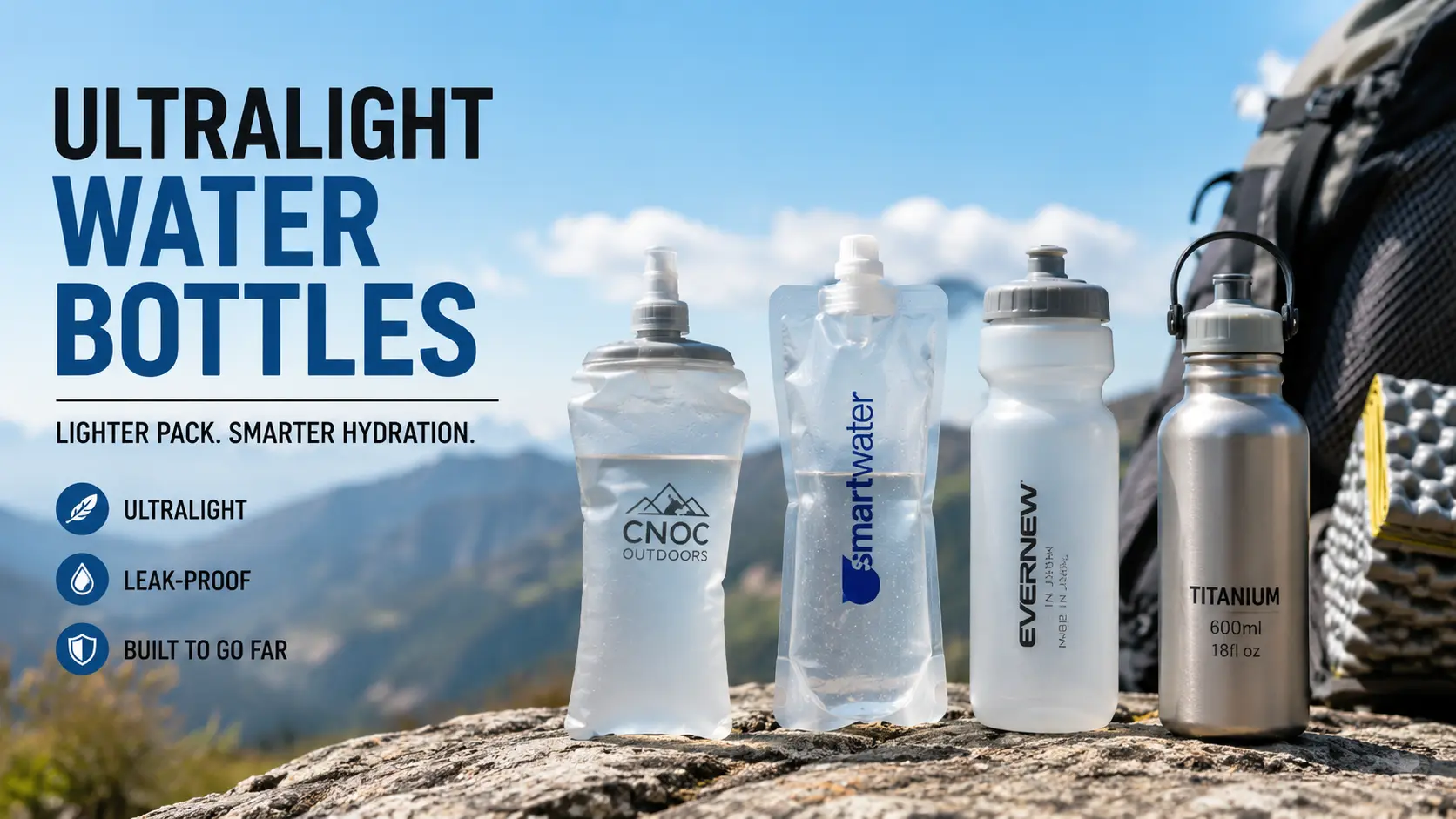
Halfway up the switchbacks, with the sun just clearing the ridge, I unscrewed the Nalgene and felt every one of its 178 grams. That was the moment I knew I’d be swapping it for a 38-gram Smartwater before the next trip.
That 140-gram difference is the weight of a full energy bar and a handful of tent stakes, carried every step, for every mile. On a 20-mile day, that’s dead weight you’re hauling for no reason. And it’s not just about the scale, as any Hydro Flask 10oz vs 16oz comparison makes clear. Choose the wrong bottle and you’re fumbling with adapters at a creek crossing, or discovering a slow leak has soaked your quilt. The stakes are real.
Key Takeaways
- Swapping a standard Nalgene (178 g) for a Smartwater (38 g) saves 140 grams per bottle, the weight of a full energy bar and a handful of tent stakes, repeated with every step
- The lightest bottle isn’t always the best choice: filter compatibility, packability, and durability matter as much as the number on the scale.
- A complete ultralight hydration system is three pieces: dirty reservoir, filter, and clean bottle, and the right pairing eliminates adapters and frustration
- Purpose-built bottles like the Cnoc ThruBottle and Evernew Water Carry now rival disposables on weight while adding years of reuse
- Use the interactive calculator below the comparison table to see exactly how many grams you’ll drop by switching from your current bottle
This guide cuts through the noise. We’ve trail-tested the bottles gram-counters actually carry, from the ubiquitous Smartwater to collapsible dirty-water reservoirs that pack flat. You’ll get a no-fluff weight comparison table, a filter compatibility breakdown that shows exactly which threads match, and a printable checklist to build your own ultralight system. No marketing speak, just what works when you’re tired, thirsty, and miles from the next source.
But before you start swapping caps, you need to understand what actually makes a bottle lightweight, and where the trade-offs hide.
What Makes a Water Bottle Lightweight: Materials & Design
Every gram you save starts with the material the bottle is made from, and the design decisions that put that material to work. A bottle’s weight on the spec sheet is only half the story; the real number is what it weighs on your scale, with the cap you’ll actually use, after a few hundred miles of abuse.
The weight savings are real, but Smartwater bottles are not reusable, no matter how many hikers pretend they are. We’ve all pushed one past its intended lifespan.
After a few hundred miles, the once-clear plastic turns cloudy, a sure sign of PET breakdown, and the water starts tasting faintly of plastic.
The bottle still weighs 38 grams, but it’s no longer the safe, clean vessel it was on day one. That’s the trade-off you’re making with every gram you shave.
Expert Tip: Weigh your empty bottle on a digital scale before a trip: manufacturer specs often exclude the cap, and a few grams off can add up over multiple bottles.
The Role of Materials: Tritan, TPU, PET, and More
PET is the lightest option (a 1L Smartwater weighs just 38 grams) but it’s a single-use plastic. With repeated use, it clouds and can leach chemicals. It’s the gram-counter’s default, but it’s disposable by design.
Tritan copolyester adds weight (around 107 grams for a 1L Nalgene) but is BPA-free, BPS-free, and BPF-free. It won’t cloud or impart taste, and it’s dishwasher-safe. For day hikes where durability trumps grams, Tritan is the safe, no-fuss choice.
TPU splits the difference. Bottles like the Cnoc ThruBottle weigh 54-63 grams, collapse flat when empty, and can handle boiling water. That’s something PET and Tritan can’t do without warping. The trade-off is a slight plastic taste that fades with use. TPU is the go-to for dirty water reservoirs and gravity systems.
PE (polyethylene) appears in ultralight bottles like the Evernew Water Carry. It’s similar in weight to PET but more flexible and less prone to cracking. It lacks Tritan’s toughness and TPU’s heat resistance. But it’s a solid middle ground for gram-counters who want a reusable bottle that won’t degrade as fast as PET.
Design Features That Shave Grams: Wall Thickness, Cap Style, and Shape
Wall thickness is the invisible weight driver. A bottle with 0.3mm walls can weigh half as much as one with 0.6mm walls, but it’ll crush more easily. Smartwater’s thin walls deform with a squeeze. That’s a feature for backflushing a filter, but a liability on a rocky fall.
Cap style is the easiest place to save grams. A standard screw cap adds 10-15 grams; a flip-top sport cap cuts that in half and lets you drink one-handed. Some caps include a clip loop, adding a gram but preventing drops.
Expert Tip: Swap a heavy screw cap for a sport cap to save grams and drink one-handed on the move. Just check the seal before you pack.
Shape determines packability. A rigid cylinder slides into a side pocket but takes up the same space empty or full. A collapsible bottle flattens to a disc, freeing pack volume. The best water bottles for cold water balance grab-and-drink ease with the ability to disappear when not in use.
BPA-Free, Tritan, and TPU: Safety and Health Considerations
“BPA-free” is a starting point, not a guarantee. Many plastics replace BPA with BPS or BPF, which may carry similar risks. Tritan is explicitly free of all three, and independent testing backs that up, unlike bottles with hidden plastic in stainless steel construction. TPU is food-safe but can retain odors and a faint taste, especially in heat. PET’s safety hinges on single use: cloudiness signals breakdown, and at that point, it’s time to recycle the bottle.
Recyclability varies. PET is widely accepted curbside. Tritan is #7 plastic and often not recycled. TPU and PE are rarely recyclable through municipal systems. If sustainability matters, a long-lasting Tritan bottle you’ll use for years may have a lower footprint than a series of disposable PET bottles.
Those material and design choices translate directly into the numbers that matter. Here’s how every bottle stacks up, gram for gram.
Weight Comparison Table
Enough theory. Here’s every bottle in this guide, weighed, measured, and ranked. The numbers don’t lie, but they do hide a few surprises.
| Bottle Model | Weight (grams) | Capacity (liters) | Material | Filter Compatibility | Packability | Price (USD) |
|---|---|---|---|---|---|---|
| Smartwater 1L | 38 | 1.0 | PET | 28mm (Sawyer) | Rigid | ~$1.50 |
| Platypus SoftBottle 1L | 23 | 1.0 | PE/TPU laminate | 28mm (Sawyer) | Collapsible | ~$13 |
| Evernew Water Carry 1.5L | 37 | 1.5 | PE | 28mm (Sawyer) | Collapsible | ~$15 |
| Cnoc Outdoors ThruBottle 1000 | 54 | 1.0 | TPU | 28mm (Sawyer) & 42mm (BeFree) | Collapsible | ~$20 |
| Smartwater 1.5L | ~45 | 1.5 | PET | 28mm (Sawyer) | Rigid | ~$2 |
| HydraPak Stow 1L | 57 | 1.0 | TPU | 28mm (Sawyer) | Collapsible | ~$20 |
| Nalgene Ultralite Wide Mouth 1L | 107 | 1.0 | Tritan | Requires adapter (63mm) | Rigid | ~$15 |
An interactive calculator lets readers select their current bottle and instantly see grams saved and the percentage of pack weight reduced by switching to each bottle in the table.
A few numbers jump out. The Evernew 1.5L weighs just 37 grams, lighter than a Smartwater 1L despite holding 50% more water. The Cnoc ThruBottle is the only bottle that combines wide-mouth BeFree compatibility, collapsibility, and Sawyer threading, at 54 grams. And the Nalgene Ultralite, at 107 grams, is among the best 32 oz water bottles despite remaining the heaviest and the only truly bombproof option.
The Platypus SoftBottle undercuts everything at 23 grams, but that number comes with a catch. You’d think the lightest bottle would be the flimsiest, right? I watched a hiking partner pull a Platypus SoftBottle from his pack, 23 grams of laminated film that folded smaller than a deck of cards.
He’d been using it for 500 miles, and it hadn’t sprung a leak, but he treated it like a fragile piece of gear, never letting it rub against a sharp rock.
That’s the trade-off the spec sheet doesn’t show: the Platypus saves grams by sacrificing puncture resistance, a fact you only learn when you see someone babying it at every water source. The table reveals a clear trade-off: every gram saved in bottle weight often sacrifices either durability or wide-mouth convenience.
Numbers tell part of the story. The rest lives in how these bottles actually perform when you’re 50 miles from the nearest road.
Best Lightweight Water Bottles: Detailed Reviews
I’ve carried every one of these bottles on real trails; here’s what survived, what failed, and what earned a permanent spot in my pack.
Smartwater 1L: The Thru-Hiker’s Gold Standard
The Smartwater bottle is the undisputed champion of gram-counting. At 38 grams, it’s lighter than any purpose-built hiking bottle. Its 28mm threads mate directly with a Sawyer Squeeze filter: no adapter, no fuss. That slim profile slides into any pack pocket, and when it finally wears out, you can grab a fresh one for a dollar at the next gas station. On a long trail, that replaceability is a superpower.
Durability is the trade-off. The thin plastic crinkles after a few weeks of squeezing, and a hard drop onto granite can crack the base. I’ve had one fail at the seam after 300 miles of daily filtering. The narrow mouth also makes cleaning a chore. You’ll need a bottle brush and some patience to reach the bottom. But for pure weight savings and filter compatibility, nothing else comes close.
Expert Tip: Use a permanent marker to add 500ml and 1L measurement lines to your bottle for precise cooking and hydration tracking.
Expert Tip: Clip a small carabiner through the bottle’s cap loop to your shoulder strap for hands-free access on the move.
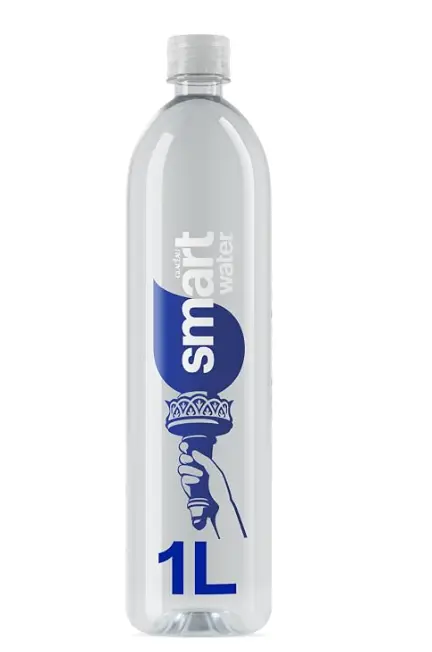
Smartwater 1 L Vapor-Distilled Water Bottle with Electrolytes
Smartwater 1 L is vapor-distilled and enhanced with electrolytes for a crisp, clean taste. Its lightweight bottle makes it easy to carry to the gym, office, or on the go, while the sugar-free, caffeine-free formula provides simple everyday hydration.
Cnoc Outdoors ThruBottle 1000: The Filter-Friendly Collapsible
The Cnoc ThruBottle is what happens when a thru-hiker designs a bottle from scratch. Its wide mouth accepts both 28mm Sawyer and 42mm Katadyn BeFree filters directly, and the collapsible TPU body rolls down to the size of a fist when empty. At 54 grams, it’s a 16-gram penalty over the Smartwater. But you gain a dirty-water reservoir that’s easy to fill from a trickling stream and a bottle that won’t crack when you sit on it.
The trade-off is taste. TPU can hold onto flavors, especially if you’ve mixed electrolytes or used it as a dirty reservoir. A baking soda soak helps, but the faint plastic note never fully disappears. Still, for versatility and packability, the ThruBottle is the best all-rounder in this guide.
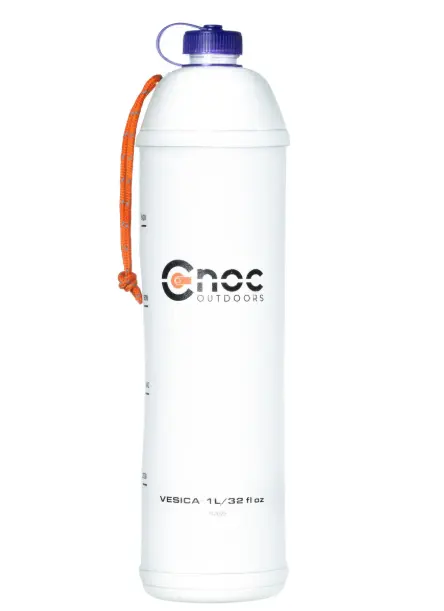
Cnoc Outdoors Vesica 1 L Collapsible Water Bottle
The Cnoc Outdoors Vesica 1 L combines ultralight performance with a collapsible design that packs down small when empty. Weighing just 67 grams and compatible with popular 28 mm water filters, it’s an excellent choice for hiking, backpacking, and travel. The bottle stands upright when full and features a tethered cap for added convenience.
HydraPak Stow 1L: The Packable Workhorse
If pack space is your obsession, the HydraPak Stow is the answer. This 57-gram TPU bottle flattens to the size of a deck of cards. It’s invisible in a daypack or travel bag. The wide mouth is a joy to fill from a faucet or stream, and the material shrugs off drops that would crack a Smartwater.
The downside is the drinking experience. Without a rigid spine, the Stow flops around when half-full, and you’ll need an adapter to thread it onto a Sawyer filter. It’s also not a great squeeze filter. The soft body collapses unevenly. For day hikes and travel, though, the space savings are unbeatable.
Expert Tip: Choose a collapsible bottle like the HydraPak Stow for day hikes; it flattens to the size of a deck of cards when empty, freeing up pack space.
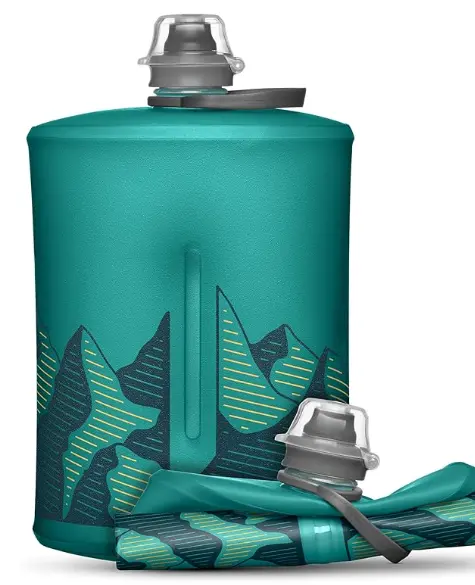
HydraPak Stow 1 L Leakproof Water Bottle for Hiking and Travel
The HydraPak Stow 1 L combines an ultralight, collapsible design with rugged durability for hiking, travel, and everyday adventures. Weighing less than 2 ounces, it rolls up when empty, connects to compatible 28 mm filters, and features a leakproof cap for reliable hydration on the go.
Nalgene Ultralite Wide Mouth 1L: The Durable Classic, Lightened
For those who refuse to baby their gear, the Nalgene Ultralite is the answer. At 107 grams, it’s 71 grams lighter than the standard Nalgene, but it’s still a Tritan tank that can survive a 10-foot drop onto granite. The wide mouth makes cleaning trivial: just soap and a sponge. And it’s the only bottle here that can survive a 10-foot drop onto granite without a second thought.
But 107 grams is heavy by ultralight standards. You’ll also need a Sawyer adapter to use it as a filter bottle, and it takes up the same pack space whether full or empty. If durability is your top priority, this is your bottle. If grams matter more, look elsewhere.
Expert Tip: For narrow-mouth bottles, a bottle brush and denture tablet soak remove stubborn residue; the Nalgene Ultralite’s wide mouth cleans with just soap and a sponge.
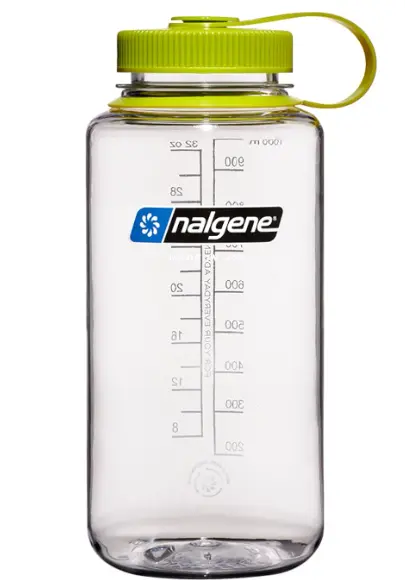
Nalgene 1 L Wide Mouth Water Bottle for Hiking and Travel
The Nalgene 1 L Wide Mouth bottle combines lightweight durability with a leakproof, BPA-free design that’s built for everyday adventures. Its wide opening makes it easy to add ice and clean, while the rugged construction stands up to hiking, gym sessions, commuting, and travel.
Platypus SoftBottle 1L: The Featherweight Champion
At 23 grams, the Platypus SoftBottle is the lightest bottle in this guide, a true featherweight. It’s a laminated PE/TPU pouch that rolls up smaller than a granola bar, making it the ultimate backup bottle for long water carries. I stash one in my pack’s brain for the 20-mile dry stretches where an extra liter means the difference between a comfortable camp and a miserable one.
But that weight comes at a cost. The material is puncture-prone: a sharp stick or a careless crampon can end it. The narrow opening is a pain to fill from shallow sources, and the plastic taste is noticeable, especially in warm weather. Treat it as a fragile backup, not your daily driver.
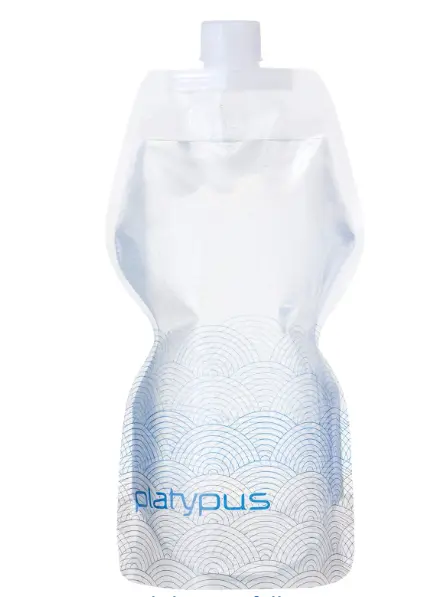
Platypus SoftBottle 1 L Packable Water Bottle with Closure Cap
The Platypus SoftBottle 1 L combines an ultralight, collapsible design with durable, BPA-free materials for hassle-free hydration on the trail. Weighing just 1.2 ounces, it rolls up compactly when empty and features an easy-grip shape, making it a smart choice for backpacking, camping, and travel.
Evernew Water Carry 1.5L: The High-Capacity Ultralight
The Evernew Water Carry 1.5L hits the sweet spot for capacity-to-weight ratio. At 1.3 ounces (37 grams), it’s lighter than most 1L bottles while carrying 50% more water.
The 28mm threads fit a Sawyer Squeeze without an adapter, and the material is tougher than the Platypus. I’ve used the same Evernew for two thru-hikes without a leak. 42 grams.
That’s the manufacturer’s spec for the Evernew 2L, but mine tipped the scale at 45g, still the lightest 2L option, but a reminder that spec sheets aren’t gospel.
The narrow mouth is the main drawback. Filling from a slow seep requires patience, and the bottle doesn’t collapse completely flat: it retains a slight bulge. But for high-capacity carries, nothing else in this guide matches its weight efficiency.
Expert Tip: For gravity filtering, screw a Sawyer Squeeze directly onto a Smartwater or Evernew bottle; the Evernew’s larger capacity means fewer refill trips.
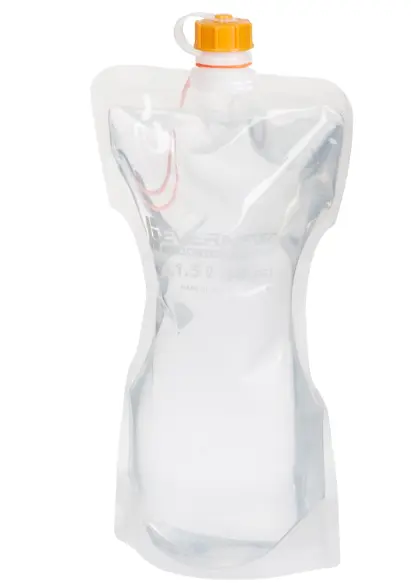
EVERNEW Water Carry 1.5 L Collapsible Water Reservoir
The EVERNEW Water Carry 1.5 L combines ultralight portability with a durable three-layer construction for reliable hydration on long hikes and outdoor adventures. Its collapsible design rolls up compactly when empty, while the gusseted base stands upright for easier filling, cleaning, and storage.
Expert Tip: In freezing temps, store bottles upside down so ice forms at the base, keeping the cap and threads clear for easy opening.
Trail-Tested: Real-World Stories from Thru-Hikers
Specs and lab tests are useful, but nothing beats the stories that come out of actual thru-hikes. Here’s what happened when these bottles met the PCT, AT, and Colorado Trail.
I figured a disposable bottle would crack within a week. By mile 200 on the PCT, I’d learned the opposite. The tell was the thread wear, or rather, the lack of it. A Smartwater bottle’s 28mm neck mates so cleanly with a Sawyer Squeeze that after hundreds of filter-on, filter-off cycles, the plastic still looked fresh.
That’s the diagnostic sign: if your bottle threads show gouging or flattening after a few days, you’re cross-threading or overtightening. A properly threaded Smartwater just works, and at 38 grams, it’s the lightest thing you’ll carry that never complains.
Smartwater on the Pacific Crest Trail
Alex started the PCT with a Nalgene. By mile 200, it was gone. “I was carrying a quarter-pound bottle that did nothing but hold water,” he told me. He swapped to a pair of Smartwater 1L bottles, the ones with the flip-top sport cap, and never looked back. Over the next 700 miles, those two bottles took every drop of unfiltered Sierra snowmelt and desert cache water he threw at them. Zero leaks.
When one finally got a little scuffed, he walked into a gas station in Tehachapi and replaced it for a dollar. That’s the replaceability advantage in a nutshell: you can resupply your water system as easily as a Snickers bar. No other bottle lets you do that.
Cnoc ThruBottle on the Appalachian Trail
Jamie’s 2,000-mile AT thru-hike was a constant up-and-down of water sources, trickling springs, mossy seeps, and the occasional piped spring. The Cnoc ThruBottle’s wide mouth let her scoop from ankle-deep trickles that would have left a narrow-mouth bottle dry. She threaded it directly onto a Katadyn BeFree filter, drank straight from the filter, and then rolled the empty bottle down to the size of a deck of cards.
“In Maine, where water is everywhere but you’re climbing hand-over-fist, that collapsible body just disappeared into my shoulder strap pocket,” she said. The 54-gram TPU bottle survived rocks, roots, and being sat on more times than she can count.
Evernew Water Carry on the Colorado Trail
Morgan section-hiked the Colorado Trail through some of its driest stretches, carrying two 1.5L Evernew Water Carry bottles. At 1.3 ounces each, they gave her three liters of capacity for less than three ounces of bottle weight, a ratio that matters when you’re staring down a 20-mile dry stretch above treeline. She used one as a dirty water reservoir, threading a Sawyer Squeeze directly onto the 28mm neck and hanging the whole rig as a gravity filter.
A pinhole appeared after a sharp rock encounter, but a dab of Seam Grip fixed it in camp. “I’d rather repair a bottle than carry a spare,” she said. That field repairability kept her moving without a hitch.
Your mileage will vary, literally. The right bottle depends on what kind of hiking you actually do. Let’s match bottles to activities.
Filter Compatibility Guide
Your bottle is useless if it doesn’t play nice with your filter. Here’s the compatibility breakdown every hiker needs.
Sawyer Squeeze Compatibility: Direct Thread vs. Adapters
The Sawyer Squeeze filter uses a 28mm thread, the same threading found on Smartwater bottles, Evernew water carries, and some Platypus soft bottles. That means you can screw the filter directly onto the bottle: no adapter needed.
Smartwater bottles are the ultralight standard: 38 grams, a dollar at any gas station, and they thread on perfectly. Evernew bottles are collapsible and durable, making them ideal for a dirty water reservoir in a gravity setup. Some Platypus bottles also thread directly, but check the cap: not all models have the 28mm thread.
If you’re using a different bottle, you’ll need a thread adapter, which adds weight and a potential leak point. For gram-counting hikers, the Smartwater-Evernew direct-thread advantage is a no-brainer.
Expert Tip: Pair a Smartwater bottle with a Sawyer Squeeze filter for a simple, gravity-fed system that requires no adapters.
Katadyn BeFree: Wide-Mouth Bottles That Fit
Standing at the trailhead with a BeFree filter and a Smartwater bottle, the 42mm thread requirement hit us like a splash of cold water. The Katadyn BeFree filter uses a 42mm thread, which is wider than the standard 28mm. Only wide-mouth bottles like the Cnoc ThruBottle fit directly. The Cnoc ThruBottle is designed with a 42mm opening, so it screws on securely.
Third-party adapters exist, but they add complexity, weight, and a risk of cross-threading or leaks. We’ve seen too many hikers fumble with adapters at the water source. Never mix thread standards: forcing a 28mm bottle onto a BeFree filter strips the threads and ruins both. Stick with the Cnoc ThruBottle if you’re committed to the BeFree system. For everyone else, the Sawyer’s 28mm thread offers far more bottle options.
LifeStraw and Other Filters: What Works
LifeStraw bottles have an integrated filter, so you drink directly through the straw. That limits bottle compatibility: you can’t swap in a different bottle for dirty water collection or gravity filtering.
For flexibility, stick with Sawyer or BeFree filters that thread onto standard bottles. Other filters like the Platypus QuickDraw also use 28mm threads, so they work with Smartwater and Evernew. But the Sawyer Squeeze remains the most popular for its reliability and flow rate. If you’re building a versatile system, the 28mm thread is your best friend.
DIY Gravity Filter Setup with Your Bottle
A gravity filter system is the lightest hands-free option. You need four pieces: a dirty water reservoir (a Smartwater or Evernew bottle), a Sawyer Squeeze filter, a short piece of tubing, and a clean bottle. Hang the dirty bottle from a trekking pole or tree branch, attach the filter, and let gravity pull water through into the clean bottle. No pumps, no squeezing.
Expert Tip: Mark measurement lines on your bottle with a permanent marker to track water intake and cooking needs without extra gear.
A compatible filter setup only works if your bottles stay clean and leak-free. Here’s how to make them last.
Care, Cleaning, and Longevity Tips
Your filter-compatible setup only works if your bottles stay clean and leak-free. Here’s how to make them last.
Cleaning Narrow-Mouth Bottles: Brushes, Tablets, and DIY Methods
Narrow-mouth bottles like the Smartwater and Evernew are a pain to clean. A standard sponge won’t reach past the neck, and a quick rinse does nothing for the biofilm that builds up after a few days of electrolyte mixes. The only two things you need are a flexible bottle brush and a pack of denture cleaning tablets. Together they weigh less than an ounce and solve the problem completely.
Expert Tip: Drop a denture tablet into a narrow-mouth bottle, soak for 30 minutes, then scrub with a flexible brush to eliminate mold and odors.
The brush gets into the shoulders and base where gunk hides. The tablets fizz out the musty smell that even boiling water sometimes leaves behind. If you’re in a pinch and don’t have tablets, a teaspoon of baking soda and warm water soaked for an hour works almost as well. Just don’t rely on bleach: it’s heavy, harsh, and overkill for trail bottles.
Preventing Mold and Mildew on Long Trips
Mold doesn’t need much: a little moisture, a little sugar, and a sealed cap. The easiest prevention is to never leave sugary drinks overnight. If you mix an electrolyte powder, rinse the bottle immediately after you finish it. Even a few hours of sitting in a warm pack can start a colony.
After every trip, pull the cap off and let the bottle dry completely before you store it. I store mine uncapped on a shelf, mouth down, so any residual moisture evaporates. For soft bottles like the Cnoc or Evernew, turn them inside out if the material allows, or prop them open with a clean chopstick. A dry bottle is a mold-free bottle.
When to Replace Your Bottle: Signs of Wear and Tear
A cloudy bottle tastes off, and it’s not just in your head. On a PCT section hike, my Smartwater bottle had about 300 miles on it when I noticed the plastic turning milky.
The water started carrying a faint chemical tang that wasn’t there before. I swapped it for a fresh one at the next gas station, and the difference was immediate: clean, neutral taste again. That’s when I stopped treating disposables as permanent gear.
Cloudiness in PET is a sign the plastic is breaking down, not just surface scum. Retire the bottle.
Beyond cloudiness, replace any bottle that has cracks, persistent odors that cleaning won’t remove, or a cap that no longer seals. A leaky bottle in your pack is a fast way to soak your quilt. For PET bottles, a few hundred miles is a reasonable lifespan; soft TPU bottles like the Cnoc ThruBottle can go much longer if you keep them out of direct sun and away from sharp objects.
A three-piece system is the lightest, most reliable backcountry hydration method, which makes the best insulated water bottles a poor choice for gram counters.
Storing Bottles to Extend Lifespan
Sunlight degrades plastics fast. Store bottles in a dark closet or gear bin, not on a windowsill. Soft bottles need extra care: keep them in a dedicated stuff sack so they don’t rub against tent stakes or stove edges. If you freeze a soft bottle for a cold-soak or as an ice pack, leave room for expansion: water expands by about 9% when it freezes, and a completely full bottle can split at the seams.
Lightweight Hydration System Setup
Cleaning and care keep individual bottles alive. Now let’s zoom out and build the complete hydration system that ties everything together.
The Core Components: Bottle, Filter, and Reservoir
A three-piece system is the lightest, most reliable backcountry hydration method, which makes the best insulated water bottles a poor choice for gram counters. You need a dirty water bottle to collect untreated water, a filter to make it safe, and a clean bottle to drink from. Each piece earns its weight.
Any wide-mouth or narrow-mouth container works as a dirty bottle, but a Smartwater bottle threads directly onto a Sawyer Squeeze filter with zero adapters. That 28mm thread compatibility saves grams and eliminates a common failure point. The filter is the workhorse: the Sawyer Squeeze is the standard for gram-counting hikers.
Your clean bottle is the drinking vessel; a Smartwater here keeps the system uniform and packable.
Some hikers swap the clean bottle for a hydration bladder. It’s a trade-off: bladders add weight and complexity, but they let you drink through a hose without stopping. If you go that route, a quick-connect kit lets you refill the bladder directly from a Smartwater through the Sawyer filter, no pouring required.
Gravity Filter System: Smartwater + Sawyer Squeeze
What does a bulletproof backcountry hydration system actually cost? After 2,000 miles of gravity filtering, I can tell you: about a dollar for the Smartwater bottle and the weight of a Sawyer Squeeze. The 28mm threads mate securely every time. I’ve never had a leak, not once. That’s the reality check: you don’t need expensive reservoirs or proprietary adapters.
Here’s the step-by-step. Fill the dirty Smartwater bottle from a stream or lake. Screw the Sawyer Squeeze directly onto the bottle’s 28mm threads. Attach a short piece of tubing (or a Sawyer cleaning coupling) to the filter’s output nipple, and push the other end into the clean Smartwater bottle. Hang the dirty bottle upside down from a tree branch or trekking pole, and gravity does the work.
A liter filters in minutes, no squeezing, no pumping. The whole gravity filter system weighs just a few ounces.
Expert Tip: A Smartwater bottle and Sawyer Squeeze filter create the lightest gravity system: the 28mm threads mate directly, no adapters needed.
On-the-Go Drinking: Sport Caps and Hydration Bladder Integration
For one-handed drinking on the move, swap a Smartwater sport cap onto your clean bottle. The flip-top spout lets you drink without unscrewing a cap, and it’s leak-proof when closed. This trick costs nothing and adds zero grams.
If you use a hydration bladder, a quick-connect kit turns your Smartwater-Sawyer setup into a refill station. Disconnect the bladder’s hose, attach the kit’s female fitting to the Sawyer’s output, and squeeze the dirty bottle to push filtered water straight into the bladder. It’s fast, and you never have to remove the bladder from your pack.
Winter Hydration: Preventing Freezing with Upside-Down Storage
Freezing conditions demand a different approach. Store your bottles upside down in your pack’s side pockets. Ice forms at the bottom, now the top, so the cap stays ice-free and functional. An insulated sleeve adds a few grams but buys you extra time before the water freezes solid.
Expert Tip: Store bottles upside down in freezing weather: ice forms at the bottom (now the top), so the cap stays ice-free and functional.
The one non-negotiable rule: sleep with your Sawyer filter. If water freezes inside the hollow fibers, it can crack the filter and ruin it. Tuck it into your sleeping bag or jacket at night.
A frozen filter is a dead filter.
Printable Checklist: Choosing Your Ultralight Bottle
You’ve got the knowledge. Now grab the checklist, make your decision, and get back on trail with a lighter pack.
I’ve distilled the entire guide into a single-page, store-ready tool: no signal, no scrolling, just the essentials.
38 grams on my scale: the Smartwater bottle’s weight is the benchmark I measure every other bottle against. That’s why the checklist starts with a line to write your current bottle’s weight. It makes gram-counting tangible and motivates the switch.
Each factor (weight, capacity, material, filter compatibility, packability, mouth size, cap style, pack fit, price, and sustainability) gets a checkbox and a quick-reference icon to speed up in-store comparisons. A labeled bottle illustration ensures you can identify 28mm vs 42mm threads at a glance, so you never grab a bottle that won’t thread onto your filter.