That 16.9-ounce bottle in your hand looks simple. It is not.
It gives you a quick drink, but it also creates more questions than most people realize. How many bottles do you need to reach 64 ounces a day? What about 100 ounces? How much are you spending each week? And how much water was used just to make the bottle?
This is where convenience becomes a trap.
The bottle-size math is easy to lose track of. That can leave you drinking too little or buying more single-use plastic without thinking about it. The hidden costs go further. Producing the bottle can require more water than the bottle actually holds. Heat and long storage may also increase concerns about chemicals and microplastics. Then there is the money. A small daily purchase can quietly add up to hundreds of dollars over a year.
I used to grab bottled water for the same reason most people do. It was quick, portable, and always available. Once I looked at the numbers, switching to a reusable bottle made far more sense.
Key Takeaways
- A standard plastic water bottle holds 16.9 oz or 500 ml.
- Reaching 64 oz takes about four standard bottles.
- Single-use bottles create hidden water waste and long-term costs.
- Heat and repeated use may increase concerns about chemicals, microplastics, and bacteria.
- A reusable bottle with tap or filtered water is cheaper and creates less waste.
- A 32 oz reusable bottle needs only two fills to reach 64 oz.
- Check your local water report before choosing a filter.
- Small daily refills can prevent hundreds of plastic bottles from being used each year.
This guide does the math for you. You will learn the exact size of common water bottles, how many you need for different daily hydration goals, what single-use plastic really costs, and how to move to tap water or filtered water without making your routine harder.
By the end, you will know exactly what that 16.9-ounce bottle gives you and what it costs beyond the price on the label.
Standard Plastic Water Bottle Sizes and Conversions
Common Bottle Sizes at a Glance
A plastic water bottle can hold anywhere from one cup to more than four cups of water. That difference matters when you are trying to track your daily intake.
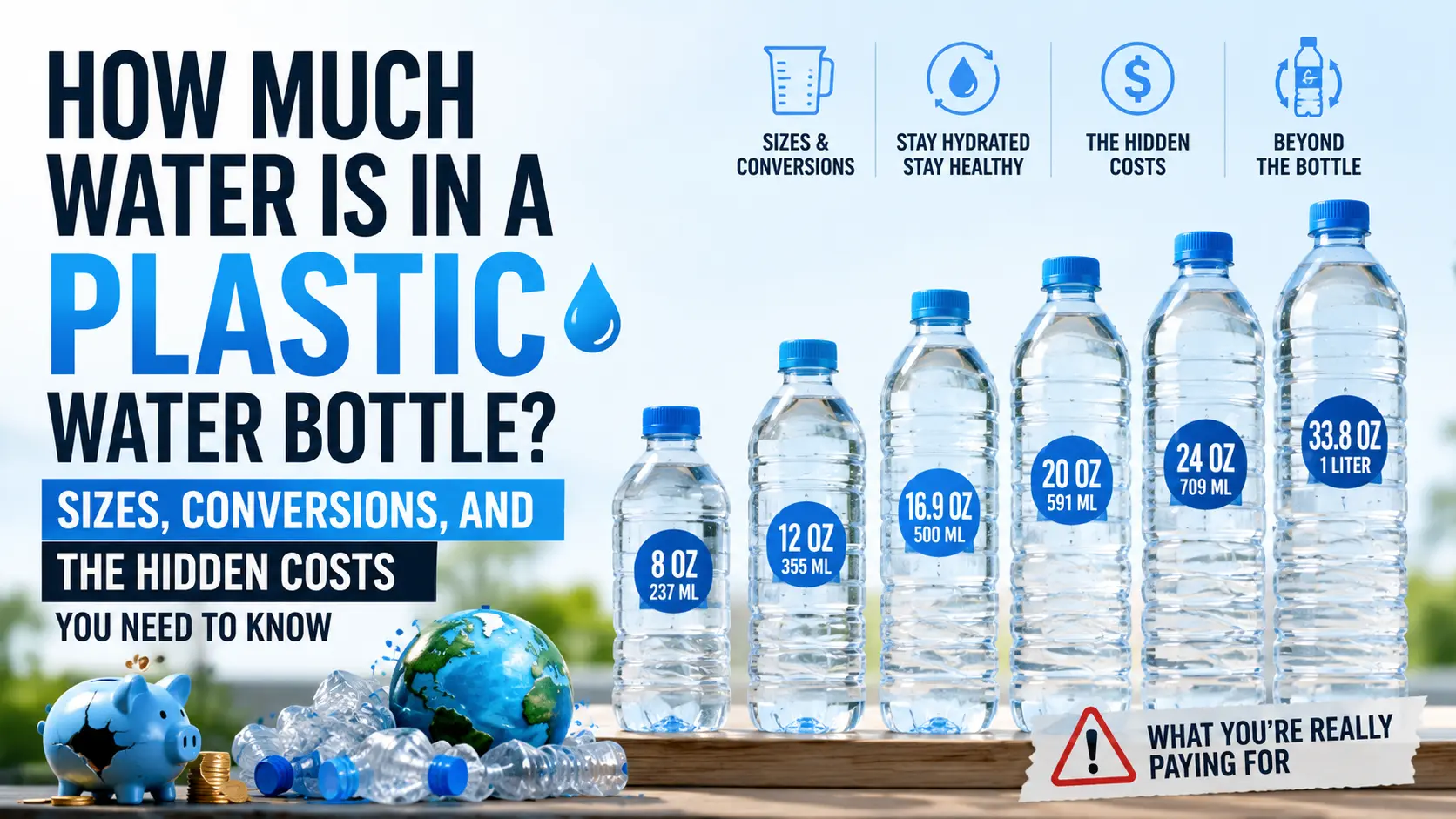
The 16.9-ounce bottle is the most common single-serve option. It holds 500 milliliters, or just over two cups. A 1-liter bottle holds about twice as much.
Bottle Size Conversions
Bottle size | Milliliters | Cups | Liters |
8 oz | 237 ml | 1 cup | 0.24 L |
12 oz | 355 ml | 1.5 cups | 0.35 L |
16.9 oz | 500 ml | 2.1 cups | 0.5 L |
20 oz | 591 ml | 2.5 cups | 0.59 L |
33.8 oz | 1,000 ml | 4.2 cups | 1 L |
How Many Bottles Do You Need?
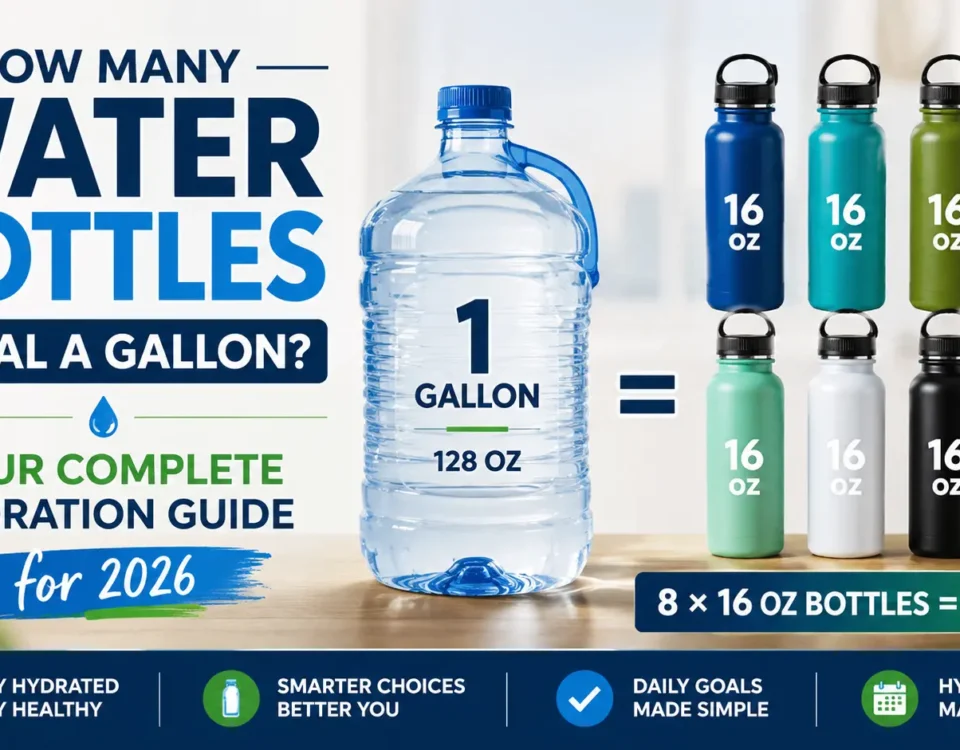
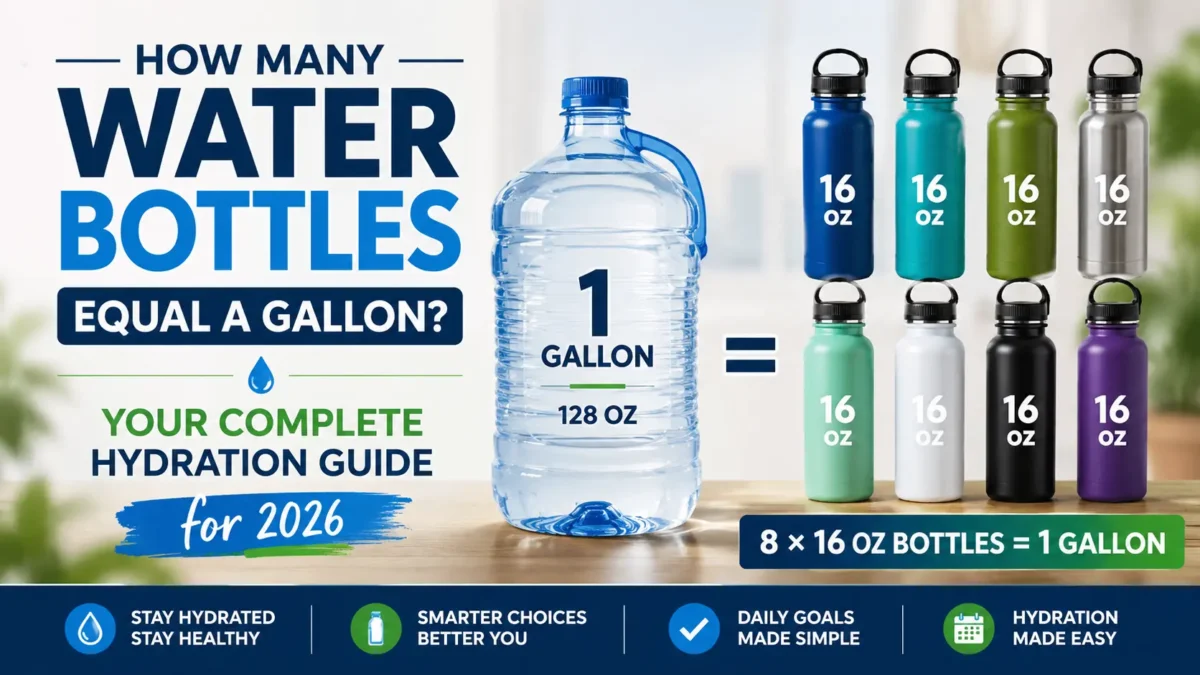
The table below shows how many bottles equal 64 ounces, 100 ounces, or one gallon. A gallon contains 128 fluid ounces.
Bottle size | To reach 64 oz | To reach 100 oz | To reach 1 gallon |
8 oz | 8 bottles | 12.5 bottles | 16 bottles |
12 oz | 5.3 bottles | 8.3 bottles | 10.7 bottles |
16.9 oz | 3.8 bottles | 5.9 bottles | 7.6 bottles |
20 oz | 3.2 bottles | 5 bottles | 6.4 bottles |
33.8 oz | 1.9 bottles | 3 bottles | 3.8 bottles |
These figures show the exact amount by volume. In real life, you would need to round up when drinking only full bottles.
For example:
- Four 16.9-ounce bottles provide 67.6 ounces.
- Six 16.9-ounce bottles provide 101.4 ounces.
- Eight 16.9-ounce bottles provide 135.2 ounces, slightly more than one gallon.
That is a lot of single-use plastic for one day.
How Many Bottles Meet Your Daily Hydration Goal?
A 64-ounce target equals roughly four standard 16.9-ounce bottles. A 100-ounce target equals roughly six.
The calculation is simple:
64 ÷ 16.9 = 3.8 bottles
100 ÷ 16.9 = 5.9 bottles
Daily water needs are not identical for everyone. Activity level, weather, diet, pregnancy, body size, and certain health conditions can all affect how much fluid a person needs. Treat 64 and 100 ounces as comparison points rather than universal rules.
I found it much easier to track my water after switching to a marked reusable bottle. Instead of counting empty plastic bottles, I could see how much I had consumed and how much was left.
Quick Reference: Bottles per Gallon
One U.S. gallon holds 128 fluid ounces.
That means it takes about 7.6 standard 16.9-ounce bottles to equal one gallon. Since you cannot usually buy or drink six-tenths of a bottle, you would need 8 full bottles to reach or slightly exceed a gallon.
Eight bottles provide 135.2 ounces, which is 7.2 ounces more than one gallon.
This comparison is useful when filling a large pitcher, planning water for a trip, or comparing single-serve bottles with a gallon jug. It also shows how quickly single-use plastic adds up. One gallon of water can mean eight empty bottles by the end of the day.
Daily Water Intake Recommendations and How Bottles Fit In
Official Hydration Guidelines
Daily water needs are higher than many people expect, but not all of that water has to come from a bottle.
The National Academies of Sciences, Engineering, and Medicine recommends an adequate total daily water intake of about:
- 15.5 cups, or 3.7 liters, for adult men
- 11.5 cups, or 2.7 liters, for adult women
These amounts include water from plain water, other drinks, and food. Fruits, vegetables, soups, and other moisture-rich foods all count toward the total.
This distinction matters.
The recommendations do not mean every man must drink 3.7 liters of plain water or every woman must drink 2.7 liters from a bottle. The often-mentioned 64-ounce target can be a useful tracking point, but it is not a universal requirement.
Factors That Affect Your Personal Water Needs
There is no perfect daily number for everyone.
Your needs may increase based on:
- Physical activity
- Hot or humid weather
- Pregnancy or breastfeeding
- Fever, vomiting, or diarrhea
- A diet high in salt or protein
- Time spent at high altitude
- Certain medicines or health conditions
Body size can also affect how much water you need, but formulas based only on weight are rough estimates. One popular method is to divide your body weight in pounds by two and use the result as a starting number in ounces.
For example:
150 pounds ÷ 2 = 75 ounces
That does not mean 75 ounces is automatically the right medical target. Food, other drinks, exercise, temperature, and personal health still matter.
Exercise also increases fluid needs, but there is no single amount that works for every workout. How much you sweat, how long you exercise, and the weather all change the calculation.
A practical approach is to drink regularly, increase your intake when you are sweating, and pay attention to thirst and urine color. Pale yellow urine often suggests adequate hydration, while consistently dark urine may mean you need more fluids.
People with kidney, heart, or liver conditions should follow guidance from a qualified healthcare professional rather than using a general hydration formula.
Translating Your Goal Into Bottle Counts
Once you choose a reasonable daily target, converting it into bottles is simple.
Use this formula:
Daily water goal ÷ bottle size = number of bottles
For a person aiming for 75 ounces with standard 16.9-ounce bottles:
75 ÷ 16.9 = 4.4 bottles
In practical terms, that means drinking about four and a half bottles. Five full bottles would provide 84.5 ounces.
Here are a few more examples:
Daily goal | Number of 16.9 oz bottles | Practical amount |
64 oz | 3.8 bottles | About 4 bottles |
75 oz | 4.4 bottles | About 4½ bottles |
80 oz | 4.7 bottles | About 5 bottles |
100 oz | 5.9 bottles | About 6 bottles |
128 oz | 7.6 bottles | About 8 bottles |
The calculation makes planning easier. It also reveals how quickly single-use plastic piles up.
A 75-ounce goal could mean nearly five empty plastic bottles every day. A reusable bottle gives you the same tracking benefit without creating that daily waste.
Simple Bottle-Count Calculator
To find your bottle count, divide your daily goal by your bottle’s capacity.
Example with a 24-ounce reusable bottle:
75 ÷ 24 = 3.1 fills
That means three full bottles plus a small extra amount.
A marked reusable bottle makes this even easier. Choose your daily target, calculate the number of refills, and use tap water or filtered water throughout the day. No pile of empty bottles. No guessing.
The Hidden Water Footprint of a Plastic Bottle
More Water to Make Than You Drink
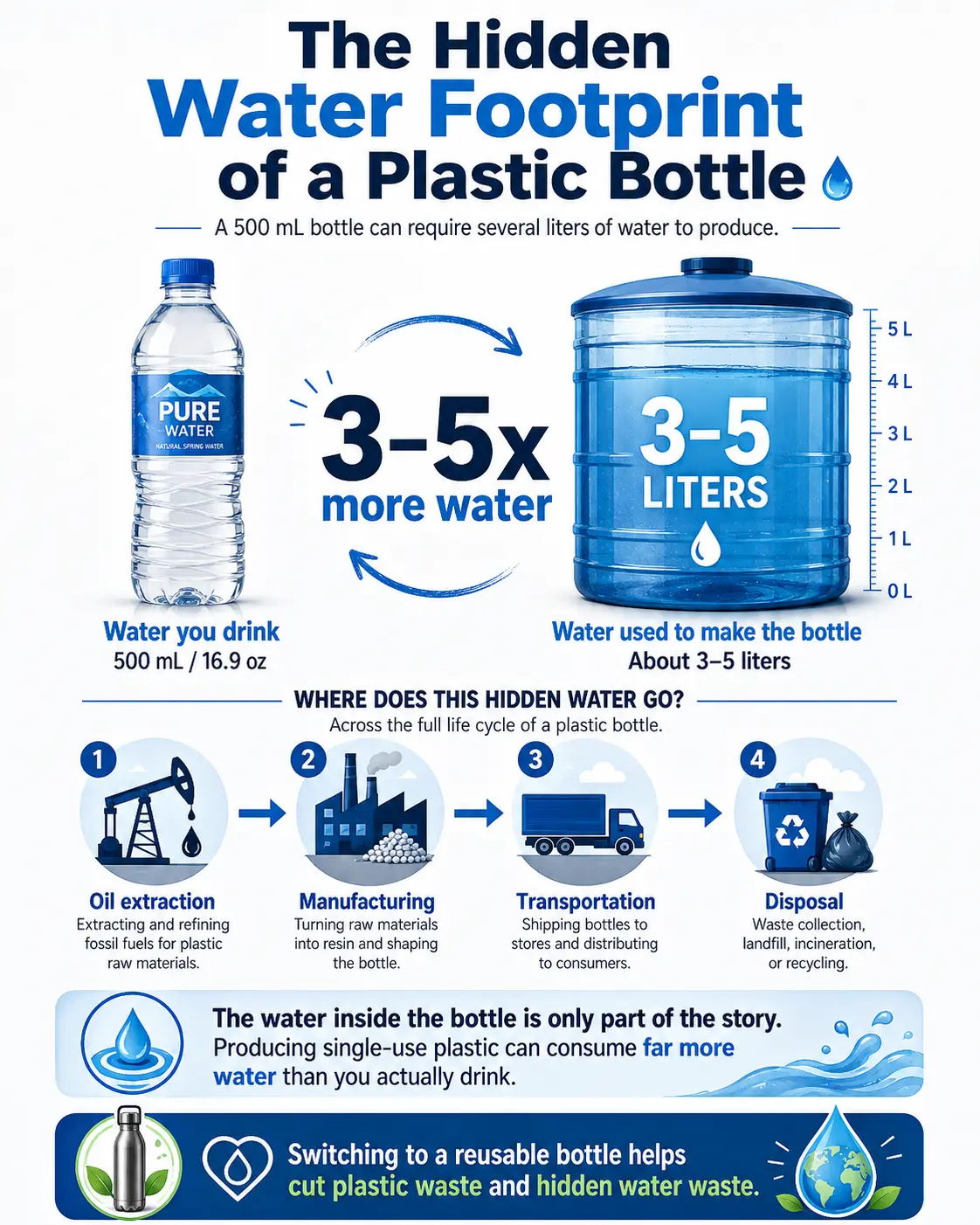
That 500-milliliter bottle contains half a liter of water. Its total water footprint can be several times larger.
Water is not used only to fill the bottle. It is also necessary to produce the plastic, cool the manufacturing equipment, clean the production lines, and prepare the bottle for filling. Some estimates place the full water cost of a single PET bottle at several liters, although the exact amount changes depending on the factory, location, and life-cycle stages included in the calculation.
The key point is simple.
You are not just buying the water inside the bottle. You are also paying for water used behind the scenes to create the packaging.
The Life Cycle of a Plastic Water Bottle
A single-use plastic bottle begins using resources long before it reaches a store shelf.
Its journey usually includes:
Raw material extraction: Most PET plastic is made from fossil-fuel-based materials. Extracting and processing those materials requires water and energy.
Plastic resin production: The raw materials are converted into PET resin. Water may be used during processing, cooling, and equipment operation.
Bottle manufacturing: The resin is heated and molded into a bottle. Manufacturing facilities use water to cool machinery and support production.
Cleaning and filling: Bottles and equipment must be cleaned before water is added. The factory also uses water for sanitation and routine operations.
Packaging and transportation: Filled bottles are packed, stored, and shipped, adding more energy and resource use.
Disposal or recycling: After one use, the bottle may be recycled, sent to a landfill, burned, or lost in the environment. Recycling can reduce the need for new plastic, but it still requires collection, sorting, cleaning, and processing.
No single stage tells the whole story. The hidden footprint comes from all of them combined.

Why This Matters for Water Scarcity
Bottled water is not only a plastic waste problem. It can also be a water waste problem.
That matters most in places already dealing with drought, shrinking groundwater supplies, or limited access to clean water. Using extra water to manufacture packaging for a drink that may already be available from the tap creates an avoidable burden.
Location matters too. A liter of water used in a water-rich region does not have the same impact as a liter taken from a drought-stressed area. This is why responsible water-footprint analysis considers both the amount of water used and where it comes from.
Switching to a reusable bottle does not eliminate every environmental impact. The bottle still has to be manufactured and washed. But when it is used repeatedly, its production cost is spread across dozens or hundreds of refills.
Fill it with tap water or filtered water, use it again tomorrow, and the amount of single-use plastic and hidden water waste begins to fall.
One refill feels small.
Repeated every day, it becomes meaningful water conservation.
Health Concerns: Chemicals, Microplastics, and Reuse Risks
BPA, Phthalates, and Other Chemicals of Concern
Most single-use water bottles are made from polyethylene terephthalate, better known as PET or plastic number 1.
PET bottles are generally made without BPA. They also do not require phthalates as plasticizers, despite the similar-sounding word “terephthalate” in the material’s name.
That does not mean the bottle is chemically inert.
PET production may involve substances such as antimony compounds, which help manufacture the plastic. Small amounts of these substances can migrate into water during storage. Migration may increase when a bottle sits for a long time or is exposed to high temperatures.
A bottle left in a hot car deserves more concern than one stored unopened in a cool cupboard.
Researchers have also studied compounds associated with taste, odor, manufacturing residues, bottle caps, labels, and processing equipment. The amounts detected are often low, but results vary by brand, storage conditions, bottle quality, and testing method.
The practical response is not panic. It is better storage and less dependence on single-use plastic.
Microplastics: What We Know So Far
Microplastics have been detected in bottled water.
Some particles may come from the bottle and cap. Others may enter during filtration, filling, packaging, or transportation. Newer testing methods have also identified much smaller nanoplastic particles that older laboratory methods could not easily detect.
The numbers can sound alarming, but an important question remains unanswered: what does long-term exposure mean for human health?
Scientists are still studying how many particles enter the body, where they travel, whether they accumulate, and what levels may cause harm. Finding particles in water does not automatically prove that they cause disease.
Still, reducing unnecessary exposure is reasonable.
Heat, sunlight, crushing, repeated opening, and rough washing may place more stress on a single-use bottle. Because these bottles are thin and not designed for long-term use, repeated handling can also create scratches and worn surfaces.
That is one reason I stopped treating disposable bottles like permanent drinkware. A proper reusable bottle is easier to clean and built to handle daily refilling.
Reuse Can Create a Bacteria Problem
Chemical migration gets most of the attention, but poor cleaning may be the more immediate concern.
Your hands and mouth transfer bacteria to the bottle every time you drink. Moisture, warmth, and leftover water can then support bacterial growth, especially around the cap and narrow opening.
Single-use bottles are difficult to clean properly. Their thin plastic can bend or scratch, and many are not made to withstand hot water or a dishwasher.
There is no reliable rule saying every disposable bottle becomes unsafe after a specific number of days. The risk depends on how it is stored, handled, and cleaned. However, a bottle designed for one-time use is not the best choice for repeated daily refilling.
Myth Busting: Is Bottled Water Always Purer?
A sealed bottle looks clean. That does not automatically make its water cleaner than tap water.
Public tap water and bottled water are regulated under different systems in the United States. The Environmental Protection Agency oversees public drinking-water systems, while the Food and Drug Administration regulates bottled water as a packaged food product.
The rules are not identical.
Public water suppliers generally test for regulated contaminants and provide customers with water-quality reports. Bottled-water companies must follow FDA safety, manufacturing, and labeling requirements. Some bottled water also begins as water from a public supply before receiving additional treatment.
Contaminants can occur in either source. The quality of tap water depends on the local water system and household plumbing, while bottled-water quality varies by source, treatment, storage, and packaging.
The better question is not simply, “Is bottled water purer?”
Ask:
- What does my local water-quality report show?
- Does my home have old plumbing or known contamination concerns?
- Would a certified filter address the problem?
- Has bottled water been stored correctly?
For many households with safe tap water, a reusable bottle filled from the tap or a suitable filter offers a practical alternative without the constant plastic waste.
Safer Bottle Materials
No bottle material is perfect. The best option is one that is durable, food-contact safe, easy to clean, and suitable for the way you use it.
Material | Main advantages | What to consider |
Stainless steel | Durable, reusable, and usually resistant to odors | Choose food-grade steel and avoid damaged internal coatings |
Glass | Does not absorb flavors and is easy to inspect | Heavier and more likely to break |
BPA-free copolyester, including Tritan | Lightweight, clear, and more durable than disposable PET | “BPA-free” does not mean completely free from every chemical |
Reusable polypropylene | Lightweight and often affordable | Replace it when deeply scratched, warped, or difficult to clean |
Look for bottles clearly sold for repeated food or beverage use. Wide-mouth water bottles with a removable seal and dishwasher-safe label can make daily cleaning much easier.
Safe Reuse and Storage Practices
When you must reuse a single-use plastic bottle temporarily:
- Keep it away from direct sunlight and hot cars.
- Do not fill it with hot liquids.
- Wash it gently with mild soap and water.
- Clean the cap and threads carefully.
- Let every part dry completely.
- Stop using it if it becomes cloudy, scratched, warped, cracked, or difficult to clean.
Do not put a disposable PET bottle in boiling water or a dishwasher unless the manufacturer specifically says it is safe.
The easier long-term option is a bottle made for reuse. Fill it with tap water or filtered water, wash it regularly, and keep it out of unnecessary heat.
That removes the guesswork.
It also means fewer disposable bottles sitting in your car, your bag, and eventually the trash.
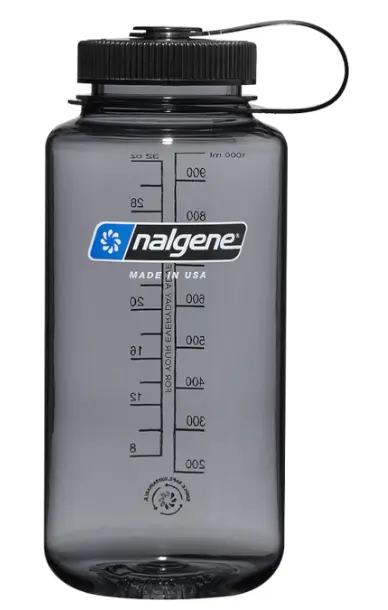
Nalgene 32 oz Wide Mouth BPA-Free Water Bottle
The Nalgene 32 oz Wide Mouth is built for everyday use with tough, lightweight Tritan Renew construction and a leakproof lid. Its wide opening makes adding ice and cleaning easy, while dishwasher-safe construction and measurement markings make it a practical choice for the gym, work, hiking, and travel.
Cost Comparison: Bottled Water vs. Filtered Tap vs. a Reusable Bottle
The True Cost of Bottled Water Over Time
A $1.50 water bottle does not feel expensive.
Buying four every day does.
A standard 16.9-ounce bottle holds 500 milliliters. To reach a 64-ounce daily goal, you need about 3.8 bottles. In real life, that usually means opening four bottles.
The calculation looks like this:
4 bottles × $1.50 = $6 per day
$6 × 365 days = $2,190 per year
Even when calculated by the exact 64-ounce volume rather than four full bottles, the annual cost is about $2,073.
That is more than $10,000 over five years.
Bulk packs can lower the price significantly, so not every bottled-water user will spend this much. Still, bottled water usually costs far more than water from the tap.
Ten-Year Cost Comparison
The table below uses the following assumptions:
- Four 16.9-ounce bottles per day
- $1.50 per single bottle
- A $30 reusable bottle
- Tap water priced at $0.01 per gallon
- A $30 filter pitcher with $30 in replacement filters each year
- A $225 under-sink reverse-osmosis system with $50 in replacement filters each year
Installation charges, taxes, electricity, replacement bottles, and local price differences are not included.
Water option | First year | Five years | Ten years |
Retail bottled water | $2,190.00 | $10,950.00 | $21,900.00 |
Reusable bottle with tap water | $31.83 | $39.13 | $48.25 |
Filter pitcher with reusable bottle | $91.83 | $219.13 | $378.25 |
Under-sink RO system with reusable bottle | $306.83 | $514.13 | $773.25 |
The difference is difficult to ignore.
Under these assumptions, a filter pitcher and reusable bottle cost less over ten years than about three months of retail bottled water.
Investing in a Reusable Bottle and Filter
I used to think a reusable bottle and filter were extra expenses.
Then I compared them with what I was already spending.
A good reusable bottle may cost $20 to $40, but it can last for years when cleaned and stored properly. Filling it with tap water costs very little in most areas.
A filter pitcher adds an upfront cost and requires regular filter replacements. Even so, the first-year total in this example is under $100.
An under-sink system costs more. A basic setup may run from around $150 to $300 before installation, with replacement filters adding to the yearly cost. Reverse-osmosis systems may also use extra water during filtration, so their operating cost can be higher than a simple pitcher.
They can still cost far less than buying individual bottles every day.
How Quickly Does the Switch Pay for Itself?
At $6 per day for bottled water, the payback can be surprisingly fast.
- A $30 reusable bottle can pay for itself in about five days.
- A pitcher, filters, and reusable bottle can recover their first-year cost in roughly two to three weeks.
- A $225 under-sink system, reusable bottle, and first-year filters can recover their cost in about two months.
The payback takes longer when bottled water is purchased cheaply in bulk or when professional installation is required. The basic pattern remains the same: the more often you buy bottled water, the faster a reusable setup saves money.
Savings Beyond the Price Tag
The financial savings are only part of the picture.
A reusable bottle also means fewer heavy cases to carry, less storage space needed at home, and fewer empty bottles filling the trash or recycling bin.
It can also reduce your dependence on water stored in thin plastic bottles, especially bottles that may sit in hot cars or direct sunlight.
Claims about guaranteed medical savings should be avoided. Research is still examining the health effects of long-term exposure to microplastics and chemicals associated with packaging.
The environmental benefit is easier to see.
Four disposable bottles per day create:
1,460 plastic bottles per year
Over ten years, that becomes:
14,600 bottles
A reusable bottle will not erase every environmental impact. It still takes materials and energy to manufacture. But using the same bottle hundreds of times spreads that impact across many refills.
The cheapest bottle is often the one you do not keep buying.
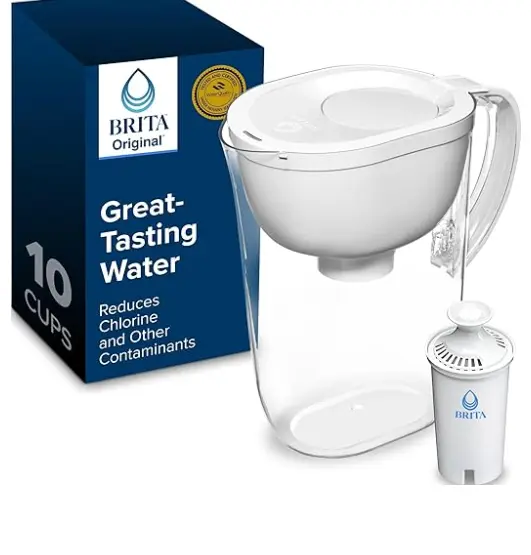
Brita 10-Cup Water Filter Pitcher with 1 Filter
The Brita 10-Cup Water Filter Pitcher makes everyday hydration taste better by reducing chlorine, mercury, copper, zinc, and cadmium from tap water. Its space-saving design fits easily in the refrigerator, while the easy-fill lid and replaceable filter make fresh-tasting water simple and convenient.
Problem-Solution Framework: How to Quit Plastic Bottles for Good
Quitting bottled water sounds simple until convenience gets in the way.
You forget your reusable bottle. Tap water tastes different. A cold plastic bottle is sitting right beside the checkout. Before long, the old habit is back.
The solution is not more willpower.
It is a better system.
Step 1: Measure Your Current Bottled-Water Habit
Start with the numbers.
For one week, track every single-use plastic bottle you drink. Do not change your routine yet. Just count.
At the end of the week, calculate:
- How many bottles you used
- How much money you spent
- How many ounces of water you drank
- How many bottles that would create over one year
Use this simple formula:
Bottles used per week × 52 = bottles used per year
For example, four bottles per day equals 28 bottles per week.
28 × 52 = 1,456 bottles per year
Then calculate the cost:
Weekly spending × 52 = annual spending
Seeing the yearly total made the decision much easier for me. What felt like a few harmless purchases was actually a large pile of plastic and a recurring expense.
You can track your intake in a hydration app, a phone note, or a simple tally on paper. The method matters less than getting an honest number.
Step 2: Choose a Reusable Bottle That Fits Your Routine
A 32-ounce reusable bottle is a practical starting point.
It holds almost the same amount as two standard 16.9-ounce bottles:
16.9 oz × 2 = 33.8 oz
That makes the refill math easy. Two fills provide 64 ounces. Three fills provide 96 ounces.
Choose a bottle that:
- Fits in your bag or cup holder
- Is easy to open with one hand
- Has a wide mouth for cleaning
- Does not leak
- Has measurement markings if you track intake
Stainless steel is a common choice among the best water bottles of 2026 because it works well for durability and temperature control.
Glass is easy to clean but heavier. BPA-free reusable plastic is lighter, although it should be replaced if it becomes deeply scratched, warped, or difficult to clean.
The best reusable bottle is not necessarily the most expensive one.
It is the one you will actually carry.
Step 3: Decide Whether You Need a Water Filter
A filter can make the switch easier when tap water has an unpleasant taste or smell.
Before buying one, check your local water-quality report. This can help you understand what is present in your water and whether a filter is necessary.
Different filters solve different problems. Some are designed mainly to reduce chlorine taste and odor. Others are certified to reduce specific contaminants.
Look for independent certification that matches your concern rather than relying only on marketing claims.
A basic pitcher may be enough for improving taste. A faucet-mounted or under-sink filter may be more convenient for a larger household. More complex systems cost more and require regular maintenance.
Remember to replace filters on schedule. An overdue filter may work poorly and can become difficult to keep clean.
Step 4: Make the Reusable Bottle Hard to Forget
Visibility drives habits.
Keep your bottle where you naturally look throughout the day. Place it beside your keys, laptop, lunch bag, or coffee mug.
I found it easier to remember mine when I filled it at night and placed it near the door. In the morning, there was no decision to make. I simply picked it up and left.
You can also connect drinking water to routines you already follow:
- Take a few sips after waking up.
- Drink with each meal.
- Refill the bottle during lunch.
- Drink after a bathroom break.
- Take water with you before leaving home.
- Refill after exercise.
A marked bottle or phone reminder can help, but you do not need to turn hydration into a complicated tracking project.
Keep the bottle close. Refill it when it is empty. Repeat.
Step 5: Prepare for the Common Obstacles
“My tap water tastes bad.”
Chlorine and minerals can affect taste. Chilling the water may help, as can a filter certified to reduce taste and odor.
You can also add lemon, cucumber, mint, or fruit for flavor. Clean the bottle daily so old odors do not become part of the problem.
“Bottled water is more convenient.”
It is convenient when you have not prepared another option.
Fill your reusable bottle before bed. Keep a second clean bottle at work or in your gym bag. Learn where refill stations are available during your normal day.
Preparation turns reusable water into the convenient choice.
“I keep forgetting my bottle.”
Give it a permanent home.
Place it beside something you never leave without, such as your phone, keys, wallet, or work bag.
“I do not want to carry a heavy bottle.”
Choose a smaller bottle and refill it more often. A lightweight 20- or 24-ounce reusable bottle may suit you better than a large insulated bottle.
“Everyone else buys bottled water.”
Most people care less about your bottle than you think.
Bring it to work, meetings, restaurants, and events where outside drinkware is allowed. Ask for tap water or a refill instead of automatically buying another bottle.
“I am travelling or cannot access safe tap water.”
Safety comes first.
When bottled water is necessary, buy the largest practical container and use it to refill your reusable bottle. Larger containers usually require less packaging per ounce than many small bottles.
Choose sealed water from a reliable source. Where safe refill stations are available, use them instead.
Do not leave your reusable bottle filled with water in a hot parked car for long periods. Heat can affect taste, encourage bacterial growth, and make the bottle itself dangerously hot to touch.
A 30-Day Plan to Quit Single-Use Plastic
You do not have to change everything on the first day.
Week 1: Build the Setup
Buy or select one reusable bottle.
Check your local water quality and choose a filter only if you need one. Begin using your reusable bottle at home.
Keep counting any plastic bottles you still use. This gives you a starting point.
Week 2: Replace One Daily Bottled-Water Habit
Choose the easiest occasion to replace.
It might be the bottle you buy on the way to work, the one you drink with lunch, or the one you grab at the gym.
Fill your reusable bottle before that moment arrives.
One replacement per day prevents seven plastic bottles per week.
Week 3: Use Reusable Water at Home and Work
Make your reusable bottle the default at home, work, and during regular errands.
Keep bottled water only for situations where safe drinking water is genuinely unavailable.
Wash the bottle every day and let it dry fully. A clean bottle is much easier to keep using; for instance, knowing that Owala bottles are dishwasher safe can simplify your routine before you buy.
Week 4: Review the Results
Count how many single-use bottles you avoided.
Calculate your savings:
Bottles avoided × price per bottle = money saved
Then estimate what the same habit could save over a year.
Notice what caused you to fall back on bottled water. Maybe you forgot your bottle, disliked the taste, or could not find a refill station. Fix that specific problem before the next month begins.
The goal is not perfection.
It is to make single-use plastic the exception instead of the default.
Quit Plastic, Not Hydration
Switching away from bottled water should not make drinking water harder.
Choose a reusable bottle that fits your day. Improve the taste of your tap water when necessary. Build refilling into routines you already have.
Start with one bottle.
Then use it again tomorrow.
Guide to Choosing the Right Reusable Bottle and Water Filter
The best reusable bottle is not the one with the longest feature list.
It is the one you can carry, clean, and refill every day.
The same rule applies to water filters. A more expensive system is not automatically better. The right filter depends on what is actually in your water.
Reusable Bottle Materials Compared
Each bottle material has strengths and trade-offs. Your routine should decide which one makes sense.
Bottle material | Best features | What to consider | Best for |
Stainless steel | Durable, reusable, and often insulated | Heavier than plastic and harder to see inside | Work, travel, exercise, and keeping water cold |
Glass | Clean taste, easy to inspect, and resistant to odors | Heavy and more likely to break | Home, office, or careful everyday use |
Tritan or BPA-free copolyester | Lightweight, clear, and shatter-resistant | Still plastic and may develop scratches or odors over time | School, commuting, travel, and lightweight carrying |
Reusable polypropylene | Affordable and lightweight | Usually less durable and may absorb odors with age | Casual use and budget-friendly switching |
Stainless Steel
Stainless steel is usually the most practical all-around choice.
It is strong, lasts for years, and does not normally hold onto flavors when cleaned properly. Double-wall insulation can keep water cold for hours, making the best water bottles for cold water useful for hot weather, travel, and exercise.
The main drawback is weight. Insulated bottles can feel heavy when full.
Choose food-grade stainless steel, and check the inside regularly, since some bottles may contain hidden plastic in stainless steel components like liners or caps. Replace the bottle if the lining or internal surface becomes badly damaged.
Glass
Glass gives water a clean, neutral taste.
It does not absorb odors easily, and its clear surface makes dirt or residue easier to spot. That helps with cleaning.
But glass is heavy. It can also break if dropped, even when protected by a silicone sleeve.
It works best at a desk, beside the bed, or in other places where you are less likely to knock it onto a hard floor.
Tritan and Other Reusable Plastics
Ultralight water bottles often use Tritan, which is light, clear, and more resistant to breaking than glass.
They are commonly marketed as BPA-free, but “BPA-free” does not mean the material contains no other chemicals. It simply means BPA was not used.
Reusable plastic can also scratch, cloud, or retain odors over time. Replace the bottle when it becomes deeply scratched, warped, cracked, or difficult to clean.
Do not confuse a reusable Tritan bottle with a thin single-use PET bottle. Tritan products are designed for repeated use. Disposable water bottles are not.
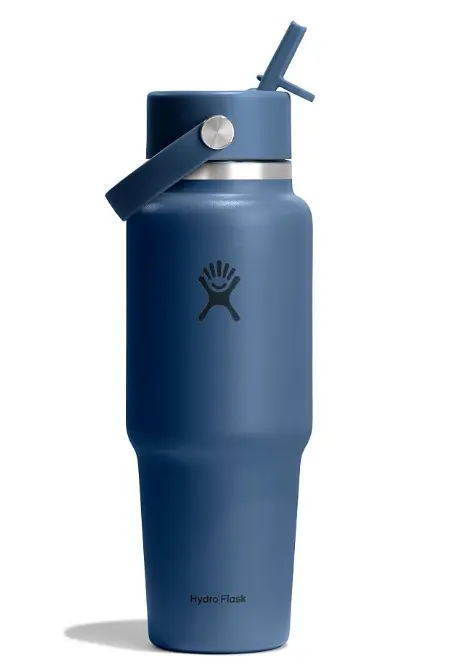
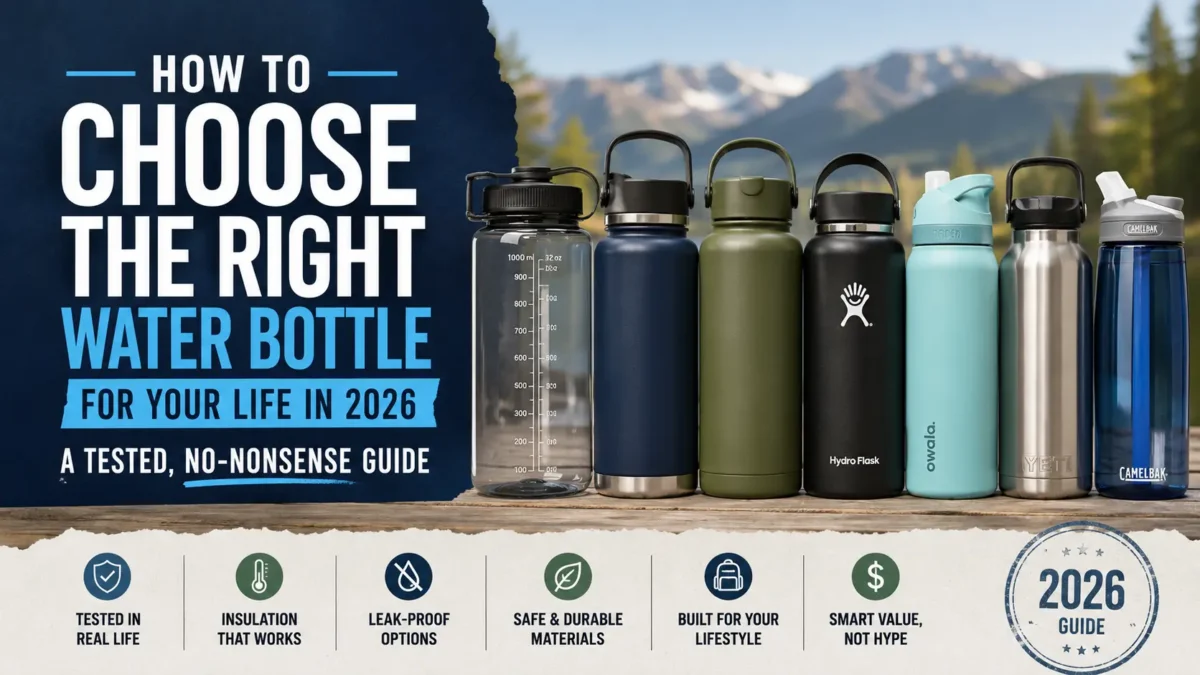
Hydro Flask 32 oz Insulated Stainless Steel Water Bottle with Flex Straw Lid
The Hydro Flask 32 oz combines double-wall TempShield insulation with a leakproof Flex Straw Cap to keep drinks cold for up to 24 hours. Its cupholder-friendly design, pure-tasting stainless steel, and dishwasher-safe construction make it a convenient choice for commuting, workouts, road trips, and everyday hydration.
Key Features to Look For
A bottle should make drinking water easier, not create another cleaning project.
A Wide Mouth
A wide opening makes it easier to:
- Add ice
- Reach the inside with a bottle brush
- Rinse away residue
- Check for dirt or mold
- Let the bottle dry fully
Narrow bottles can work well for drinking while walking, but they usually need a long cleaning brush.
A Leak-Resistant Lid
Check the lid before trusting it inside a bag.
Look for a removable silicone seal, secure threads, and a locking mechanism if the bottle uses a flip-top or straw lid.
Removable parts matter because moisture and residue often collect beneath seals and around drinking spouts.
“Leak-resistant” is more realistic than assuming any bottle is permanently leak-proof. Seals wear out, lids loosen, and damage happens.
The Right Size
A larger bottle reduces the number of refills. It also becomes heavier.
A 32-ounce bottle is a useful starting point because it holds almost as much as two standard 16.9-ounce bottles.
- Two fills provide 64 ounces.
- Three fills provide 96 ounces.
- A small extra serving brings the total close to 100 ounces.
If you find yourself choosing between sizes like a Hydro Flask 10oz versus 16oz, remember that a 20- or 24-ounce bottle may be better when you walk frequently or carry a small bag.
If you want something between 32 and 40 ounces, comparing 34 oz water bottles can help you decide, while a larger 40-ounce bottle works well when refill stations are limited.
Choose the size that fits your normal day.
Insulation
When you want cold water for several hours, the best insulated water bottles of 2026 are worth considering.
It also adds weight and cost. If you usually drink water at home or near a refrigerator, a simple non-insulated bottle may be enough.
Measurement or Time Markings
Marked bottles help you see how much water you have consumed.
Time-of-day labels can be useful reminders, but they are not medical instructions. Your water needs may change with exercise, climate, diet, and health.
Use the markings as a tracking tool, not a rigid rule.
Water Filter Types and How to Choose One
Start with your water, not the filter advertisement.
Check your local utility’s annual water-quality report, often called a Consumer Confidence Report in the United States. It lists compared contaminants, detected levels, and any reported violations.
Private well water is different. It is not monitored in the same way as a public water system, so regular laboratory testing may be necessary.
Once you know the problem, look for a filter independently certified to reduce that specific contaminant.
Pitcher Filters
Pitcher filters are affordable and simple to use.
Many are designed mainly to reduce chlorine taste and odor. Some certified models may also reduce lead, certain metals, or other contaminants.
They work well when:
- Your main concern is taste or smell
- You rent your home
- You need a low-cost option
- You do not want to alter the plumbing
The drawbacks are slow filtration, limited capacity, and frequent filter replacement.
Do not assume every pitcher removes the same substances. Check the exact certified reduction claims for the model you are buying.
Faucet-Mounted Filters
A faucet filter treats water as it comes from the tap.
It removes the need to wait for a pitcher to refill and can provide filtered water for cooking as well as drinking.
This type may suit you when:
- You use several bottles of water each day
- You want fast access to filtered water
- Your faucet is compatible with the unit
- You have enough space around the sink
Faucet filters can reduce water flow. They may also be unsuitable for pull-out, spray-style, or unusually shaped faucets.
Again, the contaminant claims depend on the individual model and its certification.
Under-Sink Filters
Under-sink systems provide filtered water through the main faucet or a separate drinking-water tap.
They offer more capacity than pitchers and keep the equipment out of sight. Depending on the system and certification, they may reduce contaminants such as chlorine, lead, certain PFAS compounds, pesticides, or other substances.
They cost more upfront and may require professional installation.
An under-sink carbon filter can be enough when taste, chlorine, or certain organic contaminants are the concern. You do not always need reverse osmosis.
Reverse-Osmosis Systems
Reverse osmosis uses a membrane to remove a broad range of dissolved substances.
A properly certified system may reduce contaminants such as lead, arsenic, nitrate, fluoride, and certain PFAS compounds. The exact performance depends on the model.
RO systems also have trade-offs:
- They cost more.
- They require several replacement filters.
- They can remove minerals along with unwanted substances.
- Many systems send some water down the drain during filtration.
- Storage tanks and tubing require maintenance.
Choose reverse osmosis because your water test or quality report shows a reason for it, not simply because it sounds more powerful.
How to Read Filter Certifications
A filter’s certification matters more than a long list of marketing claims.
Common standards include:
- NSF/ANSI 42: Often covers chlorine, taste, odor, and other aesthetic concerns.
- NSF/ANSI 53: Covers certain contaminants with health effects, depending on the product’s certified claims.
- NSF/ANSI 58: Applies to reverse-osmosis systems.
- NSF/ANSI 401: Covers certain emerging contaminants for products certified under this standard.
A certification number alone does not mean a filter removes everything covered by that standard.
Read the product’s performance data sheet. Look for the exact contaminant you want to reduce.
Match the Filter to the Problem
Water concern | Filter option to consider |
Chlorine taste or odor | Certified pitcher, faucet, or carbon filter |
Lead from plumbing | Filter specifically certified for lead reduction |
Certain PFAS compounds | Model specifically certified for the listed PFAS reduction |
Sediment or visible particles | Sediment pre-filter or suitable whole-house filter |
Broad dissolved contaminants | Properly certified reverse-osmosis system |
Hard water and scale | Water softener, not a standard drinking-water filter |
Bacteria in unsafe water | Testing and an appropriate treatment system, not a basic pitcher |
A water softener and a water filter do different jobs. A softener mainly reduces hardness minerals such as calcium and magnesium. It does not automatically make contaminated water safe to drink.
A Simple Buying Checklist
Before buying a bottle, ask:
- Will I carry it every day?
- Does it fit my bag and cup holder?
- Can I clean every part properly?
- Is the lid easy to take apart?
- Is the size realistic when full?
Before buying a filter, ask:
- What problem am I trying to solve?
- Does my water report confirm that problem?
- Is the product independently certified for it?
- How often must the filter be replaced?
- What will replacement filters cost each year?
- Can I maintain the system properly?
I made the switch easier by keeping the setup simple.
One bottle that fit my routine. One filter that matched my water. No unnecessary features.
That was enough to stop single-use plastic from becoming the automatic choice.
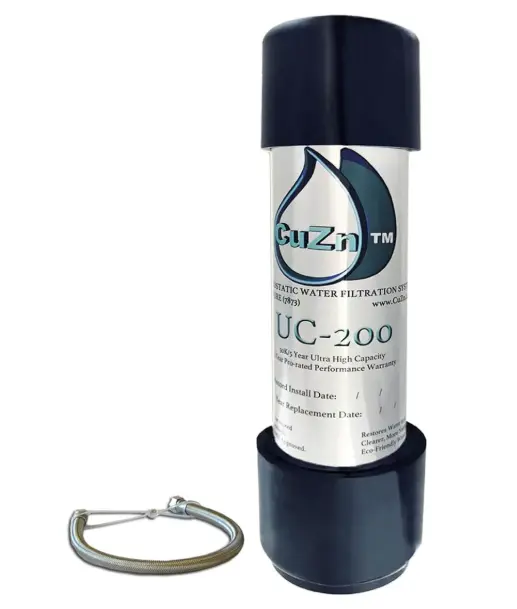
CuZn UC-200 Under-Sink Water Filter with 5-Year Filter Life
The CuZn UC-200 uses 3-stage filtration to reduce common tap-water impurities while improving taste and odor. With a 5-year filter life, compact inline design, and no-drill installation, it’s a convenient option for cleaner-tasting water directly from your kitchen or bathroom faucet.
Interactive Hydration Calculator
Why Personalization Matters
“Drink eight glasses a day” is easy to remember.
It is not equally useful for everyone.
Water needs can change with body size, activity level, climate, diet, pregnancy, and health. A person working outdoors in hot weather may need more fluid than someone spending the day in an air-conditioned office.
A hydration calculator turns a general guideline into a practical starting point. Readers can enter details such as their weight, activity level, and bottle size to estimate:
- A reasonable daily water target
- How many reusable-bottle refills that target requires
- How many single-use bottles they could avoid
- How much money they may save over time
For example, a 75-ounce daily target equals about 4.4 standard 16.9-ounce plastic bottles. With a 32-ounce reusable bottle, it becomes about 2.3 fills.
That feels much easier to plan.
Personalized results can also make the guide more useful because readers see numbers connected to their own routine rather than a generic recommendation. The calculator should still explain that its result is an estimate, not medical advice. People with health conditions or fluid restrictions should follow guidance from a qualified healthcare professional.
The goal is not to create a perfect number.
It is to replace guesswork with a clear, realistic plan.
Expert Insights and Credibility
Good advice needs more than confident wording.
It needs clear sources, honest calculations, and experts who can explain where the evidence is strong and where questions remain.
Authoritative Sources and References
Every major claim in this guide should link back to an original or authoritative source.
Use:
- The National Academies of Sciences, Engineering, and Medicine for total daily water intake guidance
- The Environmental Protection Agency for public tap-water standards and water-quality reports
- The Food and Drug Administration for bottled-water regulation and food-contact materials
- Peer-reviewed studies indexed through NIH or PubMed for microplastics, nanoplastics, chemical migration, and PET bottle research.
- Original life-cycle or water-footprint studies for estimates related to bottle production
That makes the evidence easier to check.
It also helps readers understand which statements are established guidance, which come from individual studies, and which remain under investigation.
For example, microplastics have been detected in bottled water. The long-term health effects are still being studied. Both points should appear together.
Accuracy builds more trust than alarm.
Expert Quotes and Interviews
A qualified expert can add context that numbers alone cannot provide.
For the hydration section, consider interviewing a:
- Registered dietitian
- Hydration researcher
- Exercise physiologist
- Physician with relevant clinical experience
For the environmental section, look for a:
- Environmental engineer
- Life-cycle assessment researcher
- Water-resource specialist
- Plastics or waste-management researcher
Ask specific questions instead of requesting a general comment.
Useful questions include:
- Why do daily water needs vary between people?
- What is the biggest mistake people make when using hydration formulas?
- Which parts of a plastic bottle’s life cycle use the most water?
- Why do water-footprint estimates differ between studies?
- What is known and unknown about microplastics in bottled water?
- Which filter certifications should consumers look for?
Do not create or paraphrase an expert quote without approval.
Use the expert’s exact words, confirm their name and title, and link to their institution or published research.
Transparent Methodology
The cost comparisons in this guide are estimates, not universal prices.
They are based on clearly stated assumptions so readers can repeat the math using their own numbers.
Bottled-Water Cost Assumptions
The retail bottled-water example uses:
- A 16.9-ounce bottle
- A price of $1.50 per bottle
- Four bottles per day to provide 67.6 ounces
- 365 days of use per year
The calculation is:
4 bottles × $1.50 = $6 per day
$6 × 365 = $2,190 per year
Bulk cases may cost much less. Convenience-store purchases may cost more.
Readers should replace the $1.50 figure with their usual price for a more personal estimate.
Tap-Water Cost Assumptions
The comparison uses a sample tap-water cost of approximately $0.005 to $0.01 per gallon.
Actual rates vary by city, utility, household usage, and local fees.
Filter Cost Assumptions
The filter examples include:
- The initial purchase price
- The stated replacement schedule
- The cost of replacement filters
- Tap water used during normal operation
Filter life depends on the product, water quality, and volume treated.
A filter advertised to last two months may need replacement sooner in a household that uses large amounts of water. Reverse-osmosis systems may also use additional water during filtration.
Use the manufacturer’s replacement schedule and independently verified certification data for each product discussed.
Reusable-Bottle Assumptions
The reusable-bottle comparison assumes:
- One bottle costing about $20 to $40
- Several years of use
- Regular washing
- No premature replacement due to loss or damage
A reusable bottle still requires materials, manufacturing, and cleaning. Its advantage comes from repeated use.
The more often it replaces a disposable bottle, the more its cost and environmental impact are spread across many refills.
Water-Footprint Assumptions
The estimated water footprint of a 500-milliliter PET bottle may vary widely.
Some figures cover only bottling-plant operations. Others include resin production, energy inputs, cooling, cleaning, packaging, and additional life-cycle stages.
For that reason, the article should not present the 3–5-liter estimate as a fixed number for every bottle.
Use language such as:
“Some estimates suggest that producing a 500-milliliter PET bottle can require several liters of water across its life cycle. The exact amount depends on the manufacturing process, location, and stages included in the study.”
Link directly to the study that supports the chosen range.
Do not combine figures from different system boundaries as though they measure the same thing.
Author Bio
Jack J. writes about practical ways to reduce household waste and make more informed consumer choices. After switching from bottled water to a reusable bottle and filtered tap water, he began researching the financial, health, and environmental costs behind everyday hydration habits.
Conclusion: One Bottle, Refilled
That 16.9-ounce plastic bottle carries more than water.
It also comes with manufacturing water, repeated costs, plastic waste, and unanswered questions about long-term exposure to particles and chemicals from packaging.
The good news is that the alternative is simple.
Choose a reusable bottle that fits your routine. Check your local water-quality report. Add a certified filter only when your water or personal preference calls for one. Then use the 30-day plan to make refilling the easier habit.
You do not need a perfect system on day one.
You need one bottle you will actually carry.
Use the hydration calculator to turn your daily target into realistic refill numbers. Save or share the water-footprint infographic. Track how many disposable bottles and how much money you avoid over the next month.
One refill may not feel important.
Repeated every day, it means less plastic, less water waste, and more money left in your pocket.
Start with your next drink.