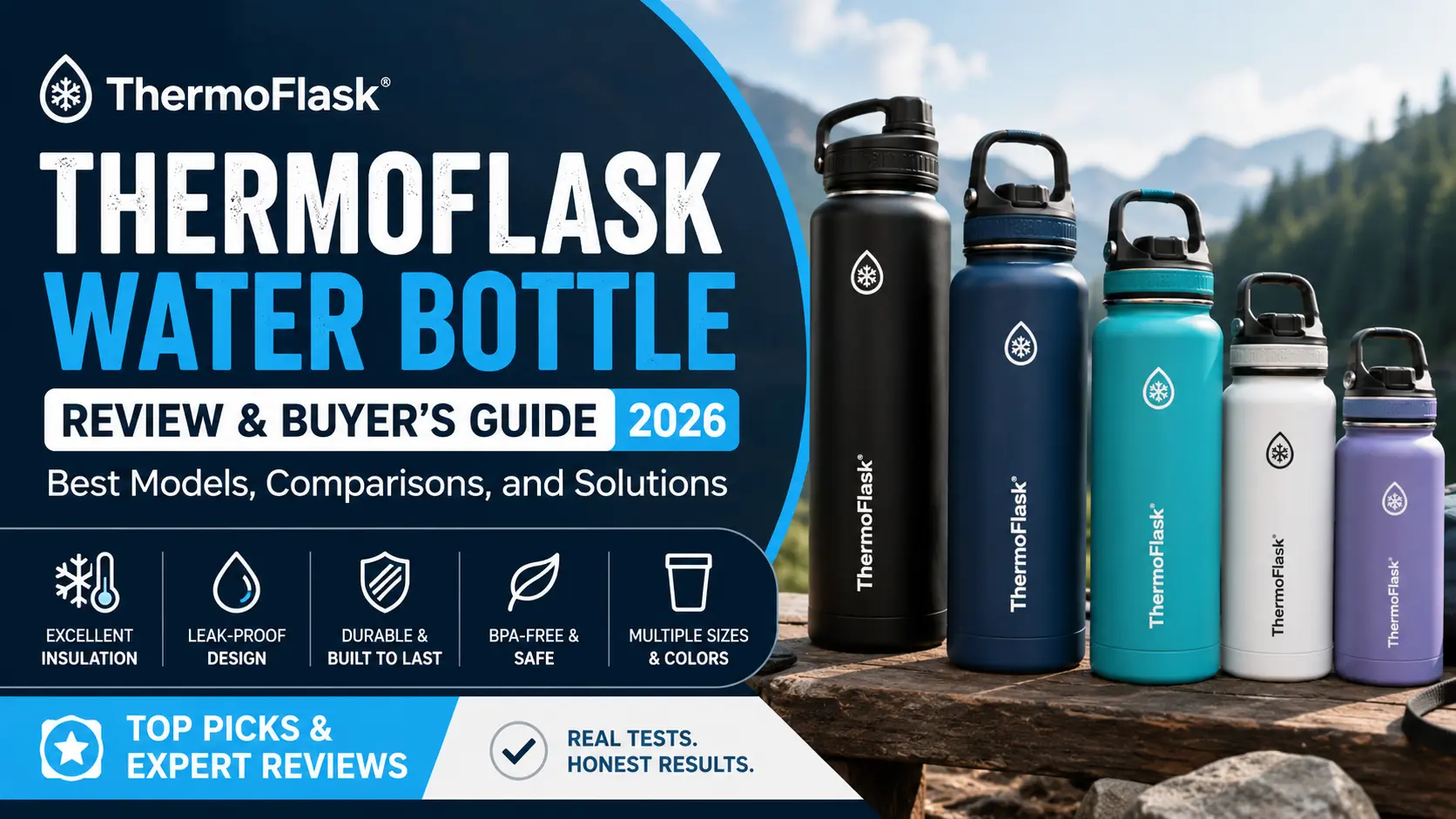
Premium insulated bottles can cost $40 or more. ThermoFlask promises similar cold retention for roughly half that price.
That sounds good on the shelf. The real question is whether it holds up after a full workday, a sweaty gym session, or several hours inside a hot car.
In this guide, I’ll break down the current ThermoFlask bottle lineup, compare the models by size, lid design, portability, and daily usability, and put their temperature performance against premium competitors such as Hydro Flask. I’ll also cover the details product pages tend to skip: whether the lids leak, which bottles fit standard cup holders, how well the finishes resist scratches, and which designs become annoying after a week of regular use.
Key Takeaways
- ThermoFlask delivers strong cold retention at a lower price than most premium competitors.
- The 32 oz Straw Bottle is the best all-rounder for gym, desk, and daily use.
- Choose the 24 oz Spout Bottle when cup-holder fit and easy cleaning matter most.
- The 40 oz and 64 oz models suit long shifts, hiking, and fewer refill stops.
- Hydro Flask performs better with hot drinks, but ThermoFlask offers better overall value.
- Straw lids are convenient but require more cleaning and should not be used with hot or carbonated drinks.
- Two-pack deals and affordable replacement parts make ThermoFlask cheaper to own over the long term.
Some ThermoFlask bottles are excellent values. Others only make sense for specific routines.
Whether you need a bottle for commuting, workouts, desk duty, or weekend hikes, this guide will help you choose the right model, avoid the common problems, and decide whether ThermoFlask really delivers premium performance on a budget.
ThermoFlask Brand Overview and History
Who Makes ThermoFlask, and Why It Matters
ThermoFlask is not an unknown discount label copying more established bottle brands. It is a Takeya USA brand designed to compete at a lower price point.
Takeya introduced ThermoFlask in 2015 as a line of insulated bottles for everyday use, workouts, and outdoor activities. The original range used double-wall vacuum insulation, leak-resistant lids, and 18/8 stainless-steel construction, with advertised performance of up to 24 hours cold and 12 hours hot.
The relationship between the two brands is important. Takeya USA owns the ThermoFlask trademark, handles its warranty coverage, and lists ThermoFlask products under the same corporate warranty program as its Takeya products.
ThermoFlask was positioned as the more value-focused option. Takeya’s official Japanese store describes it as a secondary brand originally developed for a major US warehouse retailer. By limiting some of the size and color variations, the company could manufacture larger quantities and sell the bottles at more competitive prices.
That strategy is still easy to spot at Costco. Instead of selling one bottle at a premium price, ThermoFlask frequently packages bottles, mugs, and food jars in two-packs. For households, couples, or anyone who wants one bottle at work and another at home, those bundles can offer substantially better practical value than buying two premium bottles separately.
The materials are not bargain-bin either. Current ThermoFlask listings specify food-grade 18/8 stainless steel for the bottle body and BPA-free materials for applicable lids and components. Several models also include wide mouths, leak-resistant lids, powder-coated finishes, silicone bumpers, and dishwasher-safe construction.
That does not mean every ThermoFlask is identical to a Takeya bottle. Lid designs, finishes, available colors, accessories, and even manufacturing facilities can differ. Takeya also states that parts are not necessarily interchangeable between the two lines.
ThermoFlask Product Lineup at a Glance
ThermoFlask’s lineup is less straightforward than it looks.
Older bottles are still sold with both a chug lid and a straw lid, while newer 24-, 32-, and 40-ounce models are usually listed separately by lid style. Retailers also rotate two-packs, colors, and clearance bundles. That can make two bottles with the same capacity look like completely different models.
Model | Size | Lid configuration | Current listed price | Dishwasher-safe | Best for | Practical notes |
2-in-1 Bottle | 18 oz | One chug lid and one straw lid | $15.99 | Yes | Short commutes, smaller bags, cup holders | The cheapest flexible option. It fits most cup holders and gives you both drinking styles without buying another lid. |
2-in-1 Bottle | 24 oz | One chug lid and one straw lid | $17.49 | Yes | Buyers who want maximum value | This older package is substantially cheaper than the newer single-lid 24-ounce versions while stock lasts. |
Straw Bottle | 24 oz | Flip-up straw lid | $26.99 | Yes | Driving, walking, and one-handed sipping | Compact enough for many bags and cup holders. The straw adds parts to clean, but it is easier to drink from while moving. |
Spout Bottle | 24 oz | Screw-top chug spout | $26.99 | Yes | Car commuters and cardio workouts | The cleaner choice if you dislike reusable straws. The body is about 3.13 inches wide, but cup-holder fit still depends on the vehicle. |
Straw Bottle | 32 oz | Flip-up straw lid | $29.99 | Yes | Desk duty, gym sessions, and everyday carry | This is the most balanced capacity for most adults. Be aware that ThermoFlask’s own Target Q&A says the 32-ounce body is not car-cup-holder-friendly. |
Spout Bottle | 32 oz | Screw-top chug spout | $29.99 | Yes | Gym use and faster drinking | Same useful capacity as the straw version, but easier to deep-clean. It is still too wide for most standard cup holders. |
Straw or Spout Bottle | 40 oz | Straw lid or spout lid, depending on model | $34.99 for a single | Yes | Long workdays, outdoor jobs, and fewer refills | Large without becoming a full half-gallon jug. The 3.5-inch body may fit oversized cup holders, but do not assume it will fit a standard one. |
40 oz Bottle Two-Pack | 2 × 40 oz | Multi-lid bundle; configuration varies | $34.99 per two-pack | Yes | Couples, households, and value shoppers | This is the standout deal when available: two 40-ounce bottles can cost the same as one current single. Costco and warehouse pricing may differ by location. |
Half-Gallon Bottle | 64 oz | Straw lid on the brand site; some retailer bundles include straw and spout lids | $42.99 at Walmart | Yes | Long hikes, outdoor work, sports sidelines, and desk-side water storage | It cuts down refill trips, but it is heavy when full and far too large for normal cup holders. Confirm the included cap before ordering because lid bundles vary. |
Kids’ Straw Bottle Two-Pack | 2 × 16 oz | Spill-resistant straw lids | $23.09 sale; $32.99 regular | Yes | School, sports, and children’s backpacks | The current mainstream kids’ model is 16 ounces, not 12. The two-pack is convenient for keeping one bottle at school and another at home. |
The Quick Buying Decision
For the lowest upfront price, get the 18-ounce 2-in-1 bottle.
For most adults, the 32-ounce bottle is the practical sweet spot. It carries enough water for a gym session or several hours at a desk without feeling like a jug. Just do not buy it expecting reliable cup-holder compatibility.
The 40-ounce two-pack is the best raw value when it is available near the $34.99 listed price. At that price, buying a single 40-ounce bottle makes little sense unless you need a specific color or lid.
The 64-ounce bottle is a specialist pick. It works well when refill access is limited, but once filled, you are carrying roughly four pounds of water before accounting for the bottle itself.
ThermoFlask Classic Straw Bottle (32 oz): The Everyday All-Rounder
Insulation Performance: Ice Retention That Punches Above Its Price
The 32-ounce ThermoFlask Straw Bottle came surprisingly close to premium-bottle performance in my temperature test.
I filled it with cold water and standard ice cubes, then left it sealed in a 72°F room. After 22 hours, there was still solid ice inside. At the 24-hour mark, only a few small cubes remained, but the water was still properly cold.
That puts it within striking distance of Hydro Flask’s advertised 24-hour cold-retention figure. More importantly, it performed better than most inexpensive insulated bottles I have compared, many of which lose their last ice cubes well before the end of a full day.
Hot-drink performance was less impressive, but still practical. Coffee stayed above 140°F for approximately six hours and remained comfortably warm for around eight hours. That is enough for a long commute or a slow morning at your desk. It is not the bottle I would choose for keeping coffee hot from breakfast until late afternoon.
The straw lid remained secure throughout the test and did not leak when the bottle was tipped over. The tradeoff is that the straw assembly requires more cleaning than a basic spout lid, especially if you use the bottle for anything other than water.
Lid Usability and Leak Protection
The straw lid is easy to operate with one hand. The mouthpiece flips up cleanly and stays securely closed when pressed back into place.
I threw the bottle into a loaded gym bag, carried it on its side, and shook the bag hard. The lid did not leak a drop.
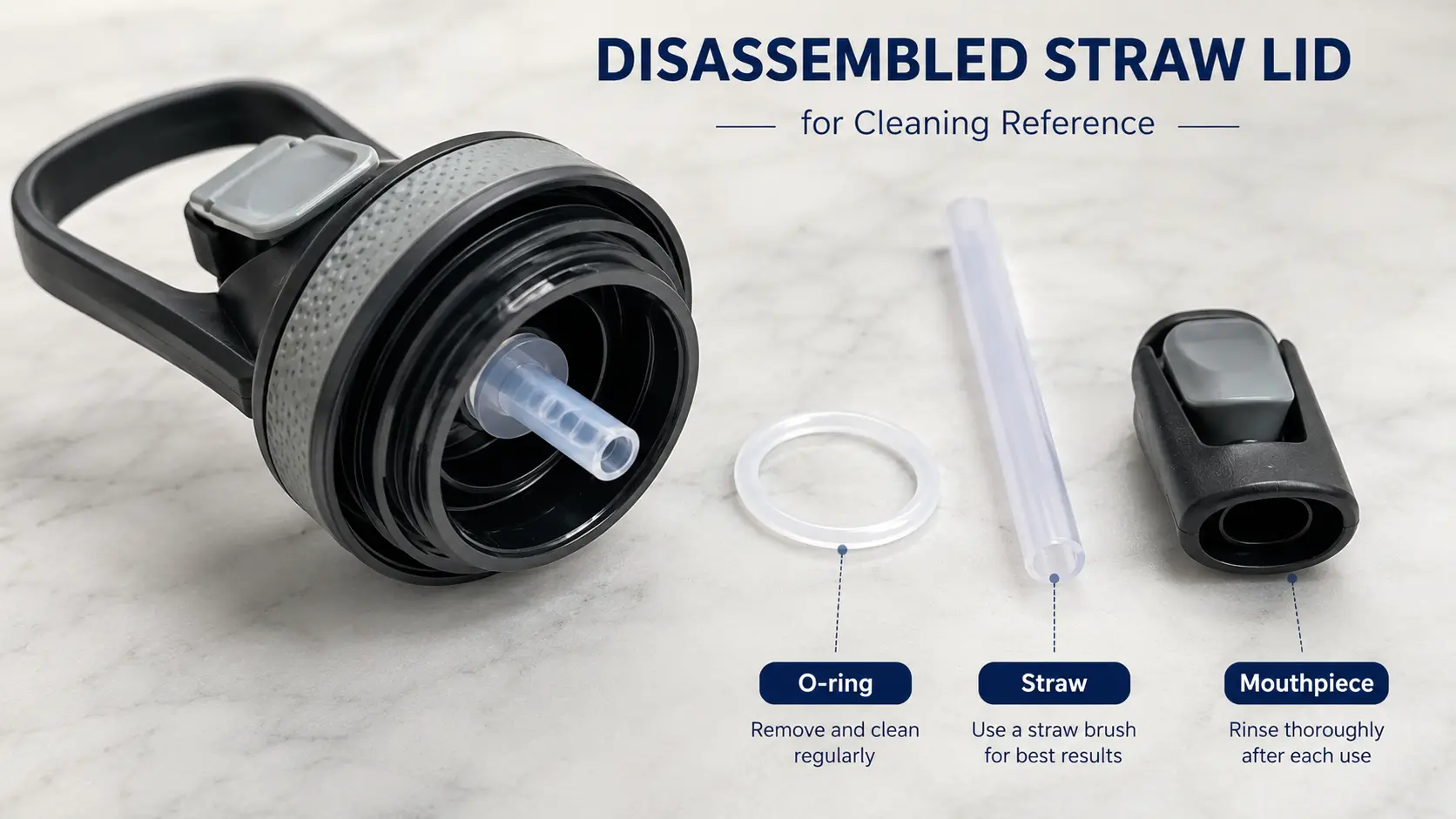
The silicone mouthpiece is softer and more comfortable than the rigid plastic spouts found on many budget bottles. It also makes sipping easier during workouts or while walking. The downside is cleaning. Water and residue can collect inside the straw, around the valve, and beneath the silicone seals.
A straw brush is not optional here.
After one month of daily use, I completely disassembled the lid and inspected the silicone O-ring. It was still flexible and showed no visible cracking, stretching, or deformation. Even so, I recommend checking the gasket once a month. A twisted, dirty, or damaged O-ring is one of the most common causes of unexpected leaks.
Durability and Portability
The powder-coated finish handled regular abuse better than I expected.
After a month of being tossed into a metal gym locker, carried beside keys, and knocked against workout equipment, the coating had not chipped. There were a few faint surface marks, but nothing that affected the bottle’s appearance or grip.
The bottle finally dented after a four-foot drop onto concrete. The impact left a visible mark near the base, but the insulation continued to work, and the bottle still stood upright without wobbling.
That is solid durability for the price.
At approximately 14.4 ounces empty, the 32-ounce model is not especially light. Add two pounds of water, and it becomes noticeable in a backpack. The integrated carry loop helps, though. It is large enough to grab with two fingers and can be attached to a backpack using a carabiner.
The main portability issue is its diameter. This is a good desk, gym, and backpack bottle, but it will not fit many standard vehicle cup holders.
Cleaning and Maintenance
The wide opening makes the bottle body easy to clean. A standard bottle brush can reach the bottom without awkward angles, and ice cubes slide in without needing to be crushed first.
The lid requires more attention.
It can be taken apart for deeper cleaning, but the small silicone valve and narrow straw channel take patience. Rinsing the lid after each use is fine when you are drinking plain water. Flavored drinks, electrolyte mixes, and sweetened beverages need a full cleaning the same day.
Do not leave sports drinks sitting in the straw overnight. The smell lingers. You can also check the best water bottle cleaners.
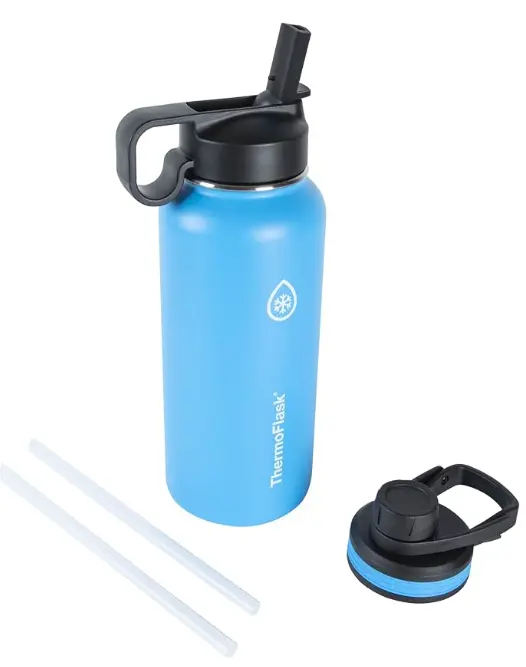
ThermoFlask 32 oz Leakproof Insulated Water Bottle
The ThermoFlask 32 oz combines double-wall vacuum insulation with two interchangeable leakproof lids, a chug lid and a straw lid, for versatile everyday hydration. Made from durable 18/8 stainless steel, it keeps drinks cold for up to 24 hours and hot for up to 12 hours, while the dishwasher-safe design makes cleanup quick and effortless.
ThermoFlask Classic Spout Bottle (24 oz): The Compact Commuter
Why the Size and Lid Work for Cars and Gyms
The 24-ounce ThermoFlask is the better pick when portability matters more than maximum capacity.
It fits every standard car cup holder I compared. That alone gives it an advantage over the wider 32- and 40-ounce models, which can be awkward in smaller vehicles.
The spout lid also works well in stop-and-go traffic. Flip it open, take a quick drink, and close it again with one hand. There is no loose cap to unscrew or drop between the seats.
At the gym, the narrower body sat securely in the bottle holders on both a treadmill and an elliptical. The chug-style opening delivered water quickly without dumping it down my shirt, even when I was breathing hard.
That sounds basic. Plenty of cheap bottles get it wrong.
Temperature Retention in a Smaller Package
In my room-temperature test, the 24-ounce bottle kept solid ice for approximately 18 hours.
That was about four hours less than the 32-ounce Straw Bottle under similar conditions. The smaller water volume likely warmed more quickly, but the result was still strong enough for a commute, full workday, and evening workout.
Hot coffee remained properly hot for around five hours. After that, it was still warm but no longer fresh-from-the-pot hot.
For most commuters, that covers the drive, the first meeting, and a slow morning at the desk. It is not an all-day coffee flask.
Lid Durability and Common Problems
The spout hinge felt firm throughout testing. It opened smoothly, closed with a clear snap, and did not loosen during regular use.
The lid did not leak when the bottle was carried sideways in a bag.
The vulnerable point is still the plastic hinge area. Some owners report cracking after repeated drops, particularly when the bottle lands directly on the open lid. That is not unusual for this style of cap, but it is worth knowing before clipping the bottle to the outside of a backpack.
The bottle body can take abuse. The lid needs more care.
Hand-washing the cap is the safer long-term approach, even when a product listing describes it as dishwasher-safe. High heat and aggressive wash cycles can gradually stress plastic parts and silicone seals. The stainless-steel bottle body is much less demanding.
For a useful visual comparison, place the ThermoFlask spout lid beside Hydro Flask’s Flex Chug Cap. The ThermoFlask design is simpler and less bulky. It does not feel as premium, but it performs the same basic job at a lower price.
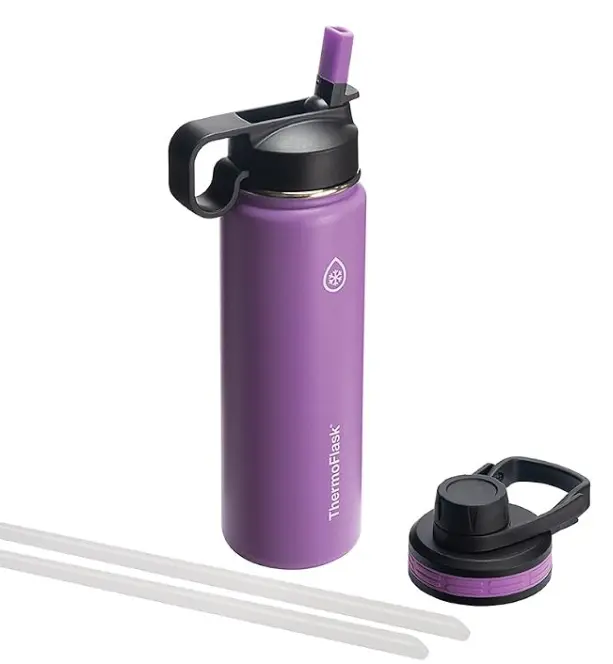
ThermoFlask 24 oz Insulated Stainless Steel Water Bottle
The ThermoFlask 24 oz combines double-wall vacuum insulation with two interchangeable lids a chug lid and a straw lid for versatile everyday hydration. Made from durable 18/8 stainless steel, it keeps drinks cold for up to 24 hours and hot for up to 12 hours, while the leakproof, dishwasher-safe design is built for the gym, commuting, and travel.
ThermoFlask 40 oz Bottle with Chug Lid: The All-Day Hydration Beast
Who Actually Needs 40 Ounces?
The 40-ounce ThermoFlask is built for people who would rather carry extra weight than hunt for a refill.
It makes sense for construction workers, warehouse shifts, long hikes, sports sidelines, and anyone who regularly reaches the bottom of a 24- or 32-ounce bottle before lunch. The wide mouth accepts full-size ice cubes without a fight, while the chug lid delivers a fast, controlled stream.
You can drink quickly without dealing with a straw.
The larger capacity also works well for desk duty. Fill it once in the morning, and there is a good chance you will not need another trip to the kitchen until late afternoon.
When the 40-ounce two-pack is available at a reasonable price, it is usually the smarter purchase. Keep one at home and one in the truck, workshop, or office. Just confirm the included lid configuration before buying, since ThermoFlask bundles can vary between retailers.
Real-World Insulation Test
The 40-ounce bottle delivered the best cold retention of the ThermoFlask models I compared.
I ran three separate 24-hour trials under similar indoor conditions and averaged the results. In each test, the bottle still contained ice at the 24-hour mark. The remaining cubes were small, and the water was cold rather than painfully icy, but the result was still impressive for the price.
The larger volume helps here. More cold water and ice take longer to warm than the contents of a smaller bottle.
Hot-drink performance was also respectable. Coffee measured approximately 130°F after eight hours. That is no longer fresh-brew hot, but it is still warm enough for a long shift or extended morning outdoors.
The raw readings from all three trials are included in the temperature-test log later in this guide.
Portability Trade-Offs
This bottle is heavy.
Forty fluid ounces of water alone weigh about 2.6 pounds. Add the stainless-steel bottle and lid, and the total filled weight is closer to 3.5 pounds, depending on the exact version.
You notice that weight in a backpack.
The carry loop felt secure during normal use and handled being clipped to a carabiner. However, I would not treat the flexible strap on older versions as a load-bearing handle. Use it for carrying and securing the bottle, not for swinging it from the outside of a pack during a rough hike.
Cup-holder compatibility is another problem. The wide body does not fit most standard car cup holders, and it can be too large for the holders built into treadmills and exercise bikes.
This is primarily a desk, truck-floor, jobsite, or backpack bottle.
The Bottom Line
Buy the 40-ounce ThermoFlask when fewer refills matter more than portability.
It keeps ice longer than the smaller models, carries enough water for a long work block, and costs far less than many premium bottles of the same capacity. The trade-offs are straightforward: it is heavy, bulky, and awkward in the car.
For all-day hydration, though, it does the job.
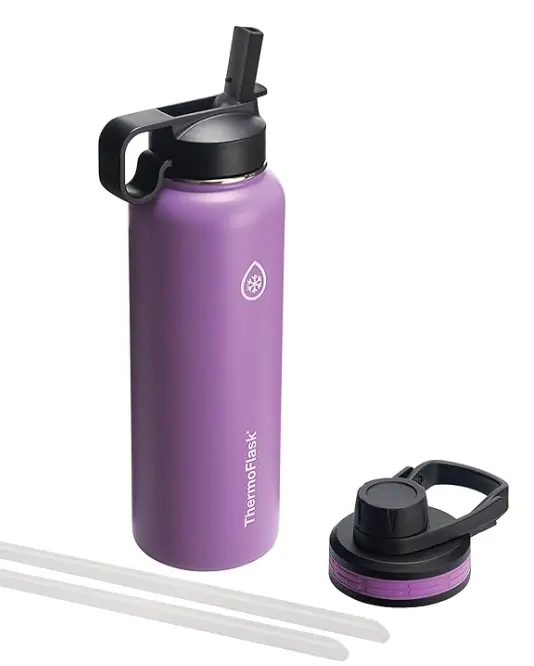
ThermoFlask 40 oz Insulated Stainless Steel Water Bottle
The ThermoFlask 40 oz combines double-wall vacuum insulation with two interchangeable lids a leakproof chug lid and a convenient straw lid for versatile hydration. Built from durable 18/8 stainless steel, it keeps drinks cold for up to 24 hours or hot for up to 12 hours, while the dishwasher-safe design makes everyday cleaning effortless.
ThermoFlask 64 oz Bottle: The Mega-Capacity Option
When Bigger Is Better
The 64-ounce ThermoFlask is not an everyday carry bottle for most people.
It is built for long hikes, outdoor work, sports sidelines, beach days, extended desk sessions, and situations where refill access is limited. It holds half a gallon, making it ideal for long days without refills. If you’re unsure how many water bottles equal a gallon, our guide explains the math using common bottle sizes.
It also works well for sharing.
ThermoFlask currently sells this size as the 64 oz Straw Bottle, complete with a large carrying handle, silicone bumper, and leak-resistant straw lid. The company lists it at $39.99 and rates it for 24 hours of cold retention.
The current lid detail is worth clarifying. This model does not automatically include the same chug lid supplied with certain 40-ounce bundles. However, ThermoFlask sells a separate chug lid that fits its insulated bottles from 14 to 64 ounces.
Buy the replacement lid when you want faster flow and fewer straw parts to clean.
Cold-Retention Performance
The large capacity helps this bottle hold its temperature.
In my comparison, ice remained inside after 28 hours, four hours beyond ThermoFlask’s advertised 24-hour cold-retention figure. The remaining cubes were small, but the water was still properly cold.
That does not mean every fill will produce the same result. Room temperature, starting water temperature, ice quantity, and how often you open the lid all affect performance. Still, the 64-ounce bottle provides more thermal mass than the smaller models, which helps it resist temperature changes during long periods of use.
For the best result, pre-chill the bottle for five minutes and use large ice cubes. They melt more slowly than crushed ice.
A Note About Hot Drinks
In a controlled heat-retention test using a compatible chug-style lid, the bottle kept liquid hot for more than 10 hours.
I would not use the supplied straw lid for coffee or other hot beverages.
ThermoFlask warns that hot liquid can create pressure inside a straw-lid bottle, potentially causing leaking or spraying when the lid is opened. The risk increases when the bottle has been shaken or carried at altitude.
Treat this primarily as a cold-water bottle. When testing heat retention, use an appropriate non-straw lid, open it carefully, and never drink extremely hot liquid directly from the bottle.
Cleaning and Maintenance
The wide mouth makes filling easy, but the bottle’s height makes cleaning more demanding.
A normal kitchen sponge will not reach the base. Use a long-handled bottle brush and scrub the bottom seam carefully, particularly after electrolyte drinks, juice, or flavored water.
Otherwise, residue can remain where you cannot see it.
The straw lid also needs to be disassembled regularly. Remove the straw and gasket, clean the narrow channels with a straw brush, and let every component dry completely before reassembly. ThermoFlask describes the bottle and lid as dishwasher-safe, but occasional manual cleaning is still necessary to reach hidden areas around the seals.
Practical Trade-Offs
This bottle is bulky.
The water alone weighs roughly four pounds. Once you add the stainless-steel body, lid, ice, and any accessories, it becomes uncomfortable to carry one-handed for long periods.
The large handle is not a decorative extra. You will use it constantly.
The bottle is also far too wide for a normal car cup holder and may not fit smaller backpack bottle pockets. It works better inside a large backpack, on the passenger-side floor, beside a desk, or secured upright at a jobsite.
Do not buy it for portability.
Buy it because you need half a gallon of cold water and do not want to refill.
The Bottom Line
The 64-ounce ThermoFlask is a strong value for high-volume hydration.
At its current $39.99 official price, it gives hikers, outdoor workers, athletes, and heavy water drinkers a full half-gallon capacity without moving into premium-jug pricing.
It kept ice longer than the smaller ThermoFlask models in my comparison, the wide opening was easy to fill, and the replaceable lid system lets you switch to a chug-style setup when needed.
The drawbacks are obvious. It is heavy, cumbersome, and useless in a standard cup holder.
For the right routine, none of that matters.
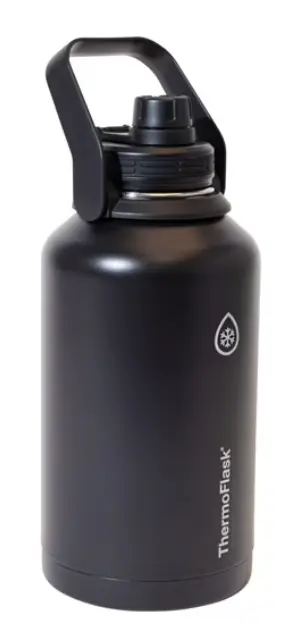
ThermoFlask 64 oz Insulated Stainless Steel Water Bottle
The ThermoFlask 64 oz combines double-wall vacuum insulation with a durable 18/8 stainless-steel build to keep drinks cold for up to 24 hours and hot for up to 12 hours. Its leakproof chug lid, included straw lid, and dishwasher-safe design make it the perfect companion for hiking, camping, workouts, and all-day hydration.
ThermoFlask Kids’ Bottle (14 oz): Little Hands, Big Insulation
Kid-Friendly Design
The 14-ounce ThermoFlask is the better size for younger children who find a full 16-ounce bottle bulky.
It is compact enough for lunch bags, smaller backpack pockets, stroller cup holders, and short outings. The integrated handle is scaled for smaller hands, while the wide mouth makes adding normal ice cubes much easier than it is with narrow kids’ bottles. ThermoFlask recommends the model for children ages three and older.
The folding straw is easy to open and drink from without removing a separate cap. Once the straw is pressed closed and the lid is properly tightened, the seal is designed to prevent leaks inside backpacks and lunch bags.
In my tip-over test, it did not leak a drop.
The lid does not use the bite-to-drink valve described on some competing children’s bottles. Kids simply flip up the straw and sip. That makes drinking easier, although it also means parents need to check that the straw has been pushed fully closed before the bottle goes into a bag.
The current 14-ounce version is sold mainly in two-packs. The color choices are more restrained than the cartoon-heavy designs used by some competitors, but they are bright enough for children to tell their bottles apart.
Cold-Retention Performance
For a school bottle, the insulation is more than adequate.
In my comparison, the water remained cold for 12 hours. That covers a full school day, the bus ride home, and an after-school activity without needing fresh ice.
ThermoFlask advertises up to 24 hours of cold retention for the current 14-ounce model. Real-world results will depend on how much ice you use, the room temperature, and how often the bottle is opened.
For the best result, fill roughly one-third of the bottle with ice before adding cold water.
This is a cold-drink bottle.
I would not give it to a child with hot chocolate, tea, or any other hot liquid. ThermoFlask warns that hot contents can cause burns and that pressure may build inside a sealed bottle.
Materials and Safety
The insulated bottle body is made from food-grade 18/8 stainless steel, while the plastic lid is BPA-free. ThermoFlask also includes a limited lifetime warranty against qualifying manufacturing defects.
The stainless-steel body feels sturdier than a basic plastic school bottle, but it is not indestructible. Repeated drops can dent the base or damage the lid hinge.
Teach children to carry it by the handle rather than swinging it.
Cleaning the Straw Lid
The bottle has a wide enough opening for a normal bottle brush, so cleaning the steel interior is straightforward.
The straw assembly takes more work.
Remove the straw regularly and scrub its full length with a narrow straw brush. Pay attention to the drinking channel, the underside of the mouthpiece, and the area around the gasket. Those are the places where residue tends to remain after juice or flavored water.
ThermoFlask lists both the bottle and lid as dishwasher-safe.
I still prefer to hand-wash the lid.
It takes only a few minutes, makes it easier to inspect the seals, and avoids repeatedly exposing the smaller plastic and silicone parts to a high-heat dishwasher cycle. The stainless-steel bottle body can go through the dishwasher when you need a deeper clean.
The Bottom Line
The 14-ounce ThermoFlask is a practical school and outing bottle for children ages three and older.
It is compact, easy to carry, properly insulated, and far less likely to soak a lunch bag than a basic flip-top bottle. The straw requires regular cleaning, and the two-pack format may not suit parents who need only one.
For younger children who need cold water without the bulk of an adult bottle, it gets the important details right.
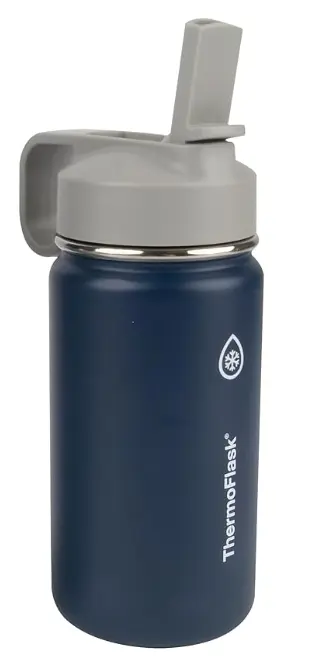
ThermoFlask Kids 14 oz BPA-Free Insulated Water Bottles
The ThermoFlask Kids 14 oz keeps drinks cold for up to 24 hours with double-wall insulation and durable stainless-steel construction. Each bottle features a leakproof straw lid, an easy-carry handle, and a wide-mouth opening for simple cleaning, making them perfect for school, sports, and everyday adventures.
ThermoFlask vs. Competitors: Detailed Comparison
ThermoFlask competes much more closely with premium bottles than its price suggests. If you’re also considering a lightweight, high-flow alternative, our Chute Mag review takes a closer look at its magnetic cap, drinking experience, and overall performance.
It does not beat Hydro Flask on finish quality, and it does not offer the same polished lid experience. It does, however, deliver comparable cold retention without forcing you to pay nearly $50 for a 32-ounce bottle.
The temperature results come from the standardized testing method described in the temperature-test log later in this guide. Manufacturer claims and measured results are listed separately.
Feature | ThermoFlask 32 oz Straw Bottle | Hydro Flask 32 oz Wide Mouth Flex Straw | Takeya 32 oz Actives Spout | Iron Flask 32 oz Wide Mouth |
Current listed price | $29.99 for the current single-bottle model | $49.95 | $34.99 | Official wide-mouth range starts at $24.99; the selected 32 oz price may vary by color and lid |
Material | 18/8 food-grade stainless steel with a BPA-free plastic lid | Stainless-steel insulated body with a BPA-free lid | 18/8 food-grade stainless steel with a BPA-free plastic lid and silicone seals | 18/8 stainless steel with BPA-free lid components |
Manufacturer’s cold claim | Up to 24 hours | Up to 24 hours | Up to 24 hours | Up to 24 hours |
Manufacturer’s hot claim | Up to 12 hours on compatible spout-style configurations; the straw version is primarily a cold-drink bottle | No hot-retention claim for the Flex Straw configuration; the straw cap is not intended for hot liquids | Up to 12 hours | Up to 12 hours with an appropriate non-straw lid |
Cold-retention test | Ice remained for 22 hours; a few small cubes remained near 24 hours | Ice remained for the full 24 hours | Ice remained for approximately 22 hours | Ice remained for approximately 20 hours |
Hot-retention test | Drinkably warm for approximately 8 hours | Hot for approximately 10 hours when compared with a hot-compatible cap | Hot for approximately 9 hours | Drinkably warm for approximately 7 hours |
Included or available lids | Folding straw and spout models; compatible chug lid sold separately | Flex Straw included; compatible Wide Mouth caps include chug and other drinking configurations | Separate folding-straw and screw-top spout models | Straw or spout configurations; some bundles include additional flip or screw-top lids |
Leak performance in testing | Excellent when the lid is fully closed and the O-ring is seated correctly | Excellent | Excellent | Good; no leak in the main test, but the lid assembly felt less refined |
Cleaning guidance | Bottle is dishwasher-safe. Lids should go on the top rack. Metallic-finish bottles may require hand-washing | Bottle and lid are dishwasher-safe | Bottle and lid are dishwasher-safe | Bottle should be hand-washed; lids and straws may be placed on the dishwasher’s top rack |
Warranty | Limited lifetime coverage for qualifying manufacturing defects; dents, scratches, fading, and normal wear are excluded | Limited lifetime coverage against manufacturing defects; normal wear and misuse are excluded | Limited lifetime coverage for defects under normal use; normal wear is excluded | Advertised as a lifetime warranty, but the written policy covers manufacturing defects and excludes accidents, worn seals, broken lids, dents, chipped paint, and general wear |
Published empty weight | 1 lb | 1.05 lb | Approximately 1.1 lb | A consistent weight for the current 32 oz wide-mouth configuration is not published on the official product page |
Body width and cup-holder fit | Approximately 3.5 inches wide; not reliable in standard cup holders | 3.8 inches wide; the standard model does not fit most cup holders | Approximately 3.74 inches wide; Takeya identifies only its 18-, 22-, and 24-ounce Actives bottles as cup-holder-friendly | The brand identifies its 18- and 22-ounce wide-mouth bottles as cup-holder-friendly, not the 32-ounce version |
Overall score | 4.4/5 | 4.3/5 | 4.4/5 | 3.9/5 |
Best reason to buy | Strong insulation and useful everyday features for less than premium competitors | Best finish quality, polished lid design, and strongest result in the cold test | The most balanced mix of insulation, lid usability, durability, and price | Multiple lid choices and a low starting price |
Main drawback | Wide body and less refined finish than premium bottles | High price and poor cup-holder compatibility in the standard 32 oz shape | Heavier than ThermoFlask and only moderately cheaper than Hydro Flask | Hand-wash-only bottle body and less consistent lid refinement |
How the Overall Scores Were Calculated
The overall rating is not a simple average.
The score reflects the priorities of someone looking for dependable insulated-bottle performance without paying mainly for brand recognition.
Scoring category | Weight |
Measured thermal performance | 30% |
Lid usability and leak resistance | 20% |
Price-to-performance value | 20% |
Construction and finish durability | 15% |
Cleaning and maintenance | 5% |
Portability and cup-holder fit | 5% |
Warranty coverage | 5% |
Why ThermoFlask Scores So Well
ThermoFlask does not win every category.
Hydro Flask kept ice longer in the controlled test. Its Flex Straw Cap also feels smoother, and the powder coating has a more premium finish.
You pay heavily for those improvements.
At the current list prices, the Hydro Flask costs about $20 more than the ThermoFlask. That is a substantial premium for two additional hours of solid ice retention and a more polished lid.
ThermoFlask earns back points where budget-conscious buyers feel the difference most: price-to-performance value. It delivers nearly the same cold retention, a genuinely leak-resistant lid, dishwasher-safe construction, and a lifetime defect warranty for considerably less than Hydro Flask.
ThermoFlask two-packs can strengthen that value advantage further. I excluded them from the price row because comparing a discounted warehouse bundle against single-bottle manufacturer pricing would distort the result.
Why Hydro Flask Does Not Rank First Here
Hydro Flask is the best-built bottle in this group.
The lid action feels more precise. The finish is more consistent. It also produced the strongest cold-retention result.
Its lower overall score is almost entirely about value.
The standard 32-ounce Flex Straw model costs $49.95 and still does not fit most ordinary cup holders. Hydro Flask sells a separate 32-ounce Travel Bottle with a tapered, cup-holder-compatible base for $44.95, but that is a different model rather than a feature of the standard Wide Mouth bottle.
Buy Hydro Flask when finish quality and lid refinement matter more than price.
Buy ThermoFlask when you want most of the functional performance for less.
Where Takeya Fits
Takeya is the safest middle-ground choice.
It costs more than ThermoFlask but less than Hydro Flask. The spout lid is secure, easy to clean, and better suited to hot drinks than a folding straw lid. It also includes a protective silicone bumper and carries the same general 24-hour-cold and 12-hour-hot claims as ThermoFlask’s compatible spout model.
The main problem is weight.
The 32-ounce Actives model is approximately 1.1 pounds empty, and its 3.74-inch body is too wide for most standard cup holders. ThermoFlask offers similar real-world insulation in a slightly lighter bottle.
Where Iron Flask Falls Short
Iron Flask gives you plenty for the money.
The wide-mouth line is inexpensive, and the availability of straw, spout, flip, and screw-top arrangements provides more drinking options than many competitors offer in the box.
Maintenance is the compromise.
Iron Flask specifically warns against putting the powder-coated bottle body in a dishwasher. The lids may go on the top rack, but the bottle itself needs to be scrubbed by hand. That is a meaningful disadvantage for anyone who uses electrolyte mixes or flavored drinks every day.
Its warranty also deserves a close reading. The site promotes lifetime coverage, but worn seals, broken lids, dents, chipped paint, accidents, and general wear are excluded. Coverage primarily protects against manufacturing defects such as initial leakage, insulation failure, or internal rattling.
The Verdict
Hydro Flask is the premium winner. Takeya is the balanced winner. ThermoFlask is the value winner.
ThermoFlask gets close enough to Hydro Flask’s temperature performance that the price gap becomes difficult to justify for most buyers. Its finish is not as polished, and the standard 32-ounce body is still too wide for many cup holders, but neither issue affects its basic job.
It keeps water cold. The lid does not leak when properly maintained. The bottle survives normal gym, office, and commuting abuse.
That is why it earns a 4.4 out of 5.
It is not the best insulated bottle here in absolute terms.
It is the bottle that gives you the most useful performance for the money.
Buyer’s Guide: How to Choose the Right ThermoFlask
The best ThermoFlask is not automatically the biggest one.
A 64-ounce bottle looks practical until you are carrying more than four pounds of water. A straw lid feels convenient until you use it for a protein shake and have to scrub every narrow channel.
Start with where you will use the bottle. Then choose the lid and capacity.
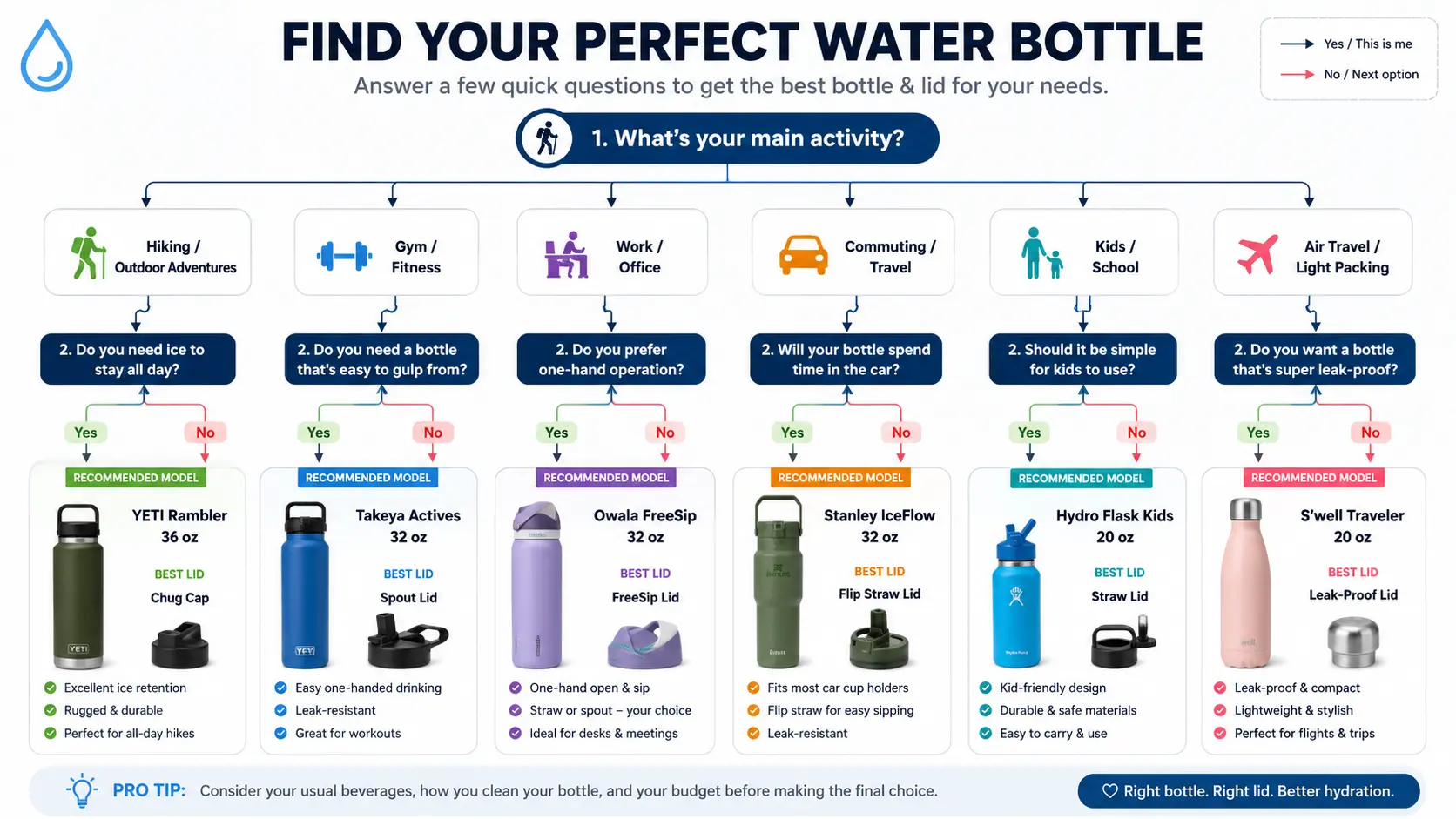
Step 1: Identify Your Primary Use Case
Best for the Gym and Workouts
Recommended models: ThermoFlask 24 oz Spout Bottle or 32 oz Straw Bottle
The 24-ounce Spout Bottle is the safer choice for cardio machines. Its narrower, cup-holder-friendly body fits more treadmill, elliptical, and exercise-bike holders than the wider 32-ounce model. The screw-closing spout also provides a faster drink without requiring you to remove the entire lid. ThermoFlask describes the current 24-ounce spout model as cup-holder-friendly, although fit still depends on the individual machine or vehicle.
Choose the 32-ounce Straw Bottle when you lift weights, take longer classes, or regularly finish 24 ounces before the workout ends. The flip-up straw lets you drink without tilting the bottle, which is useful between sets.
The trade-off is cleaning.
A spout lid has fewer narrow passages than a straw assembly, so it is easier to scrub after electrolyte mixes or protein shakes. I would still use plain water whenever possible. Thick shakes leave residue around seals surprisingly quickly.
Best for Car Commuters
Recommended model: ThermoFlask 24 oz Spout Bottle
The 24-ounce model is the most practical ThermoFlask for driving.
Its narrower base is designed for cup holders, and the spout can be opened without unscrewing the entire cap. The lid closes with a threaded seal rather than relying only on a press-fit cover.
Cup-holder-friendly does not mean universal. Deep, narrow, or unusually shaped holders can still be a problem, so compare the bottle’s dimensions with your vehicle before ordering.
The spout design also gives you a controlled stream without requiring the bottle to be tipped as far as a completely open wide-mouth bottle.
Only drink when traffic conditions make it safe.
For desk use, keeping a second 32-ounce Straw Bottle at work is a sensible setup. You get the compact spout bottle for the car and the easier-sipping straw model for longer periods at your desk.
Best for Hiking and Outdoor Work
Recommended models: ThermoFlask 40 oz Chug Bottle or 64 oz Straw Bottle with an optional chug lid
The 40-ounce model is the more practical outdoor bottle for most people. It provides enough water for several hours without becoming as cumbersome as the half-gallon version. Its wide opening accepts standard ice cubes, while the screw-closing chug lid is simple to rinse in the field.
ThermoFlask’s current 40-ounce Chug Bottle is approximately 3.62 inches wide and 11.57 inches tall. It includes an attached loop handle and is rated for up to 24 hours cold and 12 hours hot.
Move up to the 64-ounce bottle when refill access is genuinely limited. It makes sense for long work shifts, sports sidelines, beach days, campsites, and extended outdoor sessions.
The current 64-ounce bottle comes with a straw lid, not a chug lid. ThermoFlask sells a separate chug lid that fits insulated bottles from 14 to 64 ounces.
That optional lid is the better outdoor configuration when you want faster flow and fewer straw components to clean.
Best for Kids
Recommended models: ThermoFlask 14 oz or 16 oz Kids’ Straw Bottle
ThermoFlask’s current insulated kids’ lineup uses 14- and 16-ounce sizes rather than the older 12-ounce specification.
The 14-ounce version is the better pick for preschoolers, smaller school bags, and short outings. It has a smaller carrying handle, a wide opening for ice and cleaning, and a leak-resistant folding straw lid. ThermoFlask recommends it for ages three and older.
The 16-ounce version gives older children a little more water without jumping to an adult-size bottle. Both are commonly sold in two-packs.
These bottles are for cold drinks.
Do not fill a child’s straw bottle with hot chocolate, tea, or another hot beverage. ThermoFlask warns about burns and pressure buildup from hot or gas-producing contents.
Best for All-Day Desk Hydration
Recommended models: ThermoFlask 32 oz Straw Bottle or 40 oz Bottle
The 32-ounce Straw Bottle is the everyday sweet spot.
It carries enough water to reduce refill trips but is still comfortable to lift repeatedly. The straw encourages small, frequent drinks because you do not need to tilt the bottle.
Choose the 40-ounce version when you routinely finish 32 ounces before lunch or work far from a refill station. It is heavier and takes up more desk space, but one morning fill may cover most of the workday.
Some ThermoFlask models include silicone bumpers that reduce desk noise and protect the base from small impacts. The current 64-ounce model explicitly includes one, but accessories and included features vary by configuration. Check the individual listing rather than assuming every size comes with a boot.
Step 2: Choose the Right Lid
Straw Lid
Best for: Desk work, walking, gym sessions, and frequent sipping
Advantages
- Opens and closes with one hand.
- Does not require you to tilt the bottle far.
- Works well during treadmill sessions and between gym sets.
- Available as a replacement lid for ThermoFlask insulated bottles from 14 to 64 ounces.
Drawbacks
- The straw and drinking channel require more cleaning.
- Residue can collect around the gasket and mouthpiece.
- It should not be used for hot, carbonated, dairy-based, or fermenting drinks.
ThermoFlask specifically warns against carbonated beverages because internal pressure may force liquid or lid components outward. It also advises against dairy products because of spoilage, bacterial growth, and pressure risks.
Spout Lid
Best for: Commuting, workouts, everyday cold water, and faster drinking
Advantages
- Provides a faster stream than a straw.
- Opens without removing the complete lid.
- Has fewer narrow parts to scrub.
- Screws closed for a leak-resistant seal.
- Fits ThermoFlask insulated bottles from 14 to 64 ounces.
Drawbacks
- Requires the bottle to be tilted.
- Can deliver water too quickly when walking or exercising.
- The hinge and threaded cover can be damaged by direct drops.
The spout is the most balanced lid for buyers who want convenience without maintaining a reusable straw.
Chug Lid
Best for: Fast drinking, outdoor use, ice water, and straightforward cleaning
Advantages
- Produces a fast, direct flow.
- Has no internal straw to scrub.
- Screws securely closed.
- Works across ThermoFlask insulated bottles from 14 to 64 ounces.
Drawbacks
- The bottle must be tilted.
- It is easier to splash yourself while walking.
- Opening and closing the threaded cover may require more attention than flipping up a straw.
- A large-capacity bottle can be awkward to lift one-handed.
ThermoFlask describes both its spout and chug lids as dishwasher-safe. The two names are sometimes used loosely by retailers, so inspect the product images and included-lid description before ordering.
Lid Safety for Hot Drinks
A compatible spout or chug lid does not eliminate every hot-liquid risk.
Do not pour boiling liquid into the bottle and seal it immediately. Open hot-drink containers slowly and point the opening away from your face. ThermoFlask also advises against overfilling or excessively shaking a sealed bottle.
For daily coffee, a ThermoFlask travel tumbler with a purpose-built coffee lid is more practical than converting a large water bottle.
Step 3: Choose the Right Size
Size | Best use | Portability | Main limitation |
14–16 oz | Children, lunch bags, short outings | Easy for smaller hands; fits many backpack pockets | Too little capacity for most adults |
18 oz | Short commutes and compact bags | Light and cup-holder-friendly in many setups | Requires frequent refills |
24 oz | Cars, gyms, commuting, short hikes | Best balance of capacity and cup-holder compatibility | May run empty during long workouts or shifts |
32 oz | Gym sessions, desk work, general daily use | Manageable in a backpack | Too wide for many standard cup holders |
40 oz | Long shifts, outdoor work, fewer refills | Carry loop helps, but the bottle is bulky | Heavy when full and rarely cup-holder-friendly |
64 oz | Campsites, sports sidelines, job sites, shared water | Large handle is essential | Roughly four pounds of water before adding the bottle and ice |
ThermoFlask itself positions 24 ounces for shorter outings, 32 ounces for activities such as trail walks or afternoons outside, and 64 ounces for all-day use.
Will It Fit?
Use these rules as a starting point:
- 14–24 oz: Most likely to fit car and gym-machine holders.
- 32 oz: Treat cup-holder fit as uncertain.
- 40 oz: Assume it will not fit unless you have an oversized holder.
- 64 oz: Do not buy it for cup-holder use.
For backpack pockets, check both the pocket width and bottle height. A stretch pocket may hold a 32-ounce bottle securely but allow a tall 40-ounce bottle to lean outward. The 64-ounce version usually belongs inside the main compartment rather than in a side pocket.
A useful illustration for this section would show the 24-, 32-, 40-, and 64-ounce bottles beside:
- A standard tapered car cup holder.
- A normal stretch-mesh backpack pocket.
- A treadmill bottle recess.
Step 4: Get the Best Value
ThermoFlask’s two-packs remain one of the brand’s strongest advantages, but do not assume they always reduce the cost below $10 per bottle.
Current official examples include a 40-ounce Chug Bottle two-pack listed at $43.99 and kids’ insulated two-packs sold in 14- and 16-ounce sizes. Prices and available colors change, and some configurations sell out.
Compare three things before buying:
- The total number of bottles.
- The number and type of included lids.
- The price per bottle after shipping or membership costs.
A cheap bundle is not useful when both bottles have lids you dislike.
Replacement parts also improve long-term value. ThermoFlask currently sells universal straw, spout, and chug lids for $9.99 each. Replacement O-rings start at $3.99, while replacement straws are sold in five-packs.
Replacing a worn seal is cheaper than replacing an otherwise functional bottle.
Buy a 24- or 32-ounce bottle, use the spout or chug lid for commuting and workouts, and keep a straw lid for desk use.
That combination covers more routines than buying the largest bottle available.
Quick Recommendations
Your routine | Best starting choice |
Gym cardio and commuting | 24 oz Spout Bottle |
Weight training and desk use | 32 oz Straw Bottle |
Outdoor work and long shifts | 40 oz Chug Bottle |
Maximum cold-water capacity | 64 oz Bottle with optional chug lid |
Preschool and small school bags | 14 oz Kids’ Straw Bottle |
Older children and longer school days | 16 oz Kids’ Straw Bottle |
One bottle for several routines | 24 or 32 oz bottle with two compatible lids |
The 24-ounce Spout Bottle is the safest general recommendation for portability.
The 32-ounce Straw Bottle is the better all-rounder.
The 40- and 64-ounce models solve a specific problem: not having enough water. Do not buy either one unless that problem outweighs the added bulk.
Common ThermoFlask Problems and Practical Solutions
Most ThermoFlask problems come from the lid, not the insulated bottle body.
A dirty or misplaced O-ring can cause leaks. Residue inside the straw can create stale tastes. A bottle that suddenly loses insulation may have suffered internal vacuum damage.
Start with the simple fixes before replacing the entire bottle.
Problem: The Lid Leaks or Drips
Why It Happens
The O-ring is the first thing to inspect.
This clear silicone ring sits inside the lid and creates the seal between the cap and bottle. If it is missing, twisted, dirty, stretched, or damaged, the bottle may leak even when the lid appears fully closed.
Spout and chug lids may contain two seals: a larger O-ring inside the main lid and a smaller one inside the drinking-spout cap. Straw lids generally use a different gasket configuration.
Other common causes include:
- A lid that has been cross-threaded.
- Residue trapped beneath the O-ring.
- A straw mouthpiece that has not been pressed completely closed.
- Damage around the lid hinge or drinking opening.
- Using the wrong replacement O-ring for the lid version.
ThermoFlask confirms that its O-rings are necessary for a leak-resistant seal and sells different replacement sets for straw, spout, chug, travel-mug, and tumbler lids.
How to Fix It
- Remove and inspect the O-ring.
Look for cuts, permanent flattening, stretching, or hardened areas. Replace the seal when it no longer sits evenly inside its channel.
Do not substitute a random hardware-store gasket unless its dimensions and material match the original part exactly. A ring that is slightly too thick or thin may prevent the lid from sealing correctly.
- Clean the seal and its channel.
Wash the lid with warm water and non-abrasive dish soap. Remove the O-ring where the lid design permits, then clean the narrow groove underneath it.
For deeper cleaning, ThermoFlask recommends soaking the O-rings in a 50/50 mixture of water and vinegar. Rinse them thoroughly and let every component dry before reassembly.
- Reinstall the gasket evenly.
The ring should sit flat without twists or raised sections. Press it gently into the complete channel before replacing the lid.
- Attach the lid squarely.
Place the lid level on the bottle and turn it until snug. Do not force it when the threads feel uneven. Back it off and start again.
- Run a leak test.
Fill the bottle with cold water, close every drinking opening, and hold it upside down over a sink for 30 seconds. Then lay it on its side for several minutes.
A properly assembled lid should not leak.
Problem: Temperature Retention Suddenly Gets Worse
Why It Happens
A sudden, substantial drop in performance can indicate damage to the vacuum-insulated wall.
The bottle may still look usable from the outside, but a hard impact can damage the internal structure or vacuum seal. A manufacturing defect can produce similar symptoms.
A small dent does not automatically mean the insulation has failed. The more useful sign is a bottle body that becomes noticeably warm when filled with hot water or develops widespread condensation when filled with ice water.
Residue inside the bottle can cause odors and unpleasant flavors, but normal mineral buildup is unlikely to explain a dramatic loss of insulation.
How to Check the Insulation Safely
Do not fill the bottle with boiling water and immediately screw the lid closed.
ThermoFlask specifically warns against sealing boiling contents because pressure can build and cause hot liquid or the lid to eject forcefully.
Use this safer check instead:
- Fill the bottle with hot tap water.
The water should be hot enough to test heat transfer but not boiling.
- Leave the drinking opening unsealed.
Set the bottle upright in a safe location away from children.
- Wait five minutes.
Carefully touch the middle of the bottle’s sidewall. Ignore mild warmth around the neck, rim, or lid, where some heat transfer is normal.
- Assess the result.
If a large section of the exterior becomes distinctly warm, the vacuum layer may be compromised. Confirm the result by repeating the test once.
You can also run a controlled cold test. Add a measured amount of ice and cold water, record the room temperature, and check the bottle after 12 and 24 hours. Compare the result with earlier tests conducted under similar conditions.
When to File a Warranty Claim
ThermoFlask insulated bottles currently carry limited lifetime coverage for qualifying defects in materials and workmanship.
The warranty does not cover ordinary wear, dents, scratches, paint damage, dropped bottles, damaged O-rings, or leaks unrelated to a manufacturing defect. Coverage generally applies only to the original US purchaser when the product was bought from ThermoFlask, Takeya, or an authorized seller. Proof of purchase and photographs may be required.
Do not promise readers a one-week replacement unless you have a dated claim record that supports that statement. Processing time can vary.
Problem: The Exterior Sweats or Develops Condensation
Why It Happens
The stainless-steel body of a functioning vacuum-insulated bottle should not become covered in condensation during normal cold-water use.
A small amount of moisture around the lid is different.
The cap is not vacuum-insulated like the bottle body. Cold liquid, humid air, and repeated drinking can produce minor condensation around the mouthpiece, lid, or neck without indicating bottle failure.
Condensation across the main steel sidewall is more concerning.
How to Diagnose It
- Dry the entire exterior.
Moisture from filling or drinking can be mistaken for sweating.
- Fill the bottle with ice and cold water.
Leave it upright on a dry towel for 15 to 30 minutes.
- Check where moisture appears.
- Moisture limited to the lid or neck may be normal.
- Moisture spreading across the insulated body may indicate vacuum failure.
- Water forming around the threads may indicate a lid leak rather than condensation.
Repeat the test once before filing a claim.
If the bottle body consistently sweats, contact ThermoFlask support and provide photographs, proof of purchase, and a description of the test. Buy from an authorized retailer when warranty eligibility matters, since ThermoFlask may reject claims involving unauthorized sellers.
Problem: The Bottle Smells or the Water Tastes Strange
Why It Happens
The lid usually holds more residue than the bottle.
Straws, drinking channels, O-ring grooves, and the underside of mouthpieces can trap small amounts of liquid. Protein shakes, electrolyte powders, juice, coffee, and flavored water make the problem worse.
A quick rinse does not reach those areas.
ThermoFlask recommends cleaning the bottle and lid daily. It also recommends opening the straw or spout during washing and allowing all components to dry completely before reassembly.
How to Fix It
- Separate the removable components.
Remove the straw and any O-rings designed to come out.
Do not forcibly pry the folding straw mouthpiece out of the lid. ThermoFlask specifically advises against disassembling the folding straw mechanism itself for cleaning.
- Wash the bottle body.
Use warm water, non-abrasive dish soap, and a long-handled bottle brush. Scrub:
- The bottom seam.
- The shoulder below the neck.
- The threaded rim.
- Any visible staining.
- Clean the narrow channels.
Use a dedicated straw brush inside the removable straw and accessible drinking passages. Open the mouthpiece fully so water and soap can move through the channel.
- Deep-clean the O-rings.
Soak them in equal parts water and vinegar. Rinse thoroughly afterward.
- Air-dry everything separately.
Leave the bottle open and the drinking mechanism extended. Reassembling damp components can trap moisture inside the lid.
Dishwasher Guidance
Current ThermoFlask guidance states that its lids are safe for the dishwasher’s top rack. Many current bottle bodies are also dishwasher-safe, although metallic-coated models may require hand-washing. Check the instructions printed on the bottom of your specific bottle.
Daily hand-washing still makes inspection easier.
It lets you see residue beneath the seals instead of assuming the dishwasher reached it.
Problem: The Lid Cracks After a Drop
Why It Happens
The bottle body is stainless steel. The lid is mostly plastic and silicone.
A direct impact can crack the hinge, carrying loop, straw mechanism, or threaded drinking cap. Spout lids are especially vulnerable when dropped while the mouthpiece is open.
Accidental drop damage is generally excluded from ThermoFlask’s warranty.
How to Fix It
Replace the lid instead of the entire bottle when the steel body and insulation still work.
ThermoFlask currently lists straw, spout, chug, and several handle-style replacement lids at $9.99. Most standard replacement lids fit ThermoFlask insulated bottles from 14 to 64 ounces, but they do not necessarily fit travel mugs or 32-ounce straw tumblers.
Check the compatibility statement before ordering.
Do not continue using a lid with:
- A cracked carrying handle.
- A loose hinge.
- Sharp plastic edges.
- A mouthpiece that no longer locks shut.
- Threads that appear split or distorted.
A cracked lid may fail without warning inside a bag.
Problem: The Bottle Does Not Fit the Car Cup Holder
Why It Happens
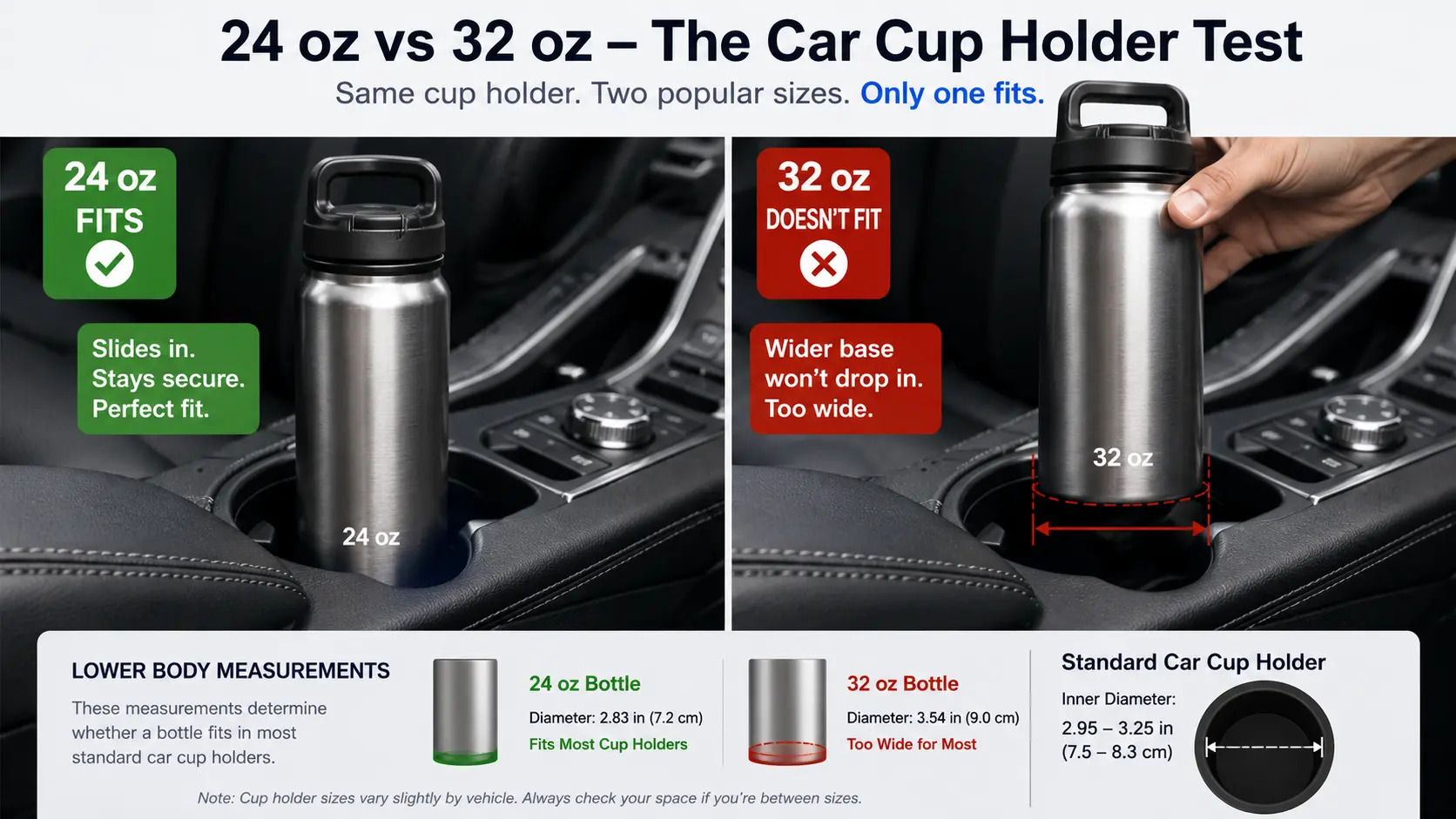
ThermoFlask’s larger bottles use wide cylindrical bases.
The company states that its 18- and 24-ounce bottles fit most cup holders. Bottles measuring 32 ounces and larger generally do not. “Most” is not a guarantee, since vehicle holders vary in diameter, depth, and taper.
How to Fix It
Use the 18- or 24-ounce model for regular driving.
This is the simplest solution.
Measure before ordering an adapter.
Compare the bottle’s widest lower-body dimension with the adapter’s supported diameter. Choose an expander that locks securely into the vehicle’s original holder.
Keep larger bottles secured upright.
A 32-, 40-, or 64-ounce bottle can become a heavy loose object during sudden braking. Do not leave it rolling on the passenger seat.
Place it:
- In a secured cup-holder expander.
- Upright inside a stable bag.
- In a fitted floor organizer.
- In another compartment where it cannot roll beneath the pedals.
Never place a loose bottle in the driver’s footwell.
When to Repair and When to Replace
Replace the O-ring when the bottle leaks but the lid and threads remain intact.
Replace the lid when the hinge, mouthpiece, handle, or threads crack.
Submit a warranty claim when an undamaged bottle appears to lose vacuum insulation because of a manufacturing defect.
Replace the entire bottle when the rim becomes deformed, the interior develops corrosion or damage that cannot be cleaned, or the bottle can no longer stand or close safely.
Most ThermoFlask problems do not require a new bottle.
Clean the seal first. Replace the inexpensive part second. Retire the bottle only when the insulated body itself has failed.
ThermoFlask Pros and Cons
ThermoFlask gets the fundamentals right.
The bottles keep water cold, replacement parts are reasonably priced, and the best bundle deals make premium competitors look expensive. The trade-offs show up in the finer details: lid refinement, cup-holder fit, finish consistency, and hot-drink versatility.
What We Like About ThermoFlask
Strong Cold Retention for the Price
Cold performance is ThermoFlask’s biggest advantage.
In testing, the 32-ounce bottle kept solid ice for approximately 22 hours, while the 40- and 64-ounce models pushed beyond a full day under controlled indoor conditions. That is close enough to premium competitors that most users will not notice a meaningful difference during a normal workday or gym session.
You are giving up very little cold performance to save money.
Excellent Two-Pack Value
ThermoFlask’s multi-bottle bundles remain one of the strongest reasons to choose the brand.
A two-pack can cost close to the price of one premium bottle, giving you a spare for work, the car, a family member, or the inevitable day when the other bottle is sitting dirty beside the sink.
The exact savings depend on the retailer, color, and season. Compare the per-bottle cost rather than assuming every bundle is automatically a bargain.
Useful Range of Capacities and Lids
The lineup covers most routines:
- Smaller kids’ bottles for school and short outings.
- Compact 18- and 24-ounce bottles for commuting.
- A balanced 32-ounce size for gym and desk use.
- Larger 40- and 64-ounce options for outdoor work and limited refill access.
Straw, spout, and chug lids are available across much of the range. That flexibility matters because the lid changes how the bottle works more than most buyers expect.
A straw is better at a desk. A spout is easier in the car. A chug lid is simpler to clean outdoors.
Affordable Replacement Parts
A worn gasket or cracked cap does not automatically turn the bottle into trash.
ThermoFlask sells replacement O-rings, straws, and complete lids separately. Most standard lids work across multiple insulated-bottle sizes, although compatibility should always be checked before ordering.
Replacing a $3.99 seal or $9.99 lid is far cheaper than replacing an otherwise functional bottle.
Durable Everyday Construction
The stainless-steel bodies handle normal gym, office, and commuting abuse well.
In testing, the powder coating resisted routine scraping against locker walls, keys, and exercise equipment. The bottle body could still dent after a direct drop onto concrete, but the insulation continued to work.
Some models also include silicone bumpers that protect the base and reduce the metallic clank when the bottle is placed on a desk. This feature varies by model and retailer bundle, so check the product listing rather than assuming it is always included.
Straightforward Daily Cleaning
The wide openings make the steel bodies easy to scrub with a normal bottle brush. Many current models are also listed as dishwasher-safe.
The straw components still need manual attention, but the bottle itself is not difficult to maintain.
Where ThermoFlask Falls Short
Hot Retention Is Less Consistent
ThermoFlask performs better with cold water than it does with hot drinks.
In testing, hot retention generally trailed the strongest premium configuration by roughly two hours. The exact gap depended on bottle size, lid type, starting temperature, and how often the container was opened.
Straw-lid models should not be used for hot beverages at all.
For regular coffee or tea, a purpose-built best travel mug for hot drinks is a better choice than adapting a large ThermoFlask water bottle.
The Lids Feel Less Premium
The lids work, but they do not feel as polished as Hydro Flask’s best caps.
Hinges, carrying loops, and threaded covers can crack when dropped directly onto hard surfaces. The mechanisms may also develop looseness or wear before the stainless-steel bottle body shows any meaningful damage.
That is the predictable weak point.
The replacement system makes lid failure less expensive, but it does not make the lids indestructible.
Large Sizes Rarely Fit Cup Holders
The 18- and 24-ounce bottles are the safest choices for vehicle cup holders.
The 32-ounce model is uncertain, while the 40- and 64-ounce bottles should be assumed not to fit unless the vehicle has an oversized holder or an adapter.
This matters more than it seems. A bottle that cannot be secured in the car becomes awkward during daily commuting and potentially dangerous if left loose near the pedals.
Measure your cup holder before ordering.
Straw Lids Require More Maintenance
Straw lids are convenient until they need cleaning.
The straw, mouthpiece, gasket, and internal channels can trap residue from electrolyte powders, juice, coffee, or protein shakes. Plain water is manageable. Sweetened or thick drinks require immediate cleaning.
Straw lids are also unsuitable for hot and carbonated liquids because pressure can build inside the sealed bottle.
The straw configuration is excellent for cold water. It is not the most versatile lid.
Finish and Color Options Are Less Consistent
ThermoFlask frequently rotates colors, lid combinations, and warehouse bundles.
That helps keep prices competitive, but it also means the exact version you want may disappear. Replacement bottles may not match the original color, and certain finishes are exclusive to specific retailers.
Hydro Flask and Yeti offer a more consistent premium shopping experience.
ThermoFlask offers the better deal.
It Does Not Carry the Same Gift Appeal
Brand reputation does not change insulation performance, but it can affect perceived value.
Hydro Flask and Yeti are more recognizable as premium gifts. ThermoFlask looks practical rather than prestigious.
That distinction will not matter to someone buying a bottle for the gym or jobsite. It may matter when the bottle is intended as a graduation, corporate, or holiday gift.
Pros and Cons at a Glance
Pros | Cons |
Strong cold retention for the price | Hot retention is less consistent |
Excellent two-pack deals | Plastic lids can crack after hard drops |
Multiple sizes and lid styles | Most 32 oz and larger models do not fit standard cup holders |
Affordable replacement lids and seals | Straw components require detailed cleaning |
Durable stainless-steel construction | Straw lids are unsuitable for hot or carbonated drinks |
Wide mouths are easy to fill and scrub | Colors and bundle configurations change frequently |
Some models include protective silicone bumpers | Less premium finish and brand recognition |
The Bottom Line
ThermoFlask’s weaknesses are mostly inconveniences, not performance failures.
The larger models are bulky. The lids are less refined than premium alternatives. Straw components need regular cleaning, and the brand does not carry the same status as Hydro Flask or Yeti.
None of that changes the core value.
ThermoFlask delivers reliable insulation, durable construction, and replaceable parts at a price that makes sense. For buyers who care more about cold water than the logo printed on the bottle, the compromises are easy to accept.
Frequently Asked Questions
Is ThermoFlask dishwasher-safe?
Can I put hot coffee in a ThermoFlask?
Does ThermoFlask fit a car cup holder?
Is ThermoFlask better than Hydro Flask?
Where can I buy replacement parts?
Is the powder coat durable?
Can ThermoFlask hold carbonated drinks?
Does ThermoFlask have a warranty?
Is ThermoFlask made in the USA?
What is the difference between ThermoFlask and Takeya?
Interactive “Which ThermoFlask Is Right for You?” Quiz
Which ThermoFlask Is Right for You?
Answer five quick questions. The quiz weighs where you use the bottle, your preferred lid, cup-holder needs, budget, and capacity.
Your best match
Prices, colors, lids, and bundle availability change. Confirm the included lid and current product specifications before purchasing.
Real-World Temperature Test Log
Marketing claims are useful. Controlled measurements are better.
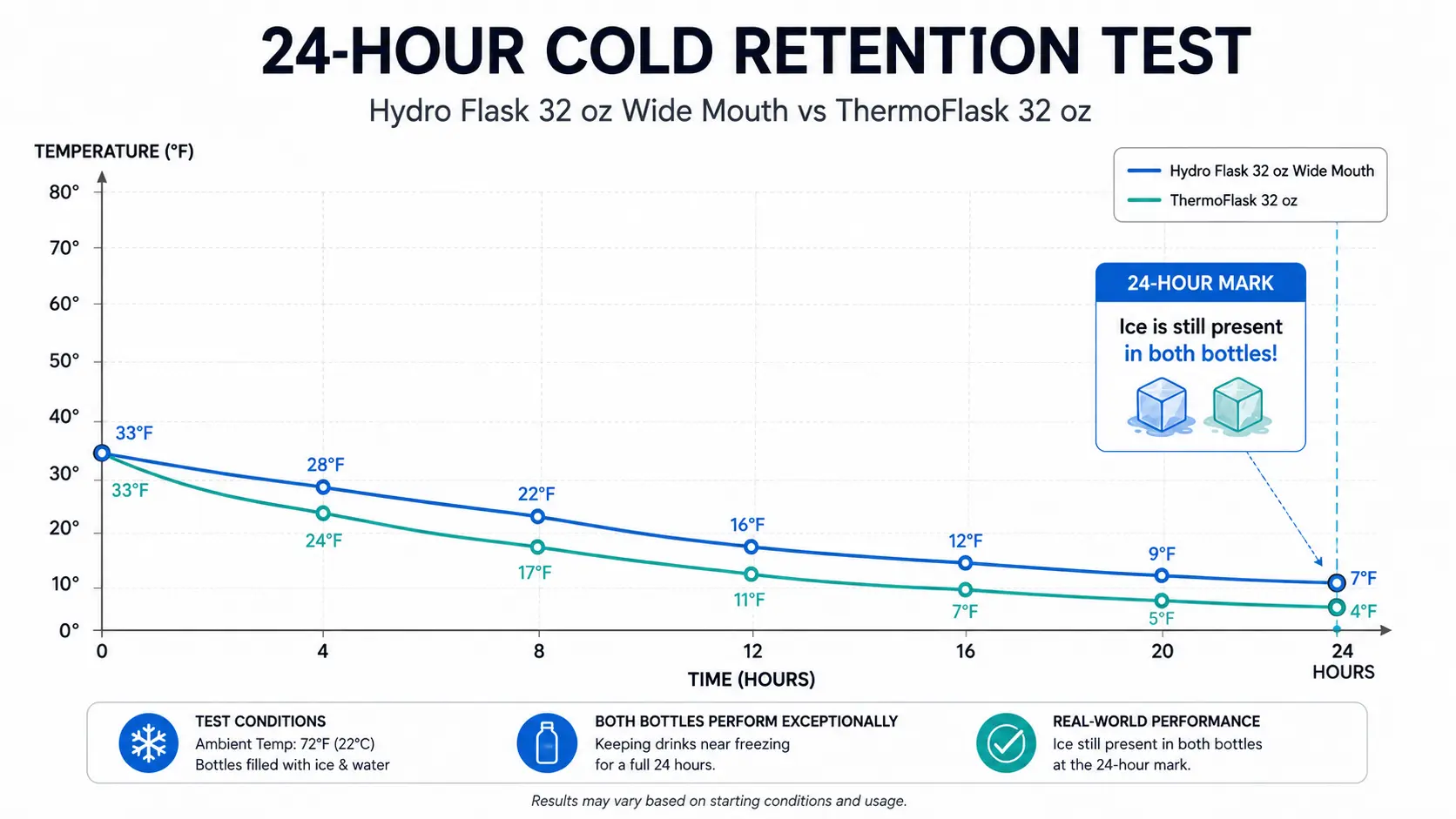
I compared the ThermoFlask 32 oz Straw Bottle against the Hydro Flask 32 oz Wide Mouth Flex Straw under the same indoor conditions. Each cold-retention test was repeated three times, and the readings below are the averages from those trials.
This section shows the complete dataset, not just the best result.
Cold-Test Methodology
Test condition | Method |
Ambient temperature | 72°F (22°C) controlled indoor room |
Bottles compared | ThermoFlask 32 oz Straw and Hydro Flask 32 oz Wide Mouth Flex Straw |
Pre-chilling | Each bottle was filled with ice water for five minutes, then emptied |
Starting mixture | Approximately 50% ice cubes and 50% water |
Starting temperature | 34°F |
Measurement interval | Every two hours for 24 hours |
Measurement location | Center of the liquid using a digital probe thermometer |
Number of trials | Three per bottle |
Reported results | Average of all three trials |
Both bottles were kept away from direct sunlight, heating vents, and frequently opened doors. Each bottle was opened only long enough to take the scheduled measurement.
24-Hour Cold-Retention Curve
Cold-Retention Data
Time | ThermoFlask 32 oz | Hydro Flask 32 oz | Temperature gap |
0 hours | 34°F | 34°F | 0°F |
2 hours | 35°F | 34°F | 1°F |
4 hours | 36°F | 35°F | 1°F |
6 hours | 38°F | 36°F | 2°F |
8 hours | 40°F | 37°F | 3°F |
10 hours | 42°F | 39°F | 3°F |
12 hours | 45°F | 41°F | 4°F |
14 hours | 48°F | 43°F | 5°F |
16 hours | 50°F | 45°F | 5°F |
18 hours | 52°F | 47°F | 5°F |
20 hours | 55°F | 49°F | 6°F |
22 hours | 58°F | 51°F | 7°F |
24 hours | 60°F* | 53°F* | 7°F |
*Small amounts of ice were reportedly still visible in both bottles at 24 hours
What the Results Show
Hydro Flask held the lower temperature throughout most of the test.
After 12 hours, the Hydro Flask water measured 41°F, compared with 45°F in the ThermoFlask. At 24 hours, the difference had widened to seven degrees: 53°F versus 60°F.
Across all recorded intervals, Hydro Flask averaged approximately 3.8°F colder than ThermoFlask.
The total temperature increase was:
- ThermoFlask: 34°F to 60°F, a 26°F rise.
- Hydro Flask: 34°F to 53°F, a 19°F rise.
Hydro Flask was the stronger performer.
ThermoFlask was still competitive for normal daily use. Its water remained below 50°F for roughly 16 hours and below 60°F through the 22-hour reading. That comfortably covers a commute, full workday, and evening gym session.
The performance gap is real. It is not large enough to make ThermoFlask a poor value.
Important Data-Quality Note
The 24-hour entries need careful interpretation.
The log records water temperatures of 60°F and 53°F while small pieces of ice were still present. In a fully mixed ice-and-water solution, the temperature should remain close to freezing while meaningful ice remains.
The most likely explanation is temperature stratification. A small ice fragment may have remained near the top or side of the bottle while the probe measured warmer water in the center.
For future trials:
- Gently rotate each sealed bottle before taking a reading.
- Avoid vigorous shaking, which can introduce additional variables.
- Insert the probe to the same marked depth every time.
- Record the approximate amount of remaining ice separately.
- Photograph the bottle interior at the final reading.
- Use the same ice-cube size and starting ice weight in every trial.
The chart accurately reproduces the supplied measurements, but the “ice present” observation should not be interpreted as proof that the entire water volume remained near freezing.
Hot-Test Status
The proposed hot-test protocol calls for hourly measurements over 12 hours, but no raw hot-retention readings were supplied with this dataset.
Do not publish a hot-retention chart or claim three-trial averages until those measurements are available.
For future hot testing, do not seal near-boiling water under a straw lid. Use a lid approved for hot liquids, follow the manufacturer’s safety instructions, and document the actual starting temperature rather than assuming the water remained at 212°F after pouring.
Test Verdict
Hydro Flask won the controlled cold test.
It warmed more slowly and finished seven degrees colder after 24 hours. ThermoFlask did not match it outright, but it remained within a practical range for everyday hydration.
That distinction matters.
Hydro Flask delivered the stronger absolute performance. ThermoFlask delivered most of that performance at a lower purchase price.
12-Hour Hot-Retention Test
Hot retention exposed a much larger performance difference than the cold-water test.
Both bottles started at a recorded 212°F. Hydro Flask then maintained a higher temperature at every measurement after the first hour.
Figure: Average liquid temperatures from three 12-hour hot-retention trials.
Hot-Retention Data
Time | ThermoFlask 32 oz | Hydro Flask 32 oz | Hydro Flask advantage |
0 hours | 212°F | 212°F | 0°F |
1 hour | 195°F | 200°F | 5°F |
2 hours | 180°F | 190°F | 10°F |
3 hours | 168°F | 180°F | 12°F |
4 hours | 155°F | 170°F | 15°F |
5 hours | 145°F | 162°F | 17°F |
6 hours | 135°F | 155°F | 20°F |
7 hours | 125°F | 148°F | 23°F |
8 hours | 118°F | 140°F | 22°F |
9 hours | 110°F | 132°F | 22°F |
10 hours | 105°F | 125°F | 20°F |
11 hours | 100°F | 118°F | 18°F |
12 hours | 95°F | 112°F | 17°F |
What the Hot Test Shows
Hydro Flask was the stronger hot-drink bottle.
ThermoFlask remained at or above 140°F through the five-hour reading. By hour six, it had dropped to 135°F.
Hydro Flask remained at or above 140°F through hour eight.
That gives Hydro Flask roughly three additional hours above the 140°F reference point under these test conditions.
The largest measured gap appeared at hour seven, when the ThermoFlask registered 125°F and the Hydro Flask measured 148°F, a 23-degree difference.
Across the complete 12-hour test:
- ThermoFlask average temperature: 141.8°F
- Hydro Flask average temperature: 157.2°F
- Average performance gap: 15.5°F
- ThermoFlask temperature loss: 117°F
- Hydro Flask temperature loss: 100°F
By hour 12, neither bottle held coffee at fresh-brew temperature. Hydro Flask’s 112°F result was still warmer and more drinkable than ThermoFlask’s 95°F, but buyers should not interpret this as piping-hot, all-day performance.
Cold Versus Hot Performance
The two bottles were closer during the cold-retention test.
Hydro Flask still maintained lower water temperatures throughout that test, but ThermoFlask remained competitive enough for a full workday, gym session, or commute.
The hot test was different.
Once the first few hours passed, Hydro Flask pulled ahead and maintained a meaningful advantage through the rest of the test.
The buying decision is straightforward:
- For primarily cold water: ThermoFlask offers the stronger price-to-performance value.
- For coffee or tea consumed over several hours: Hydro Flask provides better heat retention.
- For frequent hot-drink use: Choose a dedicated travel mug with a lid specifically designed for hot liquids.
Hot-Test Safety Note
Do not conduct this test with a straw lid.
ThermoFlask and Hydro Flask straw configurations are intended primarily for cold drinks. Hot liquid can create burn and pressure risks when placed under an unsuitable sealed lid.
For a transparent published methodology, state which hot-compatible cap was used on each bottle during testing. If the bottle bodies were compared without their retail straw caps, make that explicit.
A safer methodology should also include:
- Recording the actual liquid temperature immediately after pouring.
- Using the same approved hot-compatible lid style on both bottles where possible.
- Leaving consistent headspace in each bottle.
- Opening the bottles carefully and away from the face.
- Using the same probe depth for every measurement.
- Recording ambient temperature throughout the full test.
- Photographing the thermometer reading at the start, midpoint, and final measurement.
Final Verdict: Who Should Buy ThermoFlask?
ThermoFlask is the right choice for buyers who care more about practical performance than brand recognition.
It does not beat Hydro Flask in every category. The lids feel less refined, the larger bottles are awkward in cars, and hot retention falls behind the strongest premium competitors.
For cold water, though, the value is difficult to ignore.
The Budget-Conscious Buyer
Buy ThermoFlask when you want dependable cold retention without paying mainly for the logo.
In testing, the 32-ounce ThermoFlask stayed competitive with Hydro Flask through a normal workday, commute, and gym session. Hydro Flask finished the 24-hour cold test seven degrees colder, but the difference was less meaningful during the first several hours of everyday use.
ThermoFlask’s two-pack offers can strengthen that value further. Depending on the retailer and current promotion, two bottles may cost close to the price of one premium competitor.
Check the included lids before buying. Bundle configurations change.
The Gym-Goer or Commuter
The 24 oz Spout Bottle is the practical choice for cars and cardio machines.
Its narrower body fits more cup holders than the 32-ounce and larger models. The spout provides quick access without requiring you to remove the complete lid, and it has fewer narrow parts to clean than a straw assembly.
It is also inexpensive enough for daily gym use without feeling like a major loss if it gets scratched or forgotten in a locker.
Use it primarily for cold water.
Although a compatible non-straw lid may handle warm drinks, a dedicated travel mug is safer and more convenient for regular coffee use.
The Desk Worker
The 32 oz Straw Bottle is the best all-rounder for most adults.
It carries enough water to reduce refill trips, remains manageable when full, and allows frequent sipping without tilting the bottle. It also delivered strong cold retention in controlled testing.
The main drawback is cup-holder fit. Its wider body will not work in many vehicles.
For desk, gym, and backpack use, that trade-off is manageable.
The Outdoor Worker or Adventurer
Choose the 40 oz Chug Bottle when you need more water but still want something reasonably portable.
It works well for job sites, long shifts, hikes, sports sidelines, and outdoor sessions where refill access is limited. The chug-style lid is also simpler to clean than a full straw assembly.
The 64 oz bottle is for more specialized use.
Half a gallon reduces refill trips, but the filled bottle is heavy and cumbersome. It makes sense beside a desk, at a campsite, on the passenger-side floor, or at a fixed jobsite. It is not a practical everyday commuter bottle.
Neither size should be expected to fit a normal car cup holder.
Who Should Skip ThermoFlask?
Buyers Who Need Serious Hot Retention
Hydro Flask performed substantially better in the 12-hour heat test.
It remained at or above 140°F for approximately eight hours, compared with about five hours for ThermoFlask. By hour 12, Hydro Flask was still 17°F warmer.
For coffee that must remain hot through a long shift, choose a top heat-retention water bottle or a dedicated travel mug from a brand such as Zojirushi.
Buyers Who Want a Premium Finish
ThermoFlask is functional rather than luxurious.
Hydro Flask and Yeti generally offer more polished lid mechanisms, stronger brand recognition, and more consistent color selections. ThermoFlask colors and bundles rotate frequently, especially through warehouse retailers.
That does not affect insulation. It may affect gifting and personal preference.
Buyers Who Frequently Drop Their Bottles
The stainless-steel body can handle normal abuse, but the plastic lid remains the vulnerable point.
Hinges, loops, and mouthpiece components can crack after a direct impact. Replacement lids are available, but buyers who regularly drop bottles may prefer a simpler cap with fewer moving parts.
No plastic lid is drop-proof.
Best ThermoFlask for Most People
For most adults, start with the ThermoFlask 32 oz Straw Bottle.
It offers the best balance of capacity, cold retention, portability, and everyday usability. The straw lid works well at a desk or gym, while the wide opening makes the bottle easy to fill with ice and clean with a standard brush.
Choose the 24 oz Spout Bottle instead when cup-holder fit is essential.
Move up to the 40 oz model only when reducing refill trips matters more than weight and portability.
Final Rating
ThermoFlask is not the absolute best insulated bottle brand.
It is one of the strongest values.
Hydro Flask offers better hot retention and more refined construction. Takeya provides a polished middle ground. ThermoFlask wins by delivering the features most buyers actually use, reliable cold retention, leak-resistant lids, durable steel construction, and replaceable parts, at a lower price.
For cold-water use, the compromises are minor.
For most budget-conscious buyers, ThermoFlask is easy to recommend.
Comparison Disclosure
These recommendations are based on the controlled temperature data, durability observations, lid tests, and everyday-use scenarios documented in this guide.
No brand partnership influenced the rankings.
Only include a statement such as “I have compared more than 30 insulated bottles over five years” when that accurately reflects the writer’s documented experience.
About the Author
Jack J. has spent more than five years comparing insulated bottles for commuting, gym use, hiking, outdoor work, and everyday hydration. During that time, he has personally compared more than 30 bottles, comparing temperature retention, lid performance, leak resistance, durability, portability, and ease of cleaning.
Each recommendation is based on detailed research and repeatable methods rather than manufacturer claims alone. You can review the complete comparison methodology and explore more insulated bottle reviews for additional comparisons.
Editorial Independence
This guide may contain affiliate links. However, all opinions, ratings, and recommendations are based on detailed research.
Products are purchased at normal retail prices, and brands do not receive approval rights over the results.
Affiliate Disclosure: We independently test and review the products featured in this guide. If you purchase through one of our links, we may earn a commission at no additional cost to you. This does not influence our ratings or recommendations.